

In 2016, the experimental film-maker Charlie Shackleton submitted a film to the British Board of Film Classification entitled Paint Drying. It was 607 minutes long and it featured a single shot of – well, you can probably guess the general narrative arc. The point wasn’t to deliver thrills to the audience but to protest the often prohibitive costs of film classification in the UK. Lacking an “L” for “lethally boring”, the appraiser ended up giving it a “U” rating, indicating “no material likely to offend or harm”.
In dramatic terms, watching paint being applied to a canvas by an actor impersonating a real-life artist – a Michelangelo, a Vermeer – scores a lot higher than watching paint dry. But does it make good cinema? The answer, as cultural historian Christopher Frayling teases out in his colossal new book on Hollywood’s on-off love affair with great artists, is: not really. Forget about the art-making process, it’s the life around the work that yields the best material. And if the life needs a little embroidering to make it more dramatic, so be it. You don’t go to the movies to absorb sober, carefully presented facts about notable figures from the past; you go to be entertained.
As George Custen wrote in his 1992 book Bio/Pics, “Hollywood biography is to history what Caesar’s Palace [in Las Vegas] is to architectural history: an enormous, engaging distortion.” Frayling’s contention is that we can learn from Caesar’s Palace – about its conventions, its production practices, its outlook on the world – just as long as we don’t mistake its razzle-dazzle for truth.
And so begins this enjoyable 90-year trawl through the subgenre of Hollywood artist biopics, lavishly illustrated with film stills, posters and full-colour reproductions of Gauguin panoramas and Frida Kahlo self-portraits. Frayling has form in this area: he has previously published doorstoppers on vampires in cinema and the work of Sergio Leone, among other topics. The intention here is to track how the popular idea of the artist has evolved, or hardened into cliche, in the age of cinema: a fairly niche topic but one that the insatiably curious Frayling fills out with magpie maximalism.
He opens not in the silent era but in 1934, with The Affairs of Cellini, the first talkie feature film about a real-life artist. Starring Fredric Marsh in the lead, it presented the Italian sculptor and goldsmith Benvenuto Cellini as a swashbuckling self-mythologiser who courts trouble among his patrons but whose talent is great enough to insulate him from it – though we see very little actual evidence of that talent on screen. This is, as a Time review quipped, a portrait of the artist in his spare time.
Related articles:
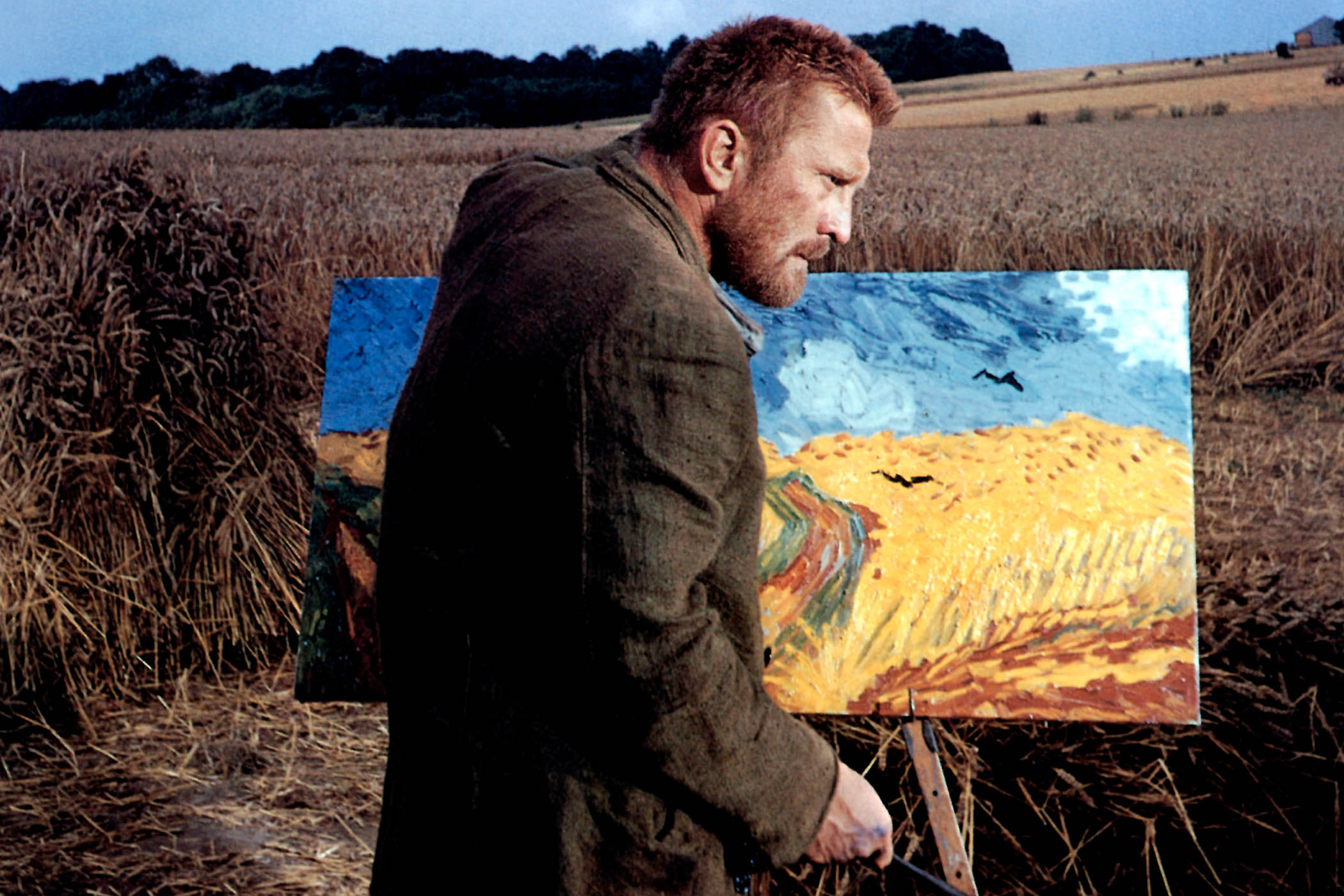
In later films such as Rembrandt (1936), The Moon and Sixpence (1942) and particularly Lust for Life (1956), starring Kirk Douglas as Vincent van Gogh, a more recognisable persona emerges: the artist as passionate, tortured outsider whose genius is largely misunderstood during his lifetime. (The “his” is not a slip: the artists immortalised on screen anywhere, not just Hollywood, have until very recently all been men.)
One of Frayling’s gripes is scenes in these films looking exactly like the paintings: a ‘lust for lifelikeness’
You can see in Frayling’s exhaustive accounts of the making of these films – the endless rewrites, the bargaining with artists’ estates – how the facts of a life can get twisted and turned to fit the Hollywood mould. The Van Gogh that Douglas portrayed in Lust for Life was, according to John Berger, “a kind of problem child-cum-gangster” with none of the erudition we encounter in the famous letters.
What these films lack in biographical accuracy, they try to make up for with visual punctiliousness. Promotional materials often trumpet the production team’s efforts to recreate the period down to the last detail. The leading man will take pains to transform himself into the subject – often literally, as in the case of José Ferrer, who wore “torture boots” in John Huston’s Moulin Rouge (1952) to play Toulouse-Lautrec, who was 4ft 9in to Ferrer’s 5ft 10in. “Needless to say,” Frayling writes, “no one ever suggested that Lautrec be played by a genuinely disabled actor.”
One of Frayling’s recurring gripes is about scenes in these films looking exactly like the paintings – a “lust for lifelikeness”, he calls it. If the whole of Paris ends up resembling a Toulouse-Lautrec, he demands, then what was special about his individual way of seeing? But it’s a difficult trap for film-makers to escape. Julian Schnabel’s Van Gogh biopic At Eternity’s Gate (2018) worked hard to avoid visual cliches, Frayling acknowledges, but then he takes it to task for looking “drab and unimpressive”. You can’t win.
Many of the more recent artist biopics have tried to inject something new into the formula, with varying degrees of success. Love Is the Devil, John Maybury’s 1998 portrait of Francis Bacon, used distorted, fragmentary visuals to bring us deeper into the psychological world of its subject, though even it fell back on some of the conventions it strove to avoid.
Artemisia (1997) and Frida (2002) were far from perfect but gave long overdue attention to great women artists, as did Schnabel’s Basquiat (1996) for artists of colour, though several critics felt that film was more about its director than its subject.
What these biopics haven’t managed to do – with the partial exception of Ed Harris’s 2000 biopic of Jackson Pollock – is make the act of painting exciting to watch for any length of time, though I can’t speak for the preferences of every audience member out there. For those with greater reserves of patience than me, and 607 minutes to spare, may I suggest a paint-related film for your viewing pleasure?
The Hollywood History of Art by Christopher Frayling is published by Reel Art Press (£70).
Editor’s note: our recommendations are chosen independently by our journalists. The Observer may earn a small commission if a reader clicks a link and purchases a recommended product. This revenue helps support Observer journalism.
Photograph of Kirk Douglas as Vincent van Gogh in Lust for Life by MGM/Alamy