
Ivo van Hove punches holes through classic drama. Sometimes, maddeningly, all you see is the director’s face peeping through. Yet sometimes you look into the engine of a play. He jolted Arthur Miller’s work into new life with his scythed-back 2014 production of A View from the Bridge. Now he does the same with All My Sons.
The familiar attack of the 1947 play has not lost its bite. Miller lays into patriarchy and apple pie, the dollar-driven imperative of the American dream. The esteemed head of a family, one of whose sons is an airman reported missing in the war, was responsible for allowing faulty parts to be installed in aircraft. Many men have died as a consequence; his partner has been jailed for the crime. Some of his family and neighbours know or have guessed, but have gone on “covering over the cracks”. When his remaining, son discovers the truth, idealism and the family crumble.
The political and personal drama is absorbingly evident here, realistic in idiom and fact (Miller had worked in an automobile warehouse). Yet Van Hove and his long-time designer Jan Versweyveld restore another dimension. An abstract setting brings echoes of Greek drama that, along with Ibsen, influenced Miller’s work, and suggests far-reaching reverberations.
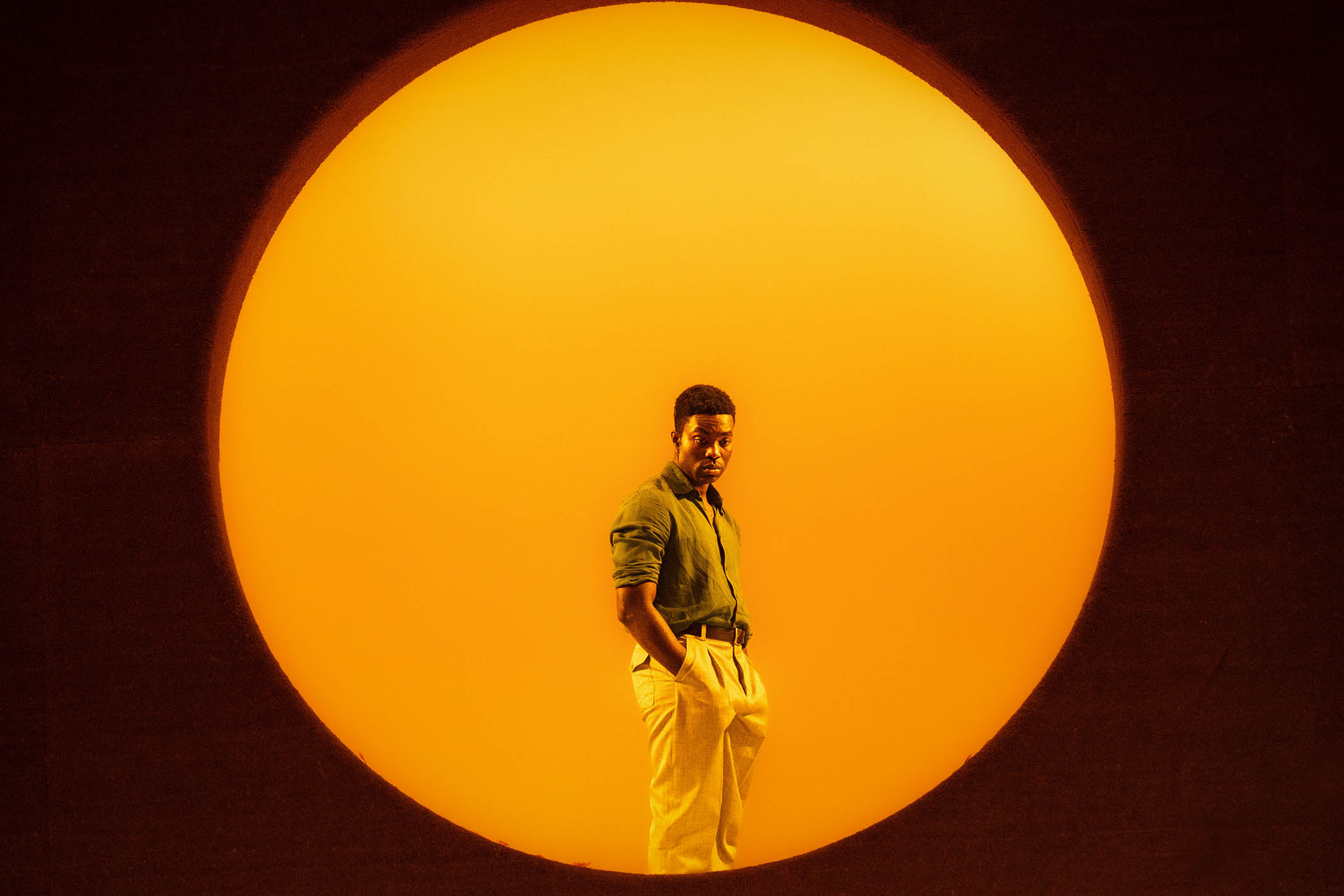
An opening tableau shows a glowing orb in a hemp-coloured wall, a massive fallen tree, a woman zigzagging across the stage in fright. That orb goes on to become an oracle of mood – changing from orange to white to unsettling green – and a window into an offstage world through which characters can be seen pacing. Crucially, Versweyveld also designs the lighting. He washes his bare-bone set in shades from weird to warm. He creates extraordinary moments of intimacy, wrapping characters within a dying light. Throughout, interestingly though too insistently, Tom Gibbons’s sound design steers the attention: a touch of John Adams; some Bach as a nudge towards greater Fathers and Sons; Johnny Cash rumbling about God coming after tricksters.
A tremendous cast gives each exchange authenticity. Tom Glynn-Carney, as the explosive outsider, quivers memorably in his hoodie. Marianne Jean-Baptiste is remarkable: driven by sentimentality but never mushy, hardened by the need to blind herself to the truth. Bryan Cranston unravels and shrivels as the patriarch from bluff geniality through blazered spryness to gaunt agitation. Paapa Essiedu is superb. Lolloping, as if he is moving in water, gentle in speech, he has the sweet air of an idealist, but the complicated emotions of a hero. Here is acting and a production that takes Miller away from finger-wagging into essential truth-telling.
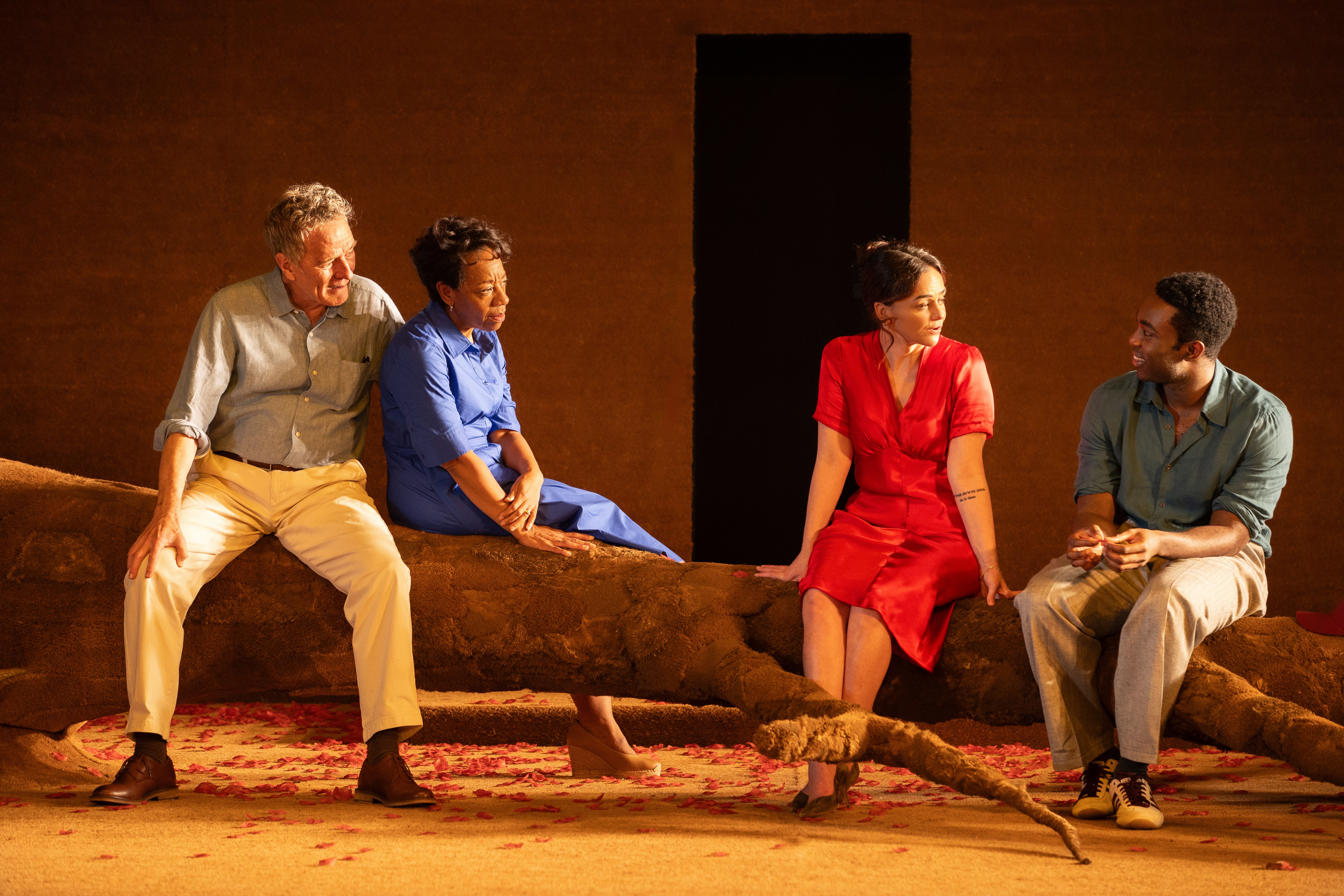
Bryan Cranston, Marianne Jean-Baptiste, Hayley Squires and Essiedu in All My Sons
David Eldridge is not a state-of-the-nation dramatist; he is state-of-Essex, state-of-the-heart, drilling down in an apparently small space. His latest play, End, is the final part of a trilogy charting the lives of three different couples: Beginning showed a man and woman circling around each other towards romance. Middle examined the falterings of a long-married couple. Now Clive Owen and Saskia Reeves, directed by Rachel O’Riordan, take on the parts of a couple who are doing everything together for the last time. Owen, playing a former DJ, has had a terminal diagnosis.
Though both kind and astute, this is the most awkward play in the trilogy: an uneasy mixture of detail and declamation. Gary McCann’s design leaves no area unrealised: stained glass in the front door, rows of vinyl records, smiling emoji clock, stainless steel fridge covered in paper notes; Owen is in a West Ham hoodie. A tender, convincing sex scene is promptly followed by the Kleenex box being waved. Reeves rubs cream into Owen’s sore feet with the ease of long habit; while immobile Owen looks on, mingling admiration and regret while she dances. Owen lays down his funeral imperatives: “None of that John Lennon Imagine bollocks.” So far so on-the-nail, but too much of the dialogue is over-explicit for a couple who have been together for years and too much is delivered standing up. There’s a reason for that (wobbly legs seize up when sitting down), but the effect, even with deft actors, is often less of intimacy than oration.
Still, Eldridge’s quality as a dramatic cartographer shines through. He brought Essex to the stage in Market Boy (2006) and In Basildon (2012). End, set in Haringey, is exact about his home county’s absorption into greater London and the careful upward climb of the aspirant to Muswell Hill. I can’t think of a dramatist other than Harold Pinter who has so much metropolitan precision. That’s capital.
All My Sons is at Wyndham’s, London, until 7 March 2026. End is at Dorfman, National theatre, until 17 January 2026
Photographs by Jan Versweyveld
Newsletters
Choose the newsletters you want to receive
View more
For information about how The Observer protects your data, read our Privacy Policy