


When was the last time you cooked with someone, the two of you side by side in the kitchen? In the domestic partnerships I’m witness to, people very reasonably tend either to take turns, or one committed cook will shoulder the responsibility while the other takes on some other Sisyphean chore.
Cooking dinner is, for the most part, a task for one person – ideally one who enjoys it at least a little. But the daily reality of putting a meal on the table means even people who love to cook can find themselves resenting it. I speak here from personal experience, as someone who will phone a friend in fury while walking through the rain to the supermarket, to rail at them and the universe: “Can you believe I have to make dinner again?!” I live alone. Of course I have to make dinner again. But it is so easy for cooking, particularly when we’re busy and overwhelmed with the state of things, to lean more towards necessary chore than pure delight.
I think this is why I’m always seeking moments when it cooking is pure delight. When I’ve enjoyed both process and product, when it ascends beyond daily chore. Remembering the best of these, one thing is clear: nothing makes me happier in the kitchen than cooking with someone I love. It’s such a different experience than that of cooking for someone, as they watch on. There is great love and generosity in making a meal for a person you adore, but to invite someone round with the promise of a romantic dinner is to put all the pressure on yourself. It’s possible that it ends up back in the realm of chore, or even that the stakes feel too high, especially if things are new.
The first time I cooked for my girlfriend I spilt the caesar dressing and had to start over in a fresh bowl, slowly incorporating my thin sauce into a new yolk – she just looked so distractingly good, sitting on a kitchen stool with a vermouth and tonic. I found myself explaining that I cook for a living, and have, in that very same kitchen, made a caesar dressing about 100 times. But I got nervous! I asked for her help with the incorporating, and then we were comrades. Cooking alongside each other instead, I found myself relaxing.
The significant mental health and sociological benefits of cooking together are well documented. Psychologists and anthropologists report a reframing of failure as learning, a development or solidifying of communication skills, and quality time spent engaged in an activity together. There’s no question that i t’s a good thing for your brain, and for your relationship.
But what this research does not linger nearly long enough on is, to my mind, far and away the most important aspect in the context of a romantic relationship: just how hot and fun it is, to cook with someone you fancy. It’s not particularly deep! It feels intimate to watch a person you already desire work with their hands, to make something you’re going to eat together. It’s intimate to manoeuvre around one another in the kitchen, to figure out how to navigate a recipe as a pair. It’s a sensory and sensual delight, to taste and smell and touch in the kitchen as you work. It’s undeniably sexy to ask: “How can I help?” or “What do we do next?” and have someone you love tell you exactly what they need, or for you to figure out the answer together.
When you’ve cooked together before, or you already know each other very well, the dance may feel familiar. An idea or move from her may spark one in you, instinct and familiarity useful tools. Cooking together will become a game, a chance to collaborate on something new or to riff on recipes familiar enough to make your own. You could teach your partner a skill you have – shape dumplings, make an omelette (one for her, then have her make one for you), whisk up a perfect salad dressing. Or you could try something new, a recipe you’ve always wanted to try. If your relationship is in the early stages, pick something that requires resting time – pastry, focaccia, something with a marinade – or multiple steps you can do at intervals,allowing you plenty of non-cooking time to chat too.
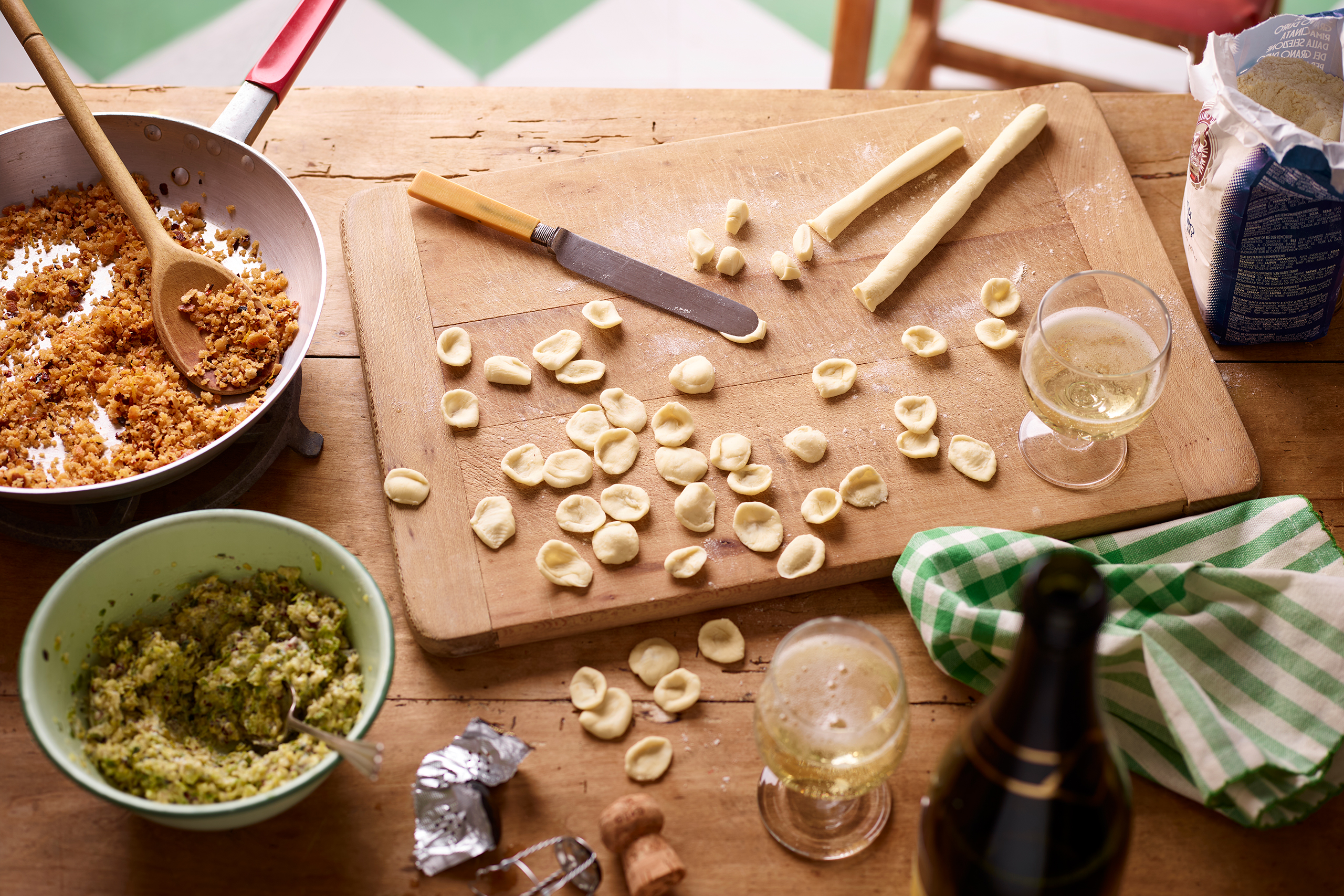
There are infinite options, but in the cold grey of February, I’m suggesting you roll out some dough. I love the repetitive motion of shaping pasta by hand; dragging serrated tomato knives over small pieces of dough, adding little ears to a shared pile as you go. No one will remember which of you made which, so all the awkward little ones become shared failures, the perfect ones shared delights.
Related articles:
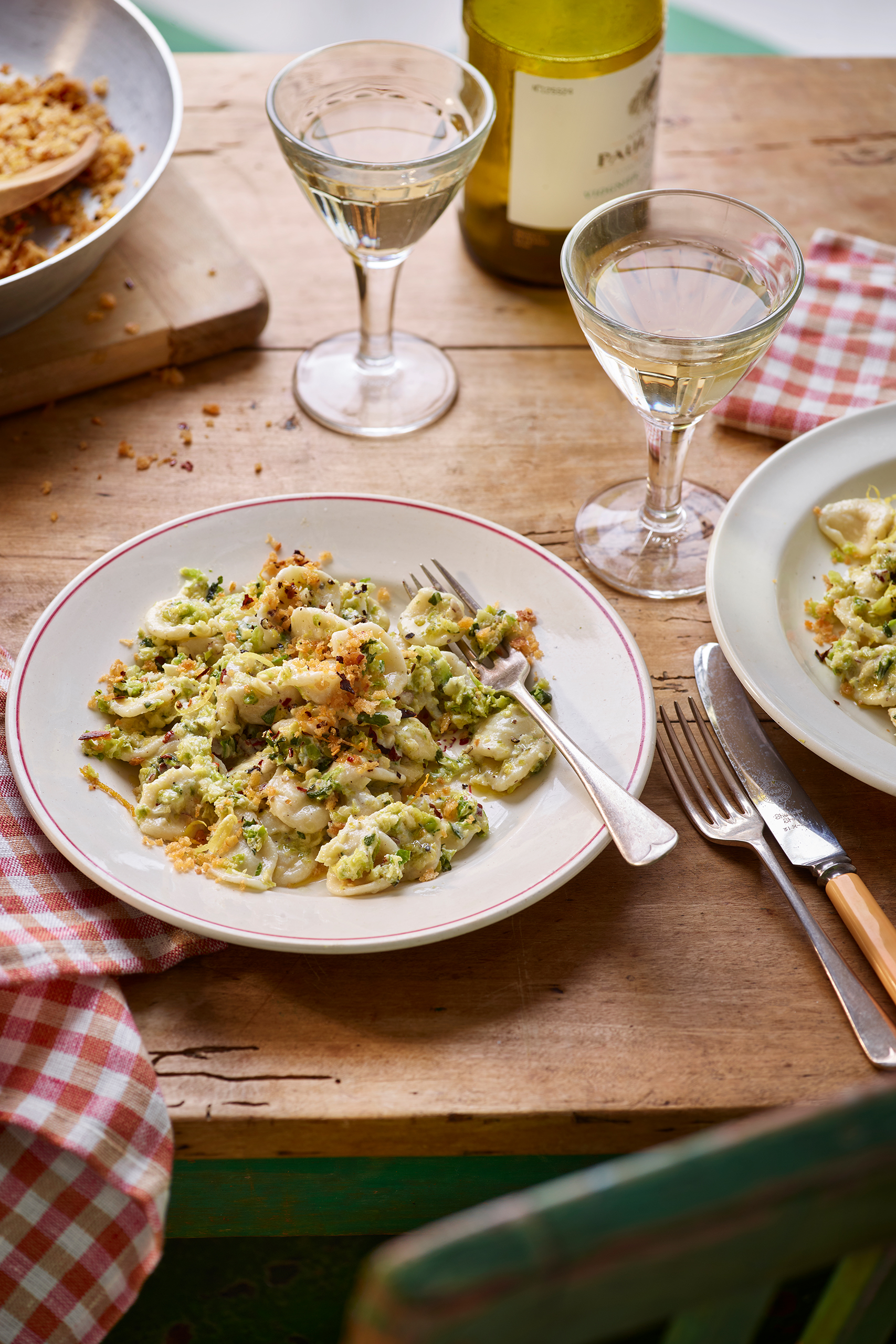
Bright green orecchiette
Serves 2. Ready in 1 hour.
Of all the many pasta shapes I have eaten, I have a special affection for orecchiette. They’re forgiving in terms of shaping, even as you’re learning, require no specialised equipment, and the dough is so lovely to work with. I’ve paired them here with a vibrant sprout pesto, a sauce that requires only blitzing, stirring, and then adding to the cooked pasta. If you like, some pangrattato would be perfect, too – a full-flavoured crunch for sprinkling over the top.
semola (fine milled semolina) 180g, plus extra for dusting
fine sea salt a pinch
tepid water 85ml
For the pesto:
sprouts 125g, cleaned and trimmed
lemon juice of 1|
tarragon 20g
pecans a small handful
dijon mustard 1 tsp
olive oil 60ml
dried chilli flakes 1 tsp
salt a pinch
ricotta 125g
For the pangrattato (optional):
olive oil 2 tbsp
breadcrumbs (panko or fresh) 50g
garlic 1 clove, minced
lemon zest of 1
dried chilli flakes a pinch
flaky sea salt a pinch
Tip the semola and salt into a bowl or a heap on your work surface, and make a well in the centre. Pour most of the water into the well and bring together into a dough. You may not need all the water; the dough should be pliable, but not sticky. Knead for 5 minutes by hand, until smooth and elastic.
Cut a piece of the dough for each of you and cover the rest with a tea towel. Each roll your piece out into a long sausage, about the width of your little finger. Sprinkle a tea towel with semola ready for your shaped pieces, so you can easily shake them into the water later.
Use a knife to cut a bit of dough from the sausage, about the size of a chickpea. Run the knife almost parallel to the work surface over the little piece of dough, dragging it towards you so that it spreads out and then curls up over the back of the knife. Then, push at the thin centre with your thumb, popping it out, which will keep the rolled piece open. Don’t stress too much about shape – you’ll get the hang of it as you go. Help each other! Watch a video online!
I like a flexible serrated knife here, but a butter knife works, too. Play around until you get the knack, and shape the rest of the dough between you.
For the pesto, blitz all the ingredients except the ricotta in a food processor or blender. Taste and add more seasoning if it needs it. If it’s thick rather than smooth, add 1 tbsp of cold water. Stir in the ricotta and set aside.
To make the pangrattato, warm the olive oil in a small frying pan, then add the breadcrumbs. Stir until lightly golden, then add the garlic, lemon zest, and chilli, and cook, stirring occasionally, until rich golden brown. Take off the heat and season with salt.
Bring a large pot of salted water to the boil and add the pasta. Cook for 4-5 minutes, then reserve a cup of the cooking water and drain the pasta. Return to the saucepan, add the pesto, and stir with a small splash of the cooking water until combined. Serve immediately with a sprinkling of the pangrattato on top.
And when thinking of lovers in the kitchen I return to 1991’s Fried Green Tomatoes, to Mary-Louise Parker and Mary Stuart Masterson cooking and flirting and flinging food at one another. The film industry wasn’t ready for the characters to be the explicitly romantic couple they are in the book, but the director wanted their time in the kitchen to work as a love scene by stealth. It does. And it makes me want to bake pies.
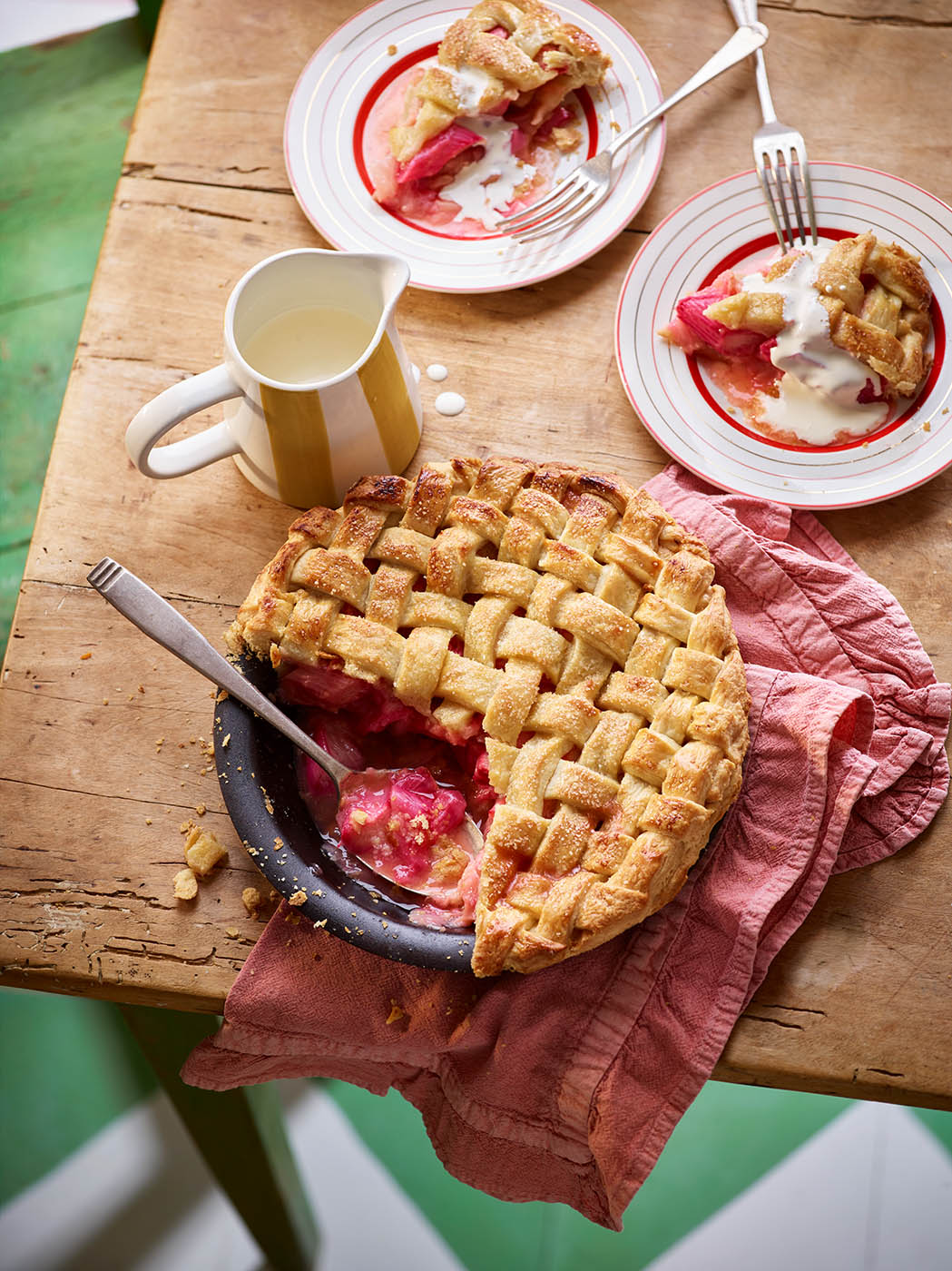
‘Don’t rush the pastry’: pink rhubarb pie
Pink rhubarb pie
Serves 2, with plenty left over. Ready in 3 hours.
To make a perfect pie is an exercise in patience. You can’t rush the pastry; it needs time to properly rest or the butter will melt and your pastry won’t flake. It’s therefore perfect work for a lazy afternoon together, a thing to return to at intervals that can be as long as you like. Eat the first slices hot with a rich vanilla bean ice-cream, and the second slices cold with yoghurt for breakfast the next morning.
rhubarb 500g
chopped stem ginger 80g
golden caster sugar 2 tbsp
cornflour 2 tbsp
ground ginger 1 tsp
For the pastry:
plain flour 320g
icing sugar 3 tbsp
salt a large pinch
butter 250g, sliced into cubes
iced water 60ml
lemon juice 1 tbsp
egg 1
You will need an 18cm pie tin. Combine the flour, icing sugar, and salt in a large bowl. Add the cubed butter, and toss to combine. Working together, both hands in the same bowl, rub the butter into the flour with only your fingertips, aiming for larger pieces that look a little like flaked almonds. Try and avoid getting your (warmer) palms involved, as you don’t want the butter to melt.
Pour most of the water and lemon juice over the flour and butter, and cut through with a knife. Bring together into a dough; if it’s too dry, add the final bit of liquid. Split the dough into 3, flatten each piece into a rough disc, wrap in cling film and refrigerate for at least an hour.
Meanwhile, prepare the filling: slice the rhubarb stems into 3cm-long batons, and toss with the stem ginger, sugar, cornflour, and ginger. Put in the fridge next to the pastry.
On a sheet of greaseproof paper, roll out one third of the pastry into a circle the thickness of a £1 coin and 6cm wider than your pie tin. Flip the paper over the tin and press the pastry into the base, aiming for some overhang on each side. Fill the pie with the rhubarb and put back in the fridge while you make the lid.
Roll out the other 2 pastry discs into circles a little thinner than the pastry base. Slice into lengths about 2cm wide. On the sheet of greaseproof paper, lay out one set of strips, and then weave the others alternating over and under each strip to form a tight lattice pattern. Transfer the top to the fridge too, still on the greaseproof paper, and leave to chill for at least 30 minutes.
Paint the edge of the pie base with some beaten egg, then slide the lid carefully over the top (it’s so useful to have two of you here!), then press the edges closed and trim the pastry to the edge of the dish. Egg-wash the top of the pie, then transfer to the freezer for 20 minutes, or the fridge for another hour.
Preheat the oven to 200C/gas mark 6. When it’s at temperature and the pie has had its chilling time, brush the top of the chilled pie with a bit more of the egg and transfer to the oven. Bake for an hour until a rich golden brown, with the rhubarb visibly bubbling through the top. Rest for 10 minutes before serving.
Newsletters
Choose the newsletters you want to receive
View more
For information about how The Observer protects your data, read our Privacy Policy