


Listen to Liv Little discuss Pillion on this week’s episode of We Have Notes.
This week Pillion, the debut film by the British director Harry Lighton, not only won an impressive four British Independent Film awards but has also importantly gifted the world Alexander Skarsgård’s recent red carpet looks. Even if you haven’t seen the film, you’ve probably seen him in Burberry shorts with white socks, or most notably the halterneck and leather trousers combo he wore at London film festival in October. He is a man committed to a theme.
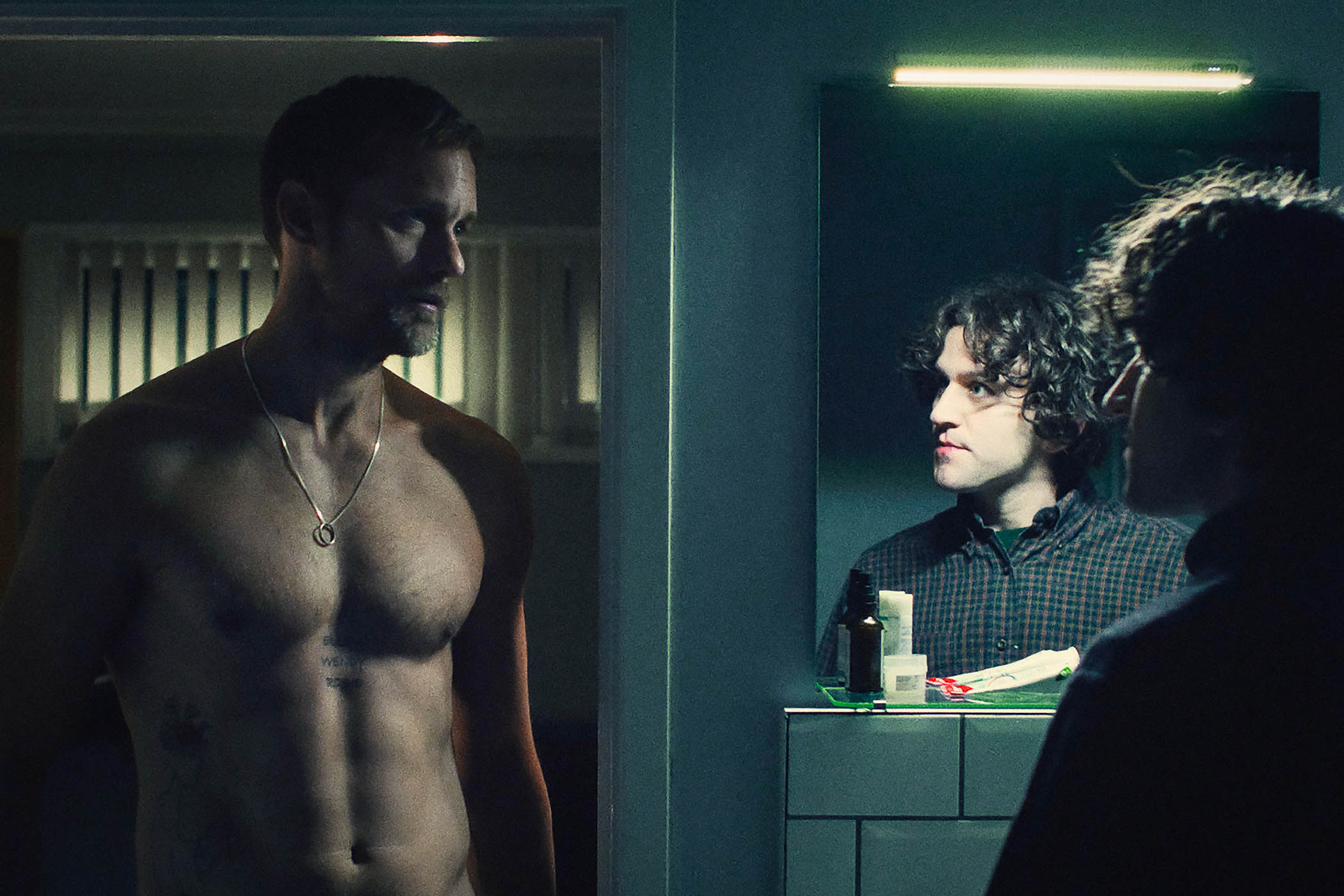
Pillion is based on Adam Mars-Jones’s novel Box Hill, and follows Colin (Harry Melling, who played Dudley Dursley in the Harry Potter films), an awkward young gay man still living with his doting parents, whose attempts to set him up on dates do not prove particularly fruitful. Everything changes, however, when Colin meets Ray (Skarsgård), a member of a queer biker gang, and is pulled into a BDSM sub-dom relationship. The film considers the question of who’s driving and who’s riding (pillion).
Pillion is tender, funny, weird and, as Wendy Ide wrote in her review, unexpectedly sweet – and it got me thinking about sex on screen. As this film demonstrates, sex scenes work when they tell us something about the characters: too often, sex scenes feel gratuitous, added simply because someone (usually a man) thinks a woman should get her tits out. The explicit moments in Pillion are a far cry from the titillating scenes in so much prestige telly (think Euphoria) or the problematic sequences of Blue Is the Warmest Colour, uncomfortable to watch and reportedly even more uncomfortable to film. Adèle Exarchopoulos said of the production, “One day you know that you’re going to be naked all day and doing different sexual positions…” while Léa Seydoux complained that having to “fake [an] orgasm for six hours” made her feel “like a prostitute”.
Perhaps the reason Pillion resonated as much as it did is because I have, while writing my debut novel Rosewater, spent many hours mapping out my protagonist’s relationship with sex. She, as a soft masc-lesbian, uses it as a balm, a way to avoid considering her own pleasure. Something profound shifts when she’s finally able to let go. Watching a film where intimacy is so clearly tied to a character arc made me realise how much emotional archaeology you can achieve through through sex. It’s a way to track the things people avoid, their yearnings but also their biggest insecurities. It made me reconsider how to capture and understand intimacy.
Which brings me to intimacy coordinators, those professionals who help actors choreograph sex scenes in a way that is comfortable for all parties. Their presence on set is shockingly recent; before that, the expectation was for actors to get on with it, whatever it was. Sex scenes were often left to actors and directors to muddle through – which could lead to confusion at best and unsafe situations at worst. Post-MeToo, the industry acknowledged that this wasn’t good enough: leading coordinator Ita O’Brien worked her first job in 2018. Since then, she’s created widely used guidelines and worked on Normal People, Sex Education, I May Destroy You and Gentleman Jack – all shows that actually reflect what intimacy, desire and sometimes trauma look like in real life.
The team on Pillion worked with intimacy coordinator Robbie Taylor Hunt. The cast have spoken about how choreographing intimate scenes reduced anxiety. Everything is blocked out in advance, enabling actors to establish trust and a sense of safety. Beyond the choreography, coordinators manage nudity agreements, camera angles and the emotional wellbeing of the actors on set – pretty much anything that ensures actors feel safe enough to perform. O’Brien explains the process beautifully: consent isn’t a one-time box ticking exercise, it’s an ongoing process. And the first question any intimacy coordinator should ask is: “Does this scene move the story along?”
In Pillion, intimacy propels the plot. Ray spots early on that Colin “has an aptitude for devotion”, and their encounters – moving, strange and sometimes painful – reveal who they are far more than dialogue.
Related articles:
Pillion’s most affecting moments aren’t particularly explicit – they’re the negotiations of power and the shifting boundaries between the two men. They’re in Colin learning the rules of the game, and Ray testing his devotion. It’s the tension between them that captivates us.
Brilliant, believable sex on screen isn’t about shock factor or how much skin you see – it’s about intention. Pillion feels groundbreaking because sex is used as it should be – as storytelling. When intimacy is handled with respect and curiosity, it can become one of the most powerful tools in cinema.
Newsletters
Choose the newsletters you want to receive
View more
For information about how The Observer protects your data, read our Privacy Policy
Photograph courtesy of Picturehouse Entertainment