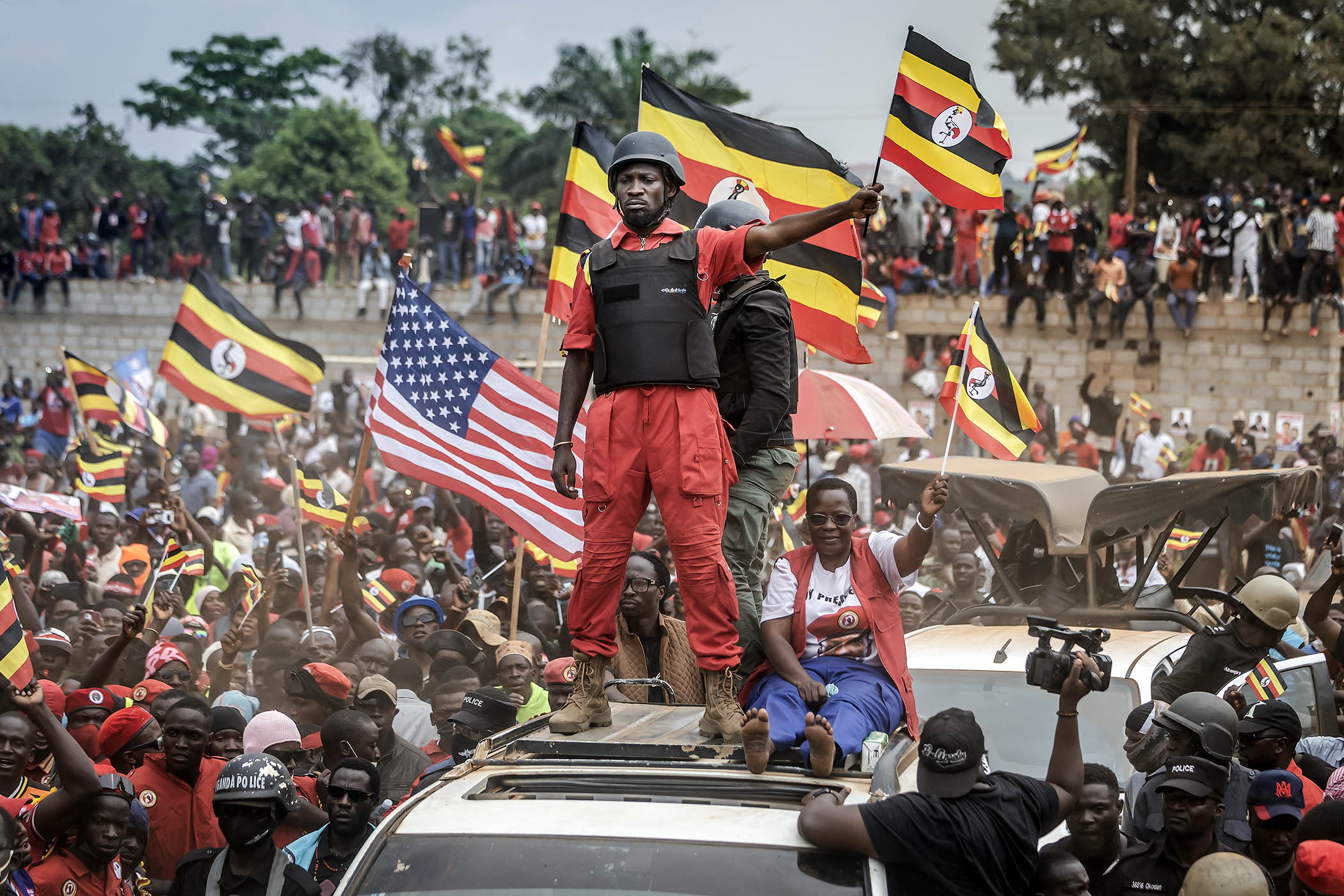
Bobi Wine knows he has little hope of winning Uganda’s presidential election on Thursday. His rallies have been broken up using teargas, hundreds of his supporters have been arrested and he campaigns in a bulletproof vest.
But the 43-year-old pop star turned politician still insists on running. “At least I’m fighting back and keeping the hope alive,” Wine told The Observer. “If I didn’t, maybe I would have been killed silently.”
This is the second time Wine, whose real name is Robert Kyagulanyi, has challenged Yoweri Museveni for the presidency. The 81-year-old incumbent seized power in 1986 at the head of a rebel army and has maintained an iron grip on the country ever since.
Last time, in 2021, Wine won 35% of the vote to Museveni’s 58%, although observers reported widespread irregularities.
Dozens were killed in the lead-up to the election, which ended with soldiers laying siege to Wine’s home after he called the results a “complete sham”. Although he lost, Wine sees that campaign as a success because it shone a light on Museveni’s oppression.
This remains his objective. “We want to continuously expose him,” said Wine. “Every time I speak out, the world gets to know that there’s a voice out there. No matter how suffocated that voice is, it can still be heard.”
It is a thankless task. This time round his supporters have been set upon with clubs, pepper spray and dogs. In December, a 16-year-old boy was killed after thugs broke up one of Wine’s rallies in the northern city of Gulu.
Wine was struck in the face with a cane during the chaos. On several occasions, his convoys have been turned back at police roadblocks. He says he is also subject to a broadcast ban.
Related articles:
“We are up against a 40-year-old dictatorship that has captured every institution of the state – the parliament, the judiciary – so it’s not free, it’s not fair,” he said. “But we are using every available window to assert ourselves.”
Before he entered politics, Wine was one of Uganda’s most successful musicians, a star who played a mix of reggae and dancehall and campaigned for better living conditions for the poor. It was a comfortable life, though not without controversy: in 2014 he was denied a UK visa over claims his lyrics were homophobic.
Newsletters
Choose the newsletters you want to receive
View more
For information about how The Observer protects your data, read our Privacy Policy
Then, in 2017, he chose to stand as an MP, quickly becoming a beacon of resistance for Uganda’s young, restless population as the “ghetto president”. He campaigned on the catchphrase “Since parliament has failed to come to the ghetto, then we shall bring the ghetto to parliament”.
It was a reference to his upbringing in Kamwokya, a slum in the Ugandan capital, Kampala.
Museveni reacted by banning Wine’s music, a move that arguably helped bolster his popularity. Wine was also arrested several times. He and 32 opposition figures were charged with treason after Museveni’s motorcade was allegedly stoned in 2018. Wine said he was tortured in military custody and was using a wheelchair when he left Uganda for medical treatment in the US.
Protests broke out in November 2020 when he was detained before the last election. The security forces killed at least 54 people.
This time, Wine has avoided prison, but Uganda’s other main opposition leader, Kizza Besigye, who has stood against Museveni four times, remains behind bars on treason charges after his abduction from Kenya in 2024.
Wine’s experiences do not appear to have dimmed his determination. “Our vision for Uganda is a free and prosperous country that provides equal rights and opportunity for everyone,” he said. “A Uganda free of corruption, a democratic Uganda where leaders are servants and not bosses.”
For Museveni, the election is about legitimising his rule. The average age in Uganda is 16, making it the world's second-youngest country, and most of its citizens were not born when he became president. Back then, Museveni criticised ageing incumbents who did not relinquish power, and promised not to linger in office. He reneged on that pledge, removing term limits and a presidential age cap to allow him to stand again and again.
Despite Wine and Besigye’s best efforts, the octogenarian leader’s biggest enemy is time. For years he has been grooming his erratic son, Muhoozi Kainerugaba, as a potential successor. In 2024 Museveni made him head of the military, despite Kainerugaba’s previous threats to invade neighbouring Kenya.
Last year, Wine’s bodyguard and friend Edward Sebuufu went missing for five days after being picked up by security officials. As Wine scrambled to establish his whereabouts, Kainerugaba announced on social media that Sebuufu was “in my basement”. He shared photos of Sebuufu, bruised and bloodied, saying his men were using him “as a punching bag” and adding: “I still have to castrate him.”
Wine said: “It was a terrible feeling of helplessness, knowing that somebody who is mandated with protecting the citizens of Uganda is torturing them, not silently or secretly, but loudly and publicly on social media.”
Wine had sharp words for the UK, which this year will send £46m in aid to Uganda. “You are a democracy – live by your word,” he said. “The UK leadership cannot be seen standing shoulder to shoulder with [Belarusian dictator Alexander] Lukashenko and it should not stand shoulder to shoulder with oppressors here in Uganda that torture people. Stand with Ugandans, not Museveni.”
Because Thursday’s election is apparently a foregone conclusion, attention is already turning to its aftermath. Several African countries witnessed widespread upheaval in 2025 as gen Z demonstrators took to the streets to criticise corruption, poverty and joblessness. Uganda shares these problems and could see similar unrest – especially if there are loud claims of electoral fraud.
“I don’t know what tomorrow brings,” said Wine. “But for as long as I'm free and able to speak, I will call upon the people of Uganda to stand firm and fight back against this oppression.”
Photograph by Luis Tato/AFP via Getty Images