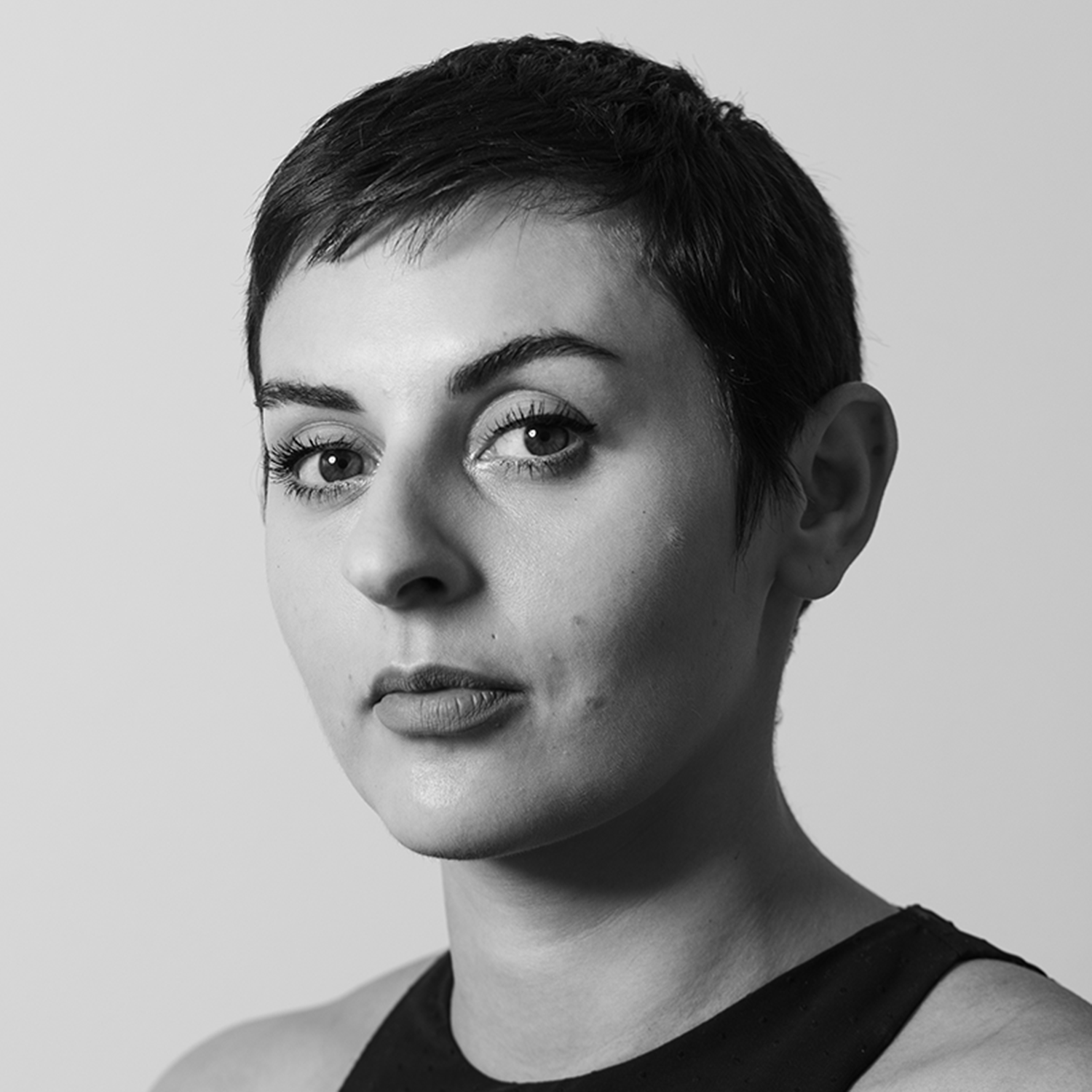
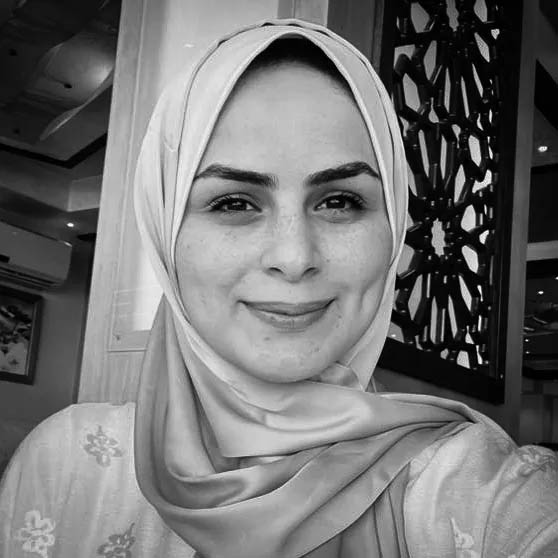


For the family of Malak al-Hajoj, there is no corpse, report of an airstrike or record of arrest to offer any clue about how she vanished. One day last December, the engineering student returned to the family home in the Bureij refugee camp to try to collect books and notes after she heard her university would resume online teaching. She was not heard from again.
Her mother begged her not to go. It would be a dangerous walk north from Deir-al Balah, the city in central Gaza the family had fled to at the start of the war, but Hajoj was determined to get her notebooks. She would be back in an hour at most, she said, hugging her mother.
Two hours passed before her family, crammed into a freezing tent in Deir al-Balah, started to worry. “We kept trying to call her phone – at first it rang, but she didn’t pick up,” said her cousin Diana al-Shams. “Then it stopped ringing altogether.”
The search for Hajoj quickly consumed them: they feared it was too dangerous to attempt to reach the Bureij camp as night fell. They wondered whether she had been detained or even killed by Israeli forces. They flooded social media with her pictures, begging anyone who might have information to contact them.
With a pause in fighting in place last March, the family returned to Bureij to begin their search – for their daughter or more likely her body. They said the only trace they found near the rubble of their family home was her bag next to the tracks from a bulldozer – a piece of equipment only operated by Israeli military forces.
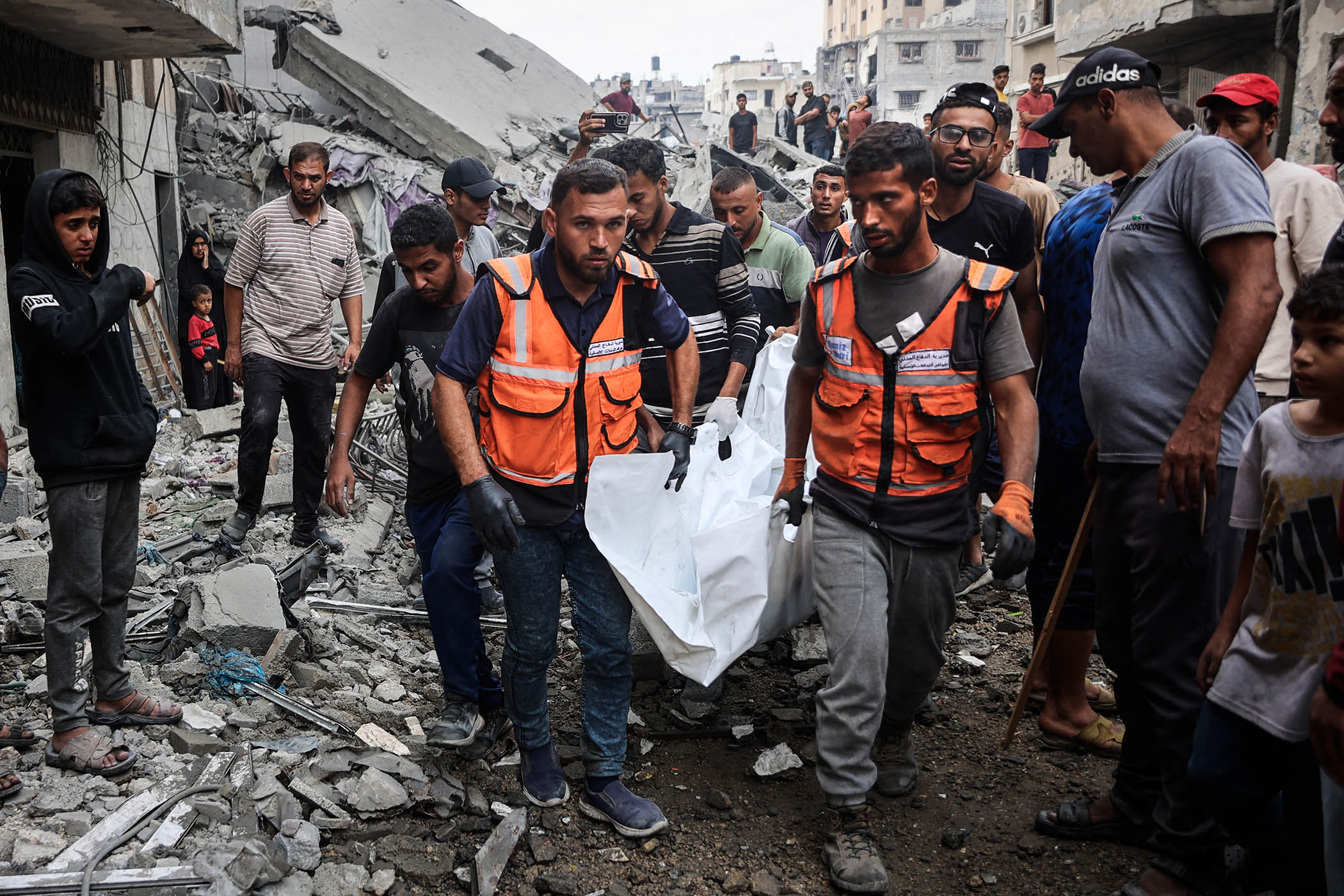
Gaza is a graveyard. Tens of thousands of bodies are entombed by layers of rubble and sand, marked only by the memories of those who buried them. Some are believed to be in mass graves that dot the tiny enclave, whether in the swathes of the territory still occupied by Israeli forces or clustered around hospitals, where dozens were buried outside as mortuaries overflowed.
Then there are those such as Hajoj, whose end and final resting place remain unknown: the Palestinian Central Bureau of Statistics says that about 11,200 people have been reported missing by their families in the two years of Israel’s assault.
This figure is part of broader efforts to record the scale of deaths in Gaza, where more than 69,000 are confirmed to have been killed in Israel’s longest war, but where a study published in the Lancet in January suggested the toll could be at least 40% higher than official figures given at the time.
Related articles:
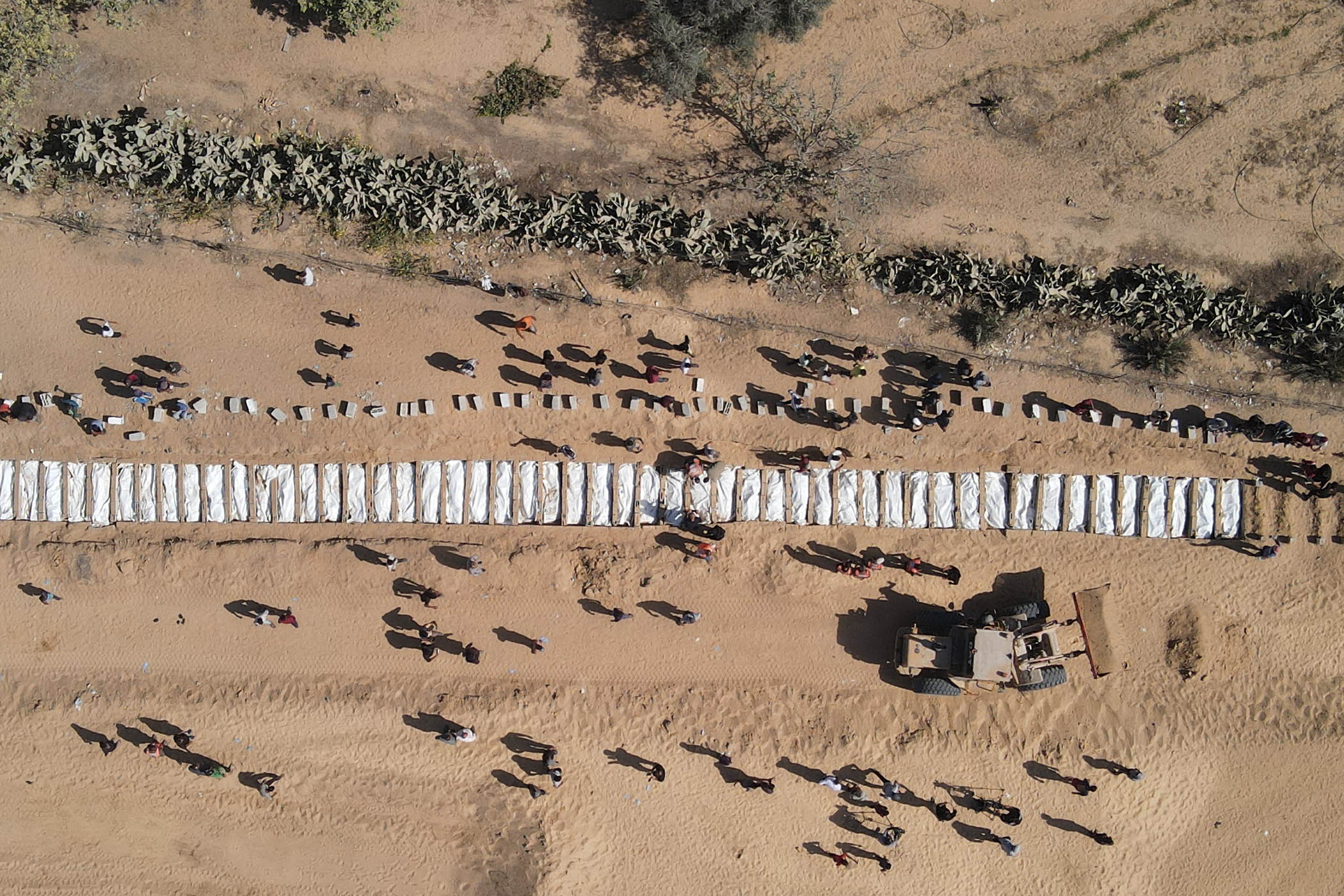
Some of the 285 bodies handed to the Palestinians in exchange for the bodies of Israeli hostages await burial in Gaza.
The UN said that almost 800,000 people have moved since a truce was announced last month, attempting a return to what remains of their homes. But with more than half of Gaza occupied by Israeli forces, and UN findings that about 80% of buildings have been partly or fully destroyed, return is not possible for many. Israeli airstrikes hit the Bureij camp 12 days ago in defiance of the ceasefire, which Israel said Hamas broke first by killing two of its soldiers.
The search to find bodies of Palestinians killed by Israel’s assault has become overwhelming for Gaza’s civil defence teams as well as the forensic doctors, working with what little equipment they have to find and identify remains.
Newsletters
Choose the newsletters you want to receive
View more
For information about how The Observer protects your data, read our Privacy Policy
Meanwhile, the families of Israeli and foreign hostages whose bodies have been held captive in Gaza have pleaded with the Israeli government to stick to the ceasefire agreement, allowing Hamas time to retrieve their loved ones’ remains. At least five bodies of hostages remain in Gaza, amid fears Hamas could take months or years to locate them among the rubble and destruction.
Dr Khalil Hamadeh, director of forensics for the Gaza health ministry, said that his team of just three doctors is working in impossible conditions in a rush to identify an overwhelming number of bodies killed in Israel’s two-year assault. “The small number of doctors can’t handle this huge influx of corpses, to both examine them and write reports,” he said.
‘Some bodies are mutilated, others are decomposing. And some have been gnawed by dogs’
‘Some bodies are mutilated, others are decomposing. And some have been gnawed by dogs’
Dr Khalil Hamadeh
Much of this retrieval is done using the most basic equipment because of a ban on heavy machinery. Forensics teams work without DNA testing equipment prohibited by Israel from entering Gaza since before the war.
Sometimes, rescue teams retrieve only a skeleton or a skull. “Some bodies are mutilated, others are already decomposing,” said Hamadeh. “Then there are bodies whose appearance is horrifying, ghastly, because they have been gnawed on by dogs or other animals roaming Gaza.”
Hundreds of Palestinian corpses returned to Gaza in exchange for the bodies of deceased hostages represent pieces of a far larger grislier tapestry: photos of some of the 285 returned bodies showed darkened corpses with their faces bloated and frozen in grimaces, their wrists and ankles showing indentations from restraints, wounds or other holes from what appeared to be abuse.
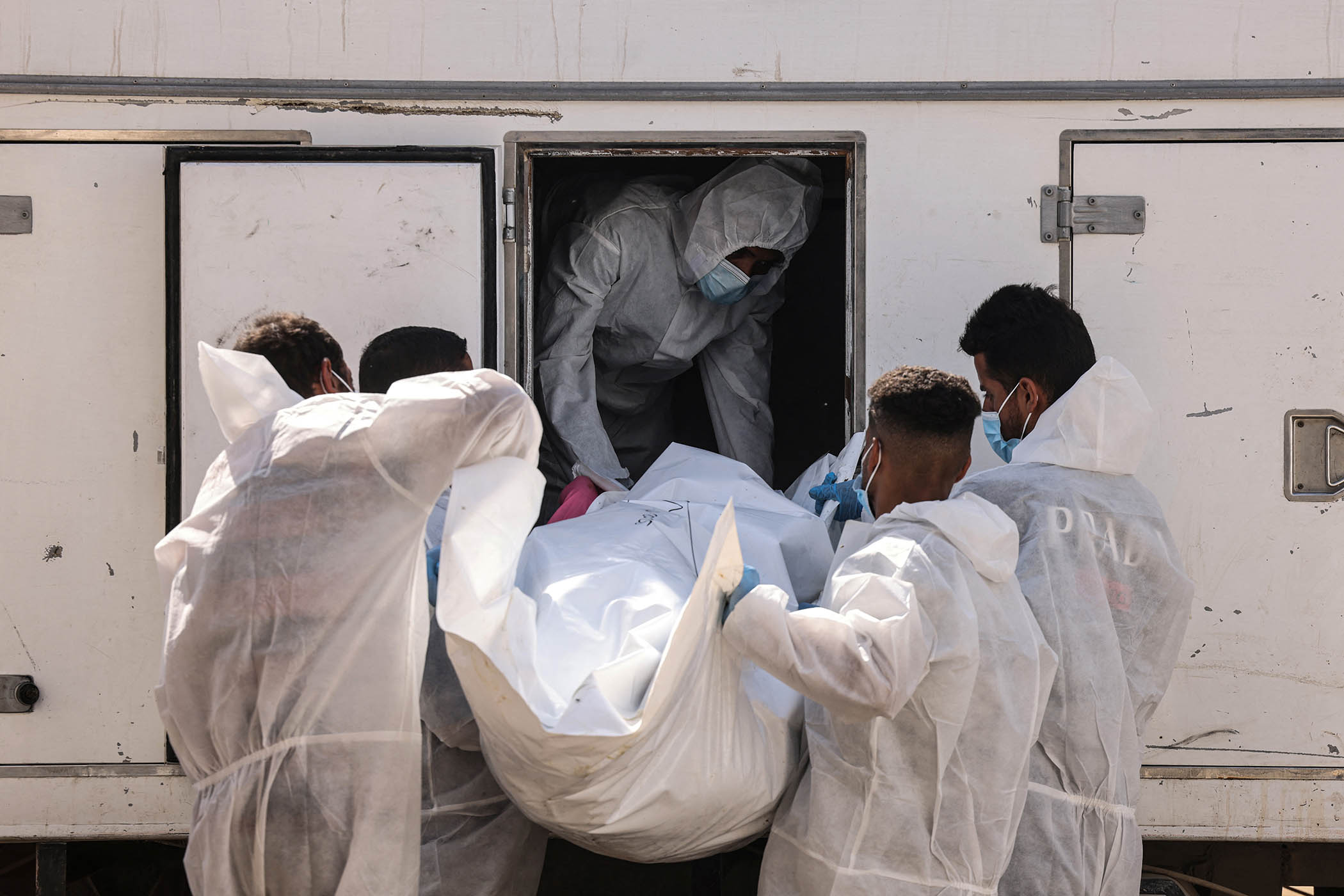
Teams from the International Committee of the Red Cross take possession of more bodies at Nasser Hospital in Khan Yunis
Palestinian health officials have identified just a fraction of the hundreds of bodies returned, many of whom were buried in two new mass graves with little ceremony. Dr Ahmed Duheir, a forensic specialist at Nasser hospital in southern Gaza, which received the bodies, said the corpses could only be transported to their final resting place in ice-cream lorries, as this was the only means available – albeit an undignified one.
Many of the corpses were delivered naked or wearing only underwear, he said. “The bodies in the first batch returned bore signs of wrist restraints and blindfolds, and they were placed in freezers in that state. A small portion of the second batch also had the same marks,” he added, indicating those returned were killed in detention. Other returned bodies were wearing military clothing and had visible gunshot wounds, potentially fighters held by Israel after the October 7 assault by Hamas.
“Despite the bodies being held in a deep freeze, most of them showed bruises from torture and beating. We were unable to perform autopsies, but the marks on the bodies were as clear as daylight,” said the doctor.
The Israeli military did not respond to questions about whether the bodies were of former detainees or which detention facility the bodies had been held in, but said only that they were all combatants. “The IDF [Israel Defense Forces] did not tie any bodies prior to their release to the strip,” it said.
Israel has been roiled by the detention of former top military lawyer Maj Gen Yifat Tomer-Yerushalmi, who is accused of abuse of power and other offences for leaking video footage showing Israeli soldiers allegedly sexually assaulting a Palestinian prisoner in the infamous Sde Teiman military facility in the Negev desert. Tomer-Yerushalmi resigned amid fury from government officials, among them, the defence minister, Israel Katz, who vowed “all necessary sanctions against her”, including stripping her of her rank.
In Gaza, forensics teams have set up screens displaying photographs in two large hospitals in the territory in an attempt to allow the public to check if their missing loved ones are among the bodies. The Hajojs were among families who rushed to the grounds of the Nasser hospital complex, hoping they might see a sign of their daughter.
The realisation that she was unlikely to be among those returned by Israel was a blow for the family. “After Malak’s body couldn’t be found, my aunt – Malak’s mother– realised she had to accept the idea that Malak had most likely been killed, that her body had either decomposed or been buried in a mass grave,” said Shams.
“Mass graves are all around us in Gaza. Often, when someone is killed without their family knowing, strangers or members of civil defence end up burying them. In the end, families like ours have no idea where their loved ones were laid to rest.”
Forensic doctors such as Hamadeh say they are acutely aware of this pain as they rush to try to identify remains. “They want to know the fate of their children – they wish to bury them and visit the graves,” he said.
Photograph by Photo by Omar Al-Qattaa/AFP. Other pictures by AFP