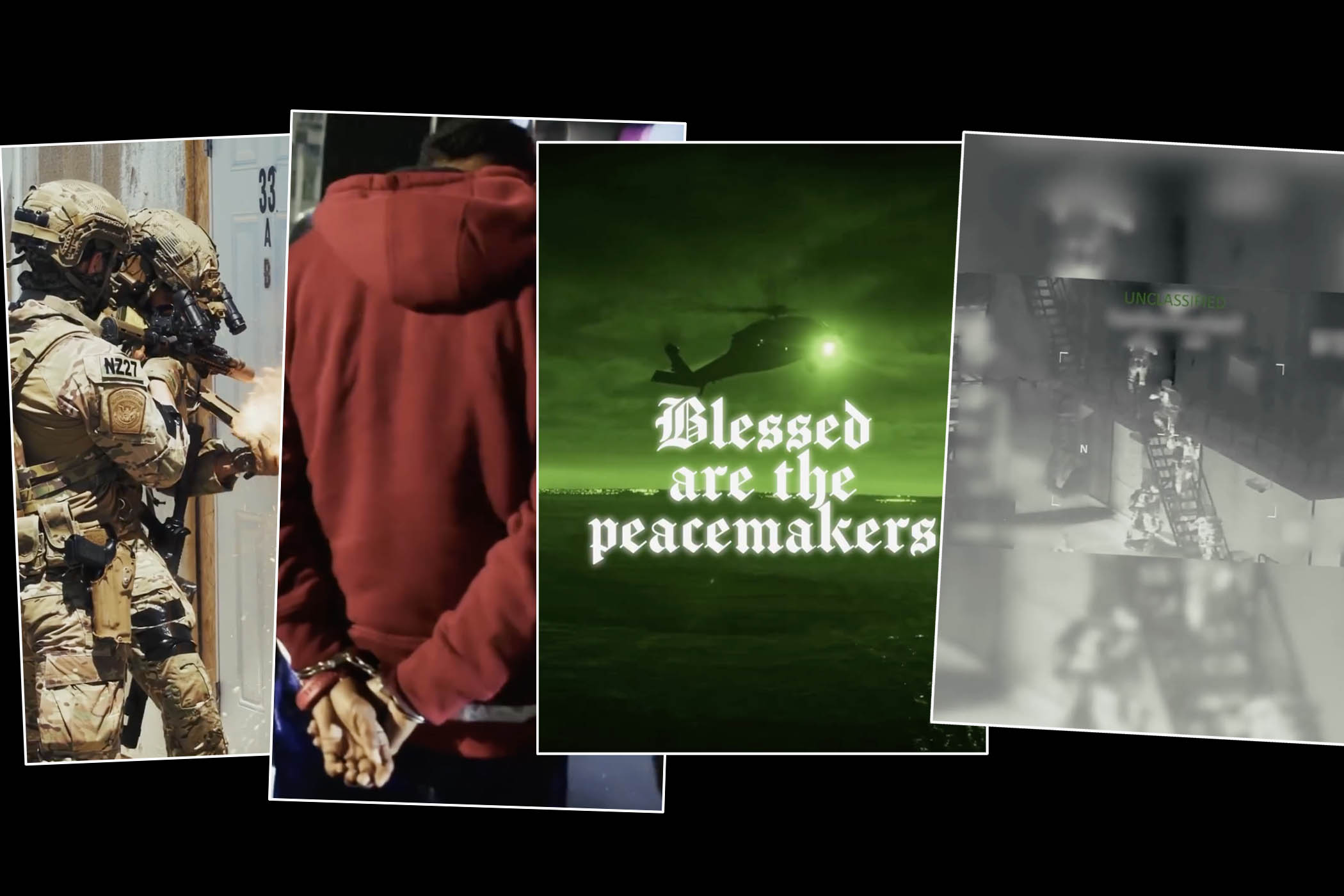

On 13 January, Immigration and Customs Enforcement (ICE) posted a video to its social media accounts overlaid with a bible verse: “Blessed are the peacemakers, for they shall be called sons of God”.
The clip looks like a video game. It cuts between camouflaged ICE officers holding AK-47s, jumping out of a helicopter, climbing off a ship, swarming and then storming into buildings. Inside, people are handcuffed, heads bowed, and forced into unmarked vans. Back in the helicopter, an officer fist-bumps the grinning secretary of homeland security, Kristi Noem. The whole thing is set to Lorde’s melancholic cover of Everybody Wants to Rule the World.
In recent months, ICE and the Department of Homeland Security (DHS) have increasingly turned immigration enforcement into a stylised online extravaganza. Almost daily, they post photos of immigrants they’ve arrested and deported. Pinned at the top of their accounts is an illustration of Uncle Sam in the old-fashioned style of army recruitment. The caption says: “America has been invaded by criminals and predators. We need YOU to get them out.”
“Social media algorithms thrive on anger and fear,” said Emma Connolly, a research fellow in the department of political science at University College London. “Simplified forms of storytelling that rely on moral binaries –good versus evil, us versus them – are especially effective at capturing attention and encouraging sharing.”
These binaries have become increasingly white supremacist. On 31 December, DHS shared an illustration on X depicting their idealised view of America: an idyllic beach, a Cadillac, no people. Overlaid on the image are the words: “AMERICA AFTER 100 MILLION DEPORTATIONS.” The caption describes the scene as “the peace of a nation no longer besieged by the third world”.
Another post from 11 January shows a cowboy on a horse in front of snowy mountains with the words “WE’LL HAVE OUR HOME AGAIN” and a link to ICE’s recruitment website. The caption is the title of a white supremacist song favoured by the Proud Boys.
‘Social media algorithms thrive on anger and fear’
‘Social media algorithms thrive on anger and fear’
Emma Connolly, University College London
A video pinned to the DHS’s Instagram account depicts a similar scene: a white nuclear family walking through a sunlit field, a mother and baby silhouetted against a beach sunset, and a sheriff on horseback carrying an American flag. “A homeland worth protecting,” the text reads.
Other posts from last week have leaned into overtly military language, framing immigration as a form of “domestic invasion”. “Defend the homeland. Protect the American way of life,” says a DHS video, responding to what it called “smears” against law enforcement following the killing of Renee Nicole Good in Minneapolis this month.
Related articles:
One post from the Department of Labor expanded this language, echoing the Nazi phrase “one people, one realm, one leader” with their own version: “One Homeland. One People. One Heritage.”
These posts are pushed into the algorithms of ICE’s recruiting goals. Geo-tracked paid social advertising targets people who step close to traditionally masculine spaces such as military bases, gun shows, fraternities and Nascar races. The slick, hyper-masculine visual language they use is reminiscent of the mercenary Wagner group in Russia, which used violent, stylised social media videos to recruit fighters and build a paramilitary force ahead of Putin’s invasion of Ukraine.
Newsletters
Choose the newsletters you want to receive
View more
For information about how The Observer protects your data, read our Privacy Policy
In both cases, targeted recruitment relied on mimicking the aesthetics of video games, and proffered the promise of belonging to a heroic, embattled cause.
Connolly cautions against viewing the shift as unprecedented. “American security institutions have always engaged in public narrative management,” she said, citing cold war propaganda and the public narrative used to justify the “war on terror”. “What is different,” she added, “is that social media facilitates a shift towards a more participatory form of political engagement”.
ICE’s social media, says Connolly, is asking people to do something: join them, report on immigrants in their communities, film their arrests. It’s a “co-production”.
Photograph dhsgov/Instagram