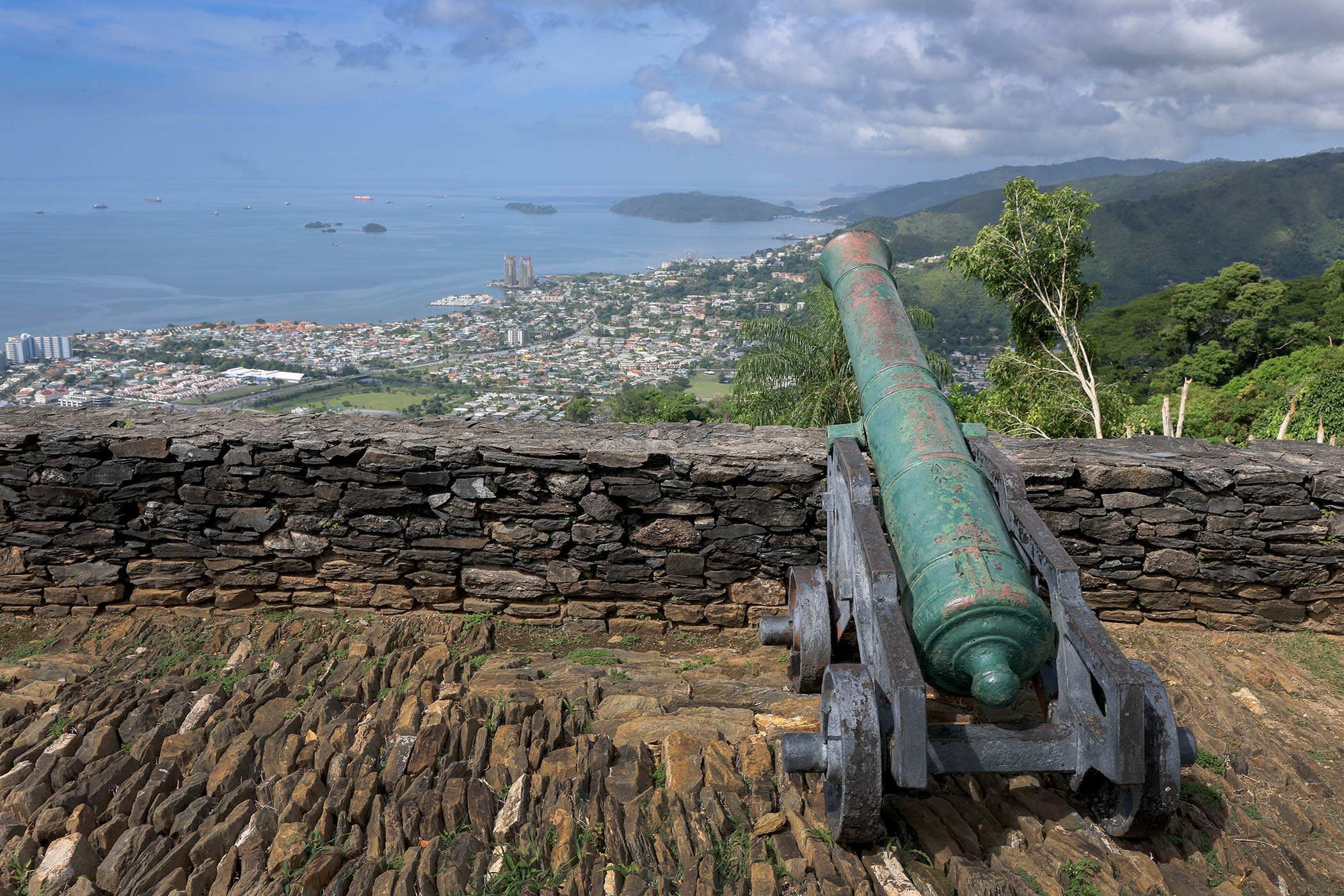

On a clear day, the view from Port of Spain on the Caribbean island of Trinidad includes yachts, tankers and, at a squint, Venezuela. At their closest, just 7km separates them. There’s a running joke that every Trinidadian fisher has two families: one here; one there.
Now, this proximity has placed Trinidad and Tobago in a geopolitical storm, as the Trump administration gathers an American armada in the Caribbean and alleges that the Venezuelan president, Nicolás Maduro, who stole an election last year, is the head of a drug trafficking cartel. The threat of regime change is in the air.
Trinidad and Tobago is far from a bystander in this. Its prime Minister, Kamla Persad-Bissessar, has upended a long diplomatic tradition by backing the US military presence to the hilt. The past months have seen the US dock warships, land military planes and set up a radar in Trinidad and Tobago – all nominally to combat drug trafficking.
But Venezuela has accused it of being a launchpad for a coming US invasion
“Trinidad and Tobago is caught in the middle,” said Bhoendradatt Tewarie, a former government minister. “Venezuela is a neighbour and energy source for Trinidad and Tobago’s fortunes. But the USA is the giant in the western hemisphere and has always been a key partner for this country.
Related articles:
“Hard choices are being made. And these hard choices have potential benefits, which have not yet been articulated [by the government] – but they also have very high risk.”
As the government withholds information, locals are left trading rumoured sightings of helicopters, drones and Americans in uniform.
In Matelot, a fishing community on Trinidad’s rugged north coast, the boats had been pulled in for the day. One fisherman, sitting in between caged birds and sipping a beer, said that business had been tough since the US began destroying alleged drug boats in the Caribbean. “Trump is bombing,” he said. “I don’t go out too far.”
One of their own, 26-year-old Chad Joseph, went missing two months ago as he ventured back by boat from Venezuela.
Up the road, Joseph’s mother, Lenore, stood outside her small brick house, under a banner with a photo of her son and the words: “Gone too soon.” She said Chad used to make regular trips to Venezuela, where he had a family – sometimes for a week, sometimes months. A little over two months ago he said he was about to come home, but never arrived. US forces destroyed a boat at the same time, claiming it was carrying drugs.
Lenore dismissed the allegation that her son was a drug trafficker. “I know that’s a lie, so I didn’t really think [about it], but it hurts me, because it’s my child. And all right, if it’s drugs, where’s the proof? They have to make it make sense.”
The stated goal is to stop the flow of drugs to the US. But many have concluded that the purpose is regime change
The US military buildup in the southern Caribbean began in mid August. It now includes the world’s largest aircraft carrier, the USS Gerald R Ford, along with about 15,000 troops, dozens of aircraft and a fleet of warships. At the same time, US forces have destroyed 28 alleged drug boats not just in the Caribbean but also the eastern Pacific, killing at least 104 people – including, it seems, two missing Trinidadians.
The Trump administration has also authorised covert operations in Venezuela and offered a $50m (£37.6m) reward for information leading to Maduro’s arrest. In late November, Trump declared that the airspace above Venezuela should be considered “closed in its entirety”. This month, his administration declared a blockade on sanctioned oil tankers. US forces have boarded and seized two so far.
Throughout, the stated goal has been to stop the flow of drugs to the US. Just recently, Trump has begun referring to disputes over oil investments, too. But many have concluded that another goal, and perhaps the fundamental one, is regime change. Trump reportedly gave Maduro an ultimatum to step down at the start of the month.
More broadly, it is part of the “Donroe doctrine”: Trump’s revival of the 1823 Monroe doctrine, in which the US marked the Americas as its patch – and was willing to impose its will through force.
The last time Trump sought to oust Maduro, in 2019, Trinidad and Tobago joined the Caribbean Community (Caricom) in seeking a diplomatic solution. This time is different.
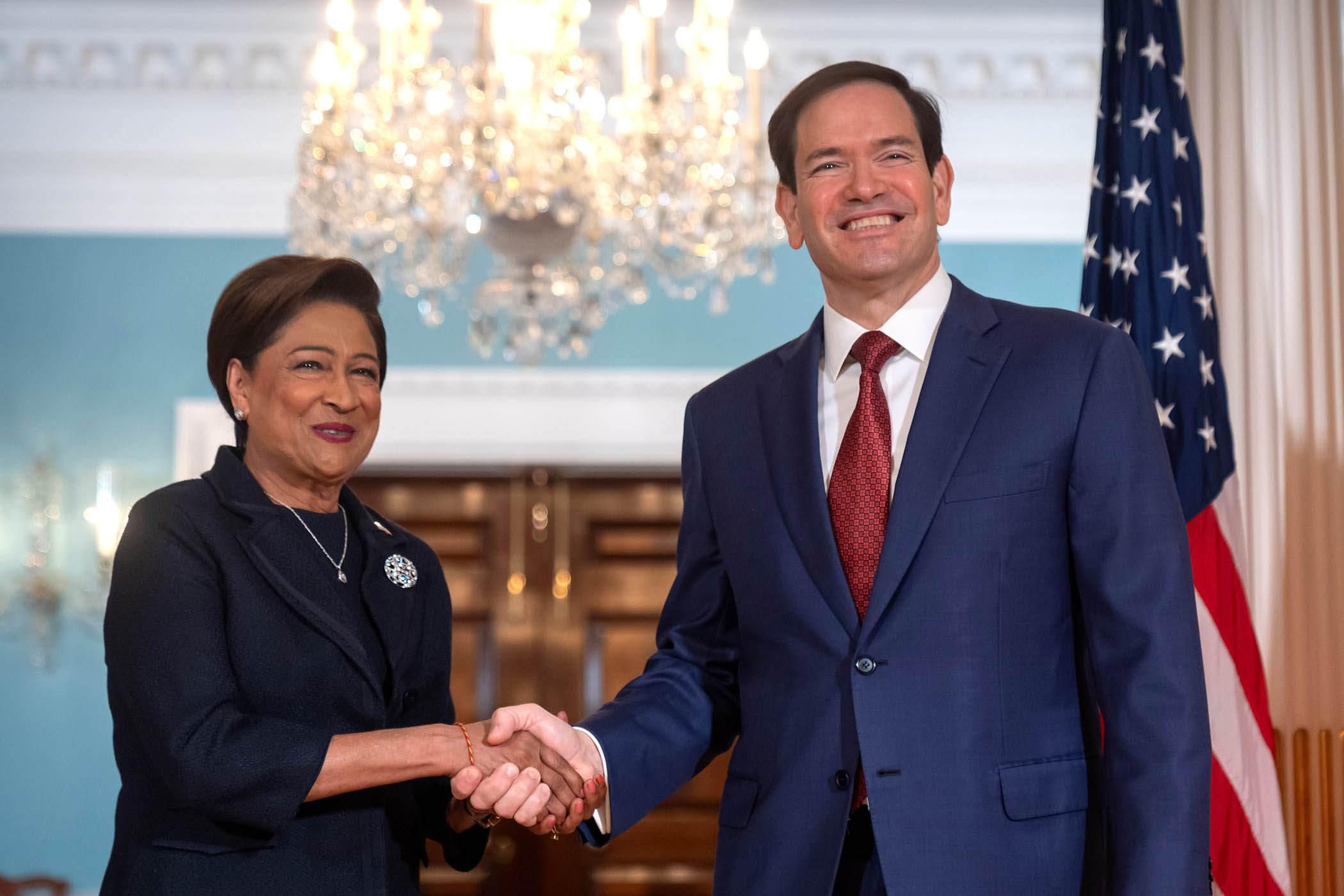
US secretary of state Marco Rubio with Trinidad and Tobago prime minister Kamla Persad-Bissessar in Washington in September.
Trinidad and Tobago has broken ranks with Caricom and backed the US. As the US began bombing alleged drug smuggling boats, Persad-Bissessar said the US should “kill them all violently”. When the rest of Caricom put out a statement reaffirming the Caribbean as a “zone of peace”, she accused them of siding with Venezuela.
“Trinidad and Tobago was once a leader within Caricom, and a champion of diplomacy, of international law, of regional solidarity, and of the use of dialogue to avoid hostility and advance the cause of peace,” said Amery Browne, an opposition senator and foreign minister under the previous government. “We have now been reduced to exchanging hostile and belligerent rhetoric with a neighbouring state.”
In fact, Trinidad and Tobago’s support for the US goes far beyond rhetoric. A few weeks ago, it emerged that the US had set up an air defence radar on Tobago. Then, last week, the government announced it had given US military aircraft permission to use its airports “in the coming weeks” for logistical purposes.
“There’s going to be a lot of repercussions,” said Gary Griffith, a former national security minister. “[Critics] are going to say, ‘There it is, we told you so. You give [the Americans] an inch, they take a yard.’”
The relationship between Trinidad and Tobago and the US now “verges on a military alliance”, said Tewarie. “You would think the PM would want to be cautious about how far she deepens that relationship and compromises the neutrality and sovereignty of Trinidad and Tobago.”
All of which begs the question why Trinidad and Tobago has taken such a strong position in support of the US
All of which begs the question why Trinidad and Tobago has taken such a strong position in support of the US, even as other countries with skin in the game – such as nearby Guyana, which has a continuing territorial dispute with Venezuela – have been much more cautious.
Neither the office of the prime minister nor the foreign ministry responded to requests for interview. But Kirk Meighoo, the public relations officer of the UNC, the ruling party, rejected the idea that Trinidad and Tobago was enabling American imperialism.
“[Venezuela has] theoretically on paper annexed two-thirds of Guyana already, and they’re making noises about Trinidad,” said Meighoo, referring to comments by Venezuela’s justice minister noting that Trinidad used to be part of Venezuela. “That’s real imperialism.
“The US’s declared agenda right now is not regime change – it is fighting narco-trafficking. That is also our agenda. We’ve said over and over, we’ve not discussed anything about using Trinidad in a US operation against Venezuela. We are not in favour of that. We’re not in favour of regime change. This is not about fighting Venezuela. We’re fighting narco-trafficking.”
Trinidad and Tobago has been struggling with gang violence for more than a decade. With 624 homicides last year in a population of around 1.5m, it was one of the most violent countries in the region. In July, the government declared a state of emergency. Homicides during the first nine months of this year were down by more than 40% compared with the same period last year.
In this, Persad-Bissessar is part of a wave of security populism across the western hemisphere, where leaders in countries such as El Salvador, Ecuador and Chile are winning support by talking tough and cracking down on criminal groups. Many of them also back the US strikes on alleged drug boats.
But another factor in the geopolitical calculus is the future of Trinidad and Tobago’s energy sector.
Oil and especially gas account for about 35% of Trinidad and Tobago’s GDP, and 80% of its exports. But gas production peaked in 2010. Short of raw chemicals, the island’s vast petrochemicals and liquified natural gas facilities are running under capacity.
Just hours after Trinidad and Tobago announced it would allow US military to use its airports, Venezuela cancelled supplying its neighbour with gas
“That’s the real story,” said one energy sector source in Trinidad and Tobago. “It puts the whole economy in a difficult position. People are crying out for natural gas.”
As the government’s oil and gas revenues fell, its fiscal deficit grew. Its foreign reserves are dwindling. Some are anticipating a devaluation of the Trinidadian dollar.
This pushed the previous government to strike cross-border gas field deals with Venezuela, which has vast, untapped resources, to keep feeding gas into Trinidad and Tobago’s industry. The plan was that these would start coming online in the next few years, but that was dashed last week.
Just hours after Trinidad and Tobago announced it would allow US military aircraft to use its airports, Venezuela cancelled all arrangements to supply its neighbour with gas.
That means Trinidad and Tobago’s prospects will be sharply affected by whether the next weeks and months bring regime change – even war – or a negotiated solution that could leave Maduro or an ally of his in power.
“They will remember [how Trinidad and Tobago supported the US],” said Tewarie. “When you align with the US in this way, you are really banking on the fact that they will protect you.”
“We must get [security] guarantees from the US,” said Griffith, the former national security minister.
The government’s geopolitical gamble has divided Trinidadians. In Matelot, a fisherman criticised the government’s all-in support for the US. “They are trying to recolonise Trinidad,” he said.
Lenore, meanwhile, described the turmoil of assuming her son is dead, but not knowing for sure. Asked about the government’s support for the US, she said: “I have nothing to say concerning them. I live with them.”
But asked about the prime minister’s “kill them violently” comment, her face hardened. “Well, she’s going to pay for whatever she says.”
Photographs by Joe Raedle/Getty, Mark Schiefelbein/AP