

Last Wednesday the deputy prime minister David Lammy presented a time capsule during a ceremony in Virginia to celebrate the 250th anniversary of American independence. The box, designed by the British architect Norman Foster, will be buried under the plaza at the Washington Monument with instructions that it should be reopened on 4 July 2276.
Along with soil from Mount Vernon, George Washington’s former residence, and Sulgrave Manor in Northamptonshire, built by ancestors of the first US president, the capsule contains a letter from Lammy. “The relationship between our two nations has never been stronger,” it says. “Over our long history together, the United Kingdom and the United States have become the closest of allies, united by shared values and mutual respect.”
But, after a week in which Donald Trump invaded Venezuela, threatened to annex Greenland, and boarded oil tankers around the world, senior figures in Whitehall wonder whether the much-vaunted “special relationship” can survive the 47th president. Trump’s declaration to the New York Times that “I don’t need international law” and “my own morality” is the only limitation on US military power, led some to question whether it should.
The emergence of what one former ambassador describes as “Trump unleashed” has scrambled traditional assumptions and created new divisions in government.
According to Peter Ricketts, the former head of the foreign office who was David Cameron’s national security adviser, there are two crucial differences between Trump and all previous US presidents since the second world war. “He doesn’t accept that the US should be constrained by any set of international rules. It’s back to the world of strong men and raw power,” Ricketts says. “And I don’t think Trump believes in the concept of allies. Those are fundamental shifts in the world that I’ve known in my 50 years in foreign affairs.”
‘Trump doesn’t accept that the US should be constrained by any set of international rules. It’s back to the world of strong men and raw power’
‘Trump doesn’t accept that the US should be constrained by any set of international rules. It’s back to the world of strong men and raw power’
Peter Ricketts, former UK national security adviser
Last week the president withdrew the US from 66 international organisations, including many that work to combat climate change. Ricketts fears that, having been elected on a promise to bring about global peace, Trump is developing a taste for “posturing as the war president and presiding over the use of force” from Iran to Venezuela. “So far, it’s been cost- free to him,” he says. “What I worry is that he will assume that he’s invincible and that America can do this with impunity.” Another retired senior diplomat puts it more starkly. “We now have a president who does not share our values, does not share our world view. That was the basis for the relationship with the United States and it has gone. We are now dealing with somebody who is volatile and whose motivation is essentially about money and enriching both the US and his family at the expense of anybody and everybody. I don’t think the risk of rupture has ever been as obvious before.”
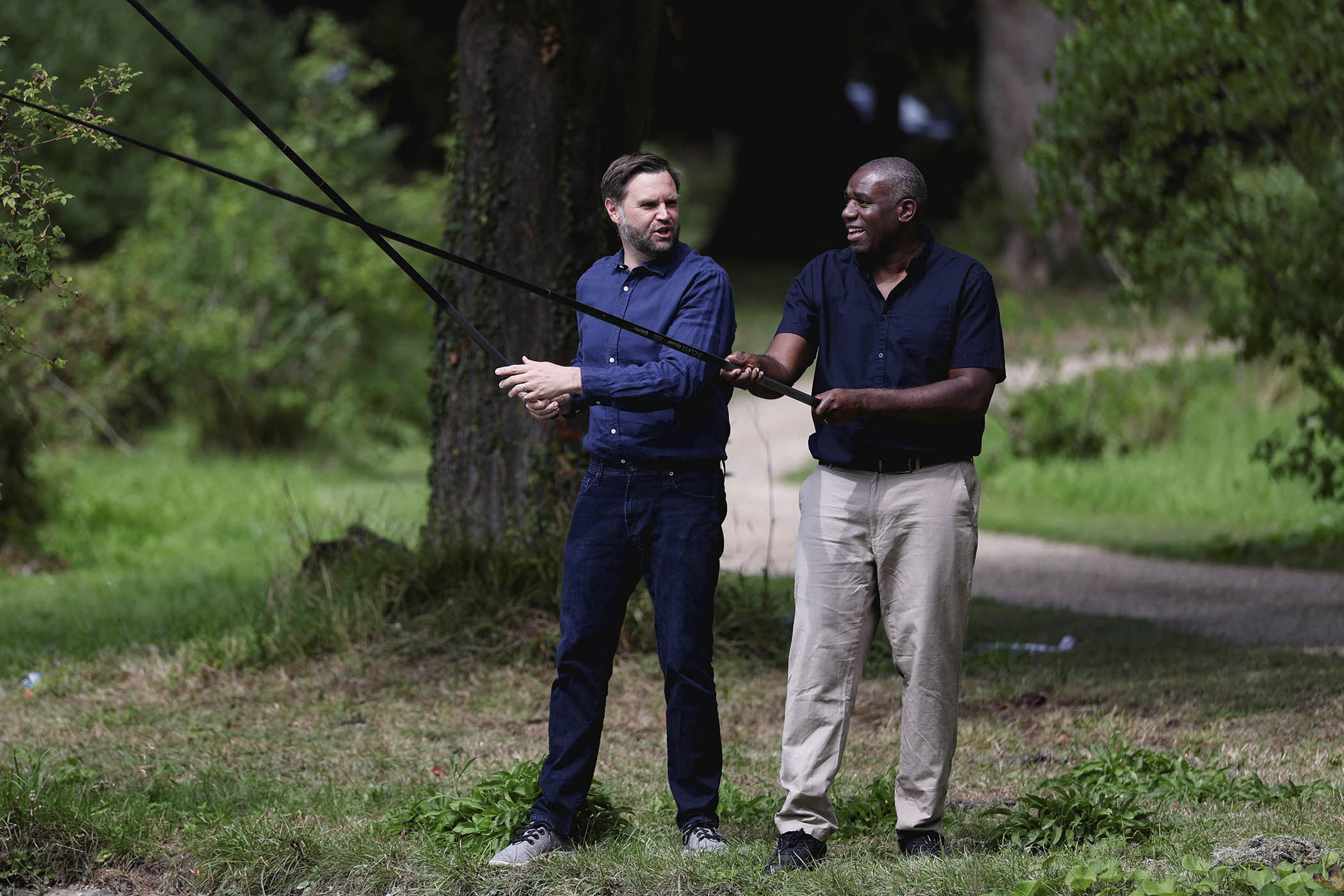
Seems like a long time ago: David Lammy and JD Vance displayed plenty of bonhomie during an August fishing trip in the Cotswolds
The “special relationship” has always been at its strongest in the realm of defence and security, but there are growing concerns about sharing intelligence with an administration that has shown itself to be loose-lipped and unreliable. The UK stopped passing on information about suspected drug trafficking vessels in the Caribbean because it did not want to be complicit in illegal military strikes.
“You have to keep calm and try to get through this but there’s bound to be some damage and some uncertainty about the future,” says one senior figure with extensive intelligence experience. “The problem is that even if Trump goes away and we revert to something more traditional, the fact that this has happened and that such an individual has been elected president has an undermining effect on confidence. That’s not going to be forgotten.”
Related articles:
A split now exists in the Labour party between the idealists, who want Starmer to do more to protect the rules-based world order, and the realists, who believe Britain must focus single-mindedly on the national interest.
In Downing Street, officials were quietly relieved that the prime minister had received no advance warning of the US action in Venezuela because it meant Starmer did not have to take a view about its legality before it was too late to stop it. Richard Hermer, the attorney general, has since told colleagues that the capture of Nicolás Maduro was clearly in breach of international law.
Newsletters
Choose the newsletters you want to receive
View more
For information about how The Observer protects your data, read our Privacy Policy
Some believe the prime minister, himself a human rights lawyer, should be more willing to stand up to the president. “It’s not right and left, it’s right and wrong,” one former cabinet minister says. “We have to be much clearer about where the moral boundaries are. You can’t just go into another country and seize its leader in the middle of the night.”
Emily Thornberry, the Labour chair of the foreign affairs select committee told the BBC that the UK should be consistent. “We condemn Putin for doing it. We need to make clear that Donald Trump shouldn’t be doing it either.”
Helena Kennedy, the barrister and Labour peer, says there is more at stake than diplomatic links between the UK and the US. “The idea that we’ve got a special relationship is dead and buried,” she says. “The law is a mortar between the bricks that holds things together. Power has always been an issue in global politics. What we are now seeing is power unconstrained by the law.”
But others in government argue that there has long been ambiguity. “The US has often operated in ways that some people have said don’t comply with international law,” according to one Whitehall source. “It’s not as binary as ‘there was a rules-based order and now there isn’t.’ That’s a rose-tinted view of the last 40 years. The idea that everything always went through the UN general assembly and was all signed off by [the human rights lawyer] Philippe Sands isn’t right. Equally, it’s not an absolute wild west now. There’s been this incident in Venezuela, but Nato still exists, the UN still exists.”
‘We are collectively paying the price for outsourcing our defence to the US and we Brits are living in a dream world’
‘We are collectively paying the price for outsourcing our defence to the US and we Brits are living in a dream world’
Jack Straw, former foreign secretary
A minister argues that there is no point hankering after a world that has gone. “We have got to stop obsessing about international law. The history of the world is the history of military power. The law exists in Britain because you can put people in jail. International law was only a meaningful concept because it was backed by American raw power. The question isn’t: is the rules-based order underpinned by international law a good or bad thing? The question is: what are the conditions for it existing?”
Others insist that maintaining good relations with the US is essential for national security. “It’s not a brilliant relationship. In fact it’s really difficult,” says a Starmer ally. “Trump is endlessly unpredictable, he’s thin- skinned and nasty. But there’s a calculation that we can’t defend Ukraine without America, so we have to keep them on board.”
Jack Straw, the former foreign secretary, says recent events have highlighted the “impotence” of Europe. “We are collectively paying the price for outsourcing our defence to the US and we Brits are living in a dream world. We would be in a very different position if we had been spending serious money on defence.”
So far, the prime minister has picked his battles. He has made clear that only Greenland and Denmark should decide the future of Greenland. He has also threatened to ban X if Elon Musk does not stop the AI tool Grok churning out “undressed” images of women and children, even though Trump has made clear that the technology giants must be protected as part of any trade deal.
On Monday Starmer will emphasise the connection between global instability and the cost of living in Britain. “We live in a volatile world where international events impact the UK more directly than at any time that most of us can remember,” he will tell staff in No 10.
But voters are increasingly sceptical about the UK’s alliance with the US and believe Starmer should look for friends closer to home. An Opinium poll for The Observer found that 42% of adults see America as an ally, compared with 49% for Germany and 53% for France. A third see the US as a threat and almost two-thirds do not trust Trump.
‘Starmer walks a daily tightrope because he never knows what Trump is going to do next’
‘Starmer walks a daily tightrope because he never knows what Trump is going to do next’
Kim Darroch, former British ambassador to US
In the coming weeks pro-European cabinet ministers and officials will seize on the president’s increasingly bellicose attitude to make the case for the closest possible relationship with the EU.
Kim Darroch, the former British ambassador to Washington, says Trump has no particular loyalty to Britain. “The UK is a place where he buys some golf courses and that’s about it. Of course he’s very sentimental about his Scottish mother and her admiration for the royal family but privately I think he believes that we once used to count for a lot but we’re diminished.
“Starmer walks a daily tightrope because he never knows what Trump is going to do next. He’s a capricious, thin-skinned leader who is quite capable of lashing out if you say something that annoys him.”
The reality is that “having left the European Union and floating uneasily in choppy waters mid-Atlantic with this guy in the White House doing all sorts of extraordinary things, we are very very vulnerable”, Darroch says. “It means that every problem that ends up now on people’s desks in No 10 and the Foreign Office is an exercise in damage limitation, in appeasement to stop the worst.”
Photographs by Andrew Harnik/Getty Images, Suzanne Plunkett/Pool via AP