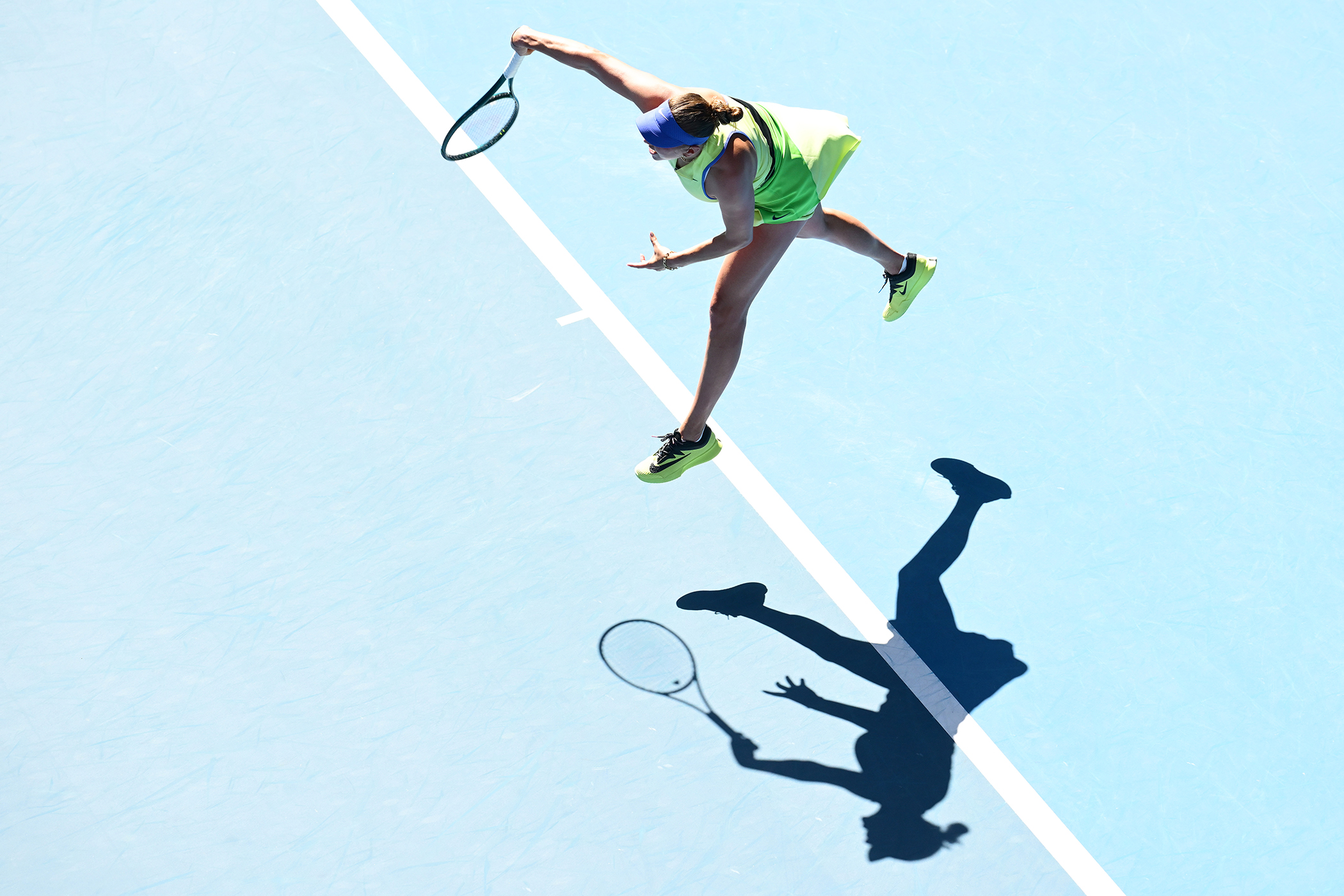

Sporting prodigies are damned from the start. The gilded few who meet our near-impossible expectations of genius are only achieving what was promised, but the vast majority are condemned to a life of what-ifs and simmering disappointment. Harold Bloom wrote that prodigies failing “makes our mediocrity more bearable”. For most of her career, Amanda Anisimova seemed fated to serve that purpose.
Still only 24, this is Anisimova’s seventh Australian Open – she made the round of 16 on her first appearance, then 17, beating Aryna Sabalenka en route. That was the supposed vindication and culmination of an unconventional childhood even by the warped standards of elite tennis, the supposed start of a dominance only supposed to end when she said so.
Born in New Jersey to parents who had emigrated from Moscow a few years prior, Anisimova’s family moved to Florida when she was three to be closer to the country’s best tennis coaches and academies. She was first given a tennis racket at two, and her mother Olga’s version of protection was not bombarding young Amanda with technical coaching until she turned seven.
Her sister Maria, 13 years older and a prospect herself, appears to have been a test case for dad Konstantin’s coaching skills having never played professionally. Maria had hated the pressurised bubble her parents isolated her in, so while Amanda was home-schooled, her mother set up a tennis academy to help her make friends. It’s the little things.
Her younger sister’s idol, Maria stopped playing competitive tennis while studying at Wharton, one of America’s most prestigious business schools, and was named on Forbes’ financial 30 under 30 in 2018. When Anisimova was first breaking through at 15, she said she was considering going into medicine after finishing her tennis career, and still believes she could have been a surgeon. Other modest ambitions at the time included one of each Grand Slam and becoming world No 1. Although Anisimova maintains her parents never forced her into anything, it is hard not to assess the evidence and draw a different conclusion. There’s a great line in a New York Times profile from 2017 that “she and her parents insist that she has been encouraged and supported but not pushed”. There are endless examples of barbarity forced upon children in the name of sporting ambition and misguided love.
Anisimova turned pro at 15 having first won a match in US Open qualifying at 14, but her body already ached like she was 50. She used to get stomach pains while travelling, later diagnosed as the psychosomatic result of homesickness and extreme stress. At the 2018 Miami Open, a 16-year-old Anisimova broke her foot in the third set against Qiang Wang and still went on to win.
When your whole life has been in service of a grand aim, doing something just because will never suffice.
When your whole life has been in service of a grand aim, doing something just because will never suffice.
She has only recently started to engage with the absurdity of her upbringing – speaking to New York Magazine late last year, she called herself a “sensitive person” who “did not have an easy childhood at all”, and said “I feel like if I really explained my story, a lot of people would be absolutely shocked at the events in my life”.
First she was the youngest player in the WTA top 300, then the top 150. She reached the 2019 French Open semi-final at 17, the youngest woman to do so since 2006. She made the Wimbledon quarter-finals and the second week at Roland Garros. The masterplan was working.
Related articles:
But a week before the 2019 US Open and Anisimova’s 18th birthday, her father – and coach for most of her life – was found dead at 52. She said at the time “hitting tennis balls is how I get my feelings out” and returned to the tour weeks later, later admitting that was far too early. A month later she signed a reported $100m long-term deal with Nike.
By 2023 she had won one WTA tour title, had not surpassed the world No 21 ranking she reached at 17 and rarely made it past the third round at Slams. She struggled first with injuries and motivation and direction, then with tennis as a whole. In May 2023, she stepped away from the sport indefinitely, burned out and racked by depression and anxiety.
Newsletters
Choose the newsletters you want to receive
View more
For information about how The Observer protects your data, read our Privacy Policy
She spent time with her sister, travelled and enrolled for a semester at Nova Southeastern University. She worked with a therapist who specialised in trauma. She read and wrote and painted. “I began to feel like something was missing from my life,” she said in August 2023. “Art became my place to unwind and disconnect from the world. It was a source of tranquility and originality that I missed.”
And yet even her art had to find a greater purpose – she launched a campaign called “Art for Hope” to sell her paintings to raise funds for mental health charities and helping victims of child abuse. When your whole life has been in service of a grand aim, doing something just because will never suffice.
It was eight months until she returned to tennis, having reset not just herself but expectations around her. "I honestly never took a break that was longer than two weeks in my life,” she later said. “I just needed that, as a human being, to just rest for once and let my body recover.”
Having fallen to world No 359 after her break, she finished 2024 in 36th. And while it’s easy to attribute her recent career transformation to the break, to learning her boundaries and reassessing her relationship with the sport, it was only when she began working with physio Shadi Soleymani in early 2025 that she realised how many shortcuts her talent had allowed her to take. She had been drinking too much coffee and not enough water, following a vegan diet lacking vital protein, and did ineffective strength and conditioning work that strained an already strained young body. Her muscles were riddled with scar tissue and she could only train pain-free for 45 minutes or so.
After only a few months working with Soleymani, both physio and a crucial female ally, she reached the Wimbledon final, even if she collapsed to a devastating 6-0, 6-0 defeat to an imperious Iga Świątek. To then reach the same point at Flushing Meadows two months later is testament to the sustainability of her success and her renewed resilience. Some combination of healing mental and physical scars has freed her and her potential. The next step is learning how to win the biggest matches, how to exist where the air is thinnest.
Tennis doesn’t look hard for her, but it sounds like it; all grunts and shrieks and cathartic screams.
Tennis doesn’t look hard for her, but it sounds like it; all grunts and shrieks and cathartic screams.
It is almost impossible to distinguish what constitutes natural talent when you started playing at two, but Anisimova’s physical armoury is extraordinary. Her backhand – the best in the women’s game – is an act of beautiful violence; pure power and malicious intent; with an average pace that exceeds Carlos Alcaraz and Jannik Sinner’s. There are moments you wonder how she has not spent seven years flattening everything before her.
Despite rising to WTA No 3 and making the previous two Grand Slam finals, Anisimova is still significantly less popular, by a modern metric at least, than her direct peers – her 469,000 Instagram followers are dwarfed by Sabalenka (4.1m), Coco Gauff (2.2m) and Iga Świątek (2.3m). Margaret Court Arena was less than half-full for the vast majority of her first two matches, although both have featured stodgy and awkward periods where she has lacked rhythm.
For everything she has gone through, the rise and fall and rise again, she still feels like an inevitable megastar – charming and comfortable off-court, emotions poorly concealed enough on it to be relatable and interesting, combined with a brutally aggressive game. Spend enough time in her orbit and she drags you in one way or another. Tennis doesn’t look hard for her, but it sounds like it; all grunts and shrieks and cathartic screams. She’s admirably present when she plays, although occasionally caught in the moment to a fault, practicing mindfulness every day to strike the right balance.
There are murmurs of a new Big Four in women’s tennis, but Anisimova needs to win a Slam to really earn her place. She entered the Australian Open as the fourth seed and although Sabalenka and Świątek both beat her in finals last year, she beat them in semis. This is where she was always supposed to be. She just had to fall apart and put herself back together to get there.
Photograph by Quinn Rooney/Getty Images