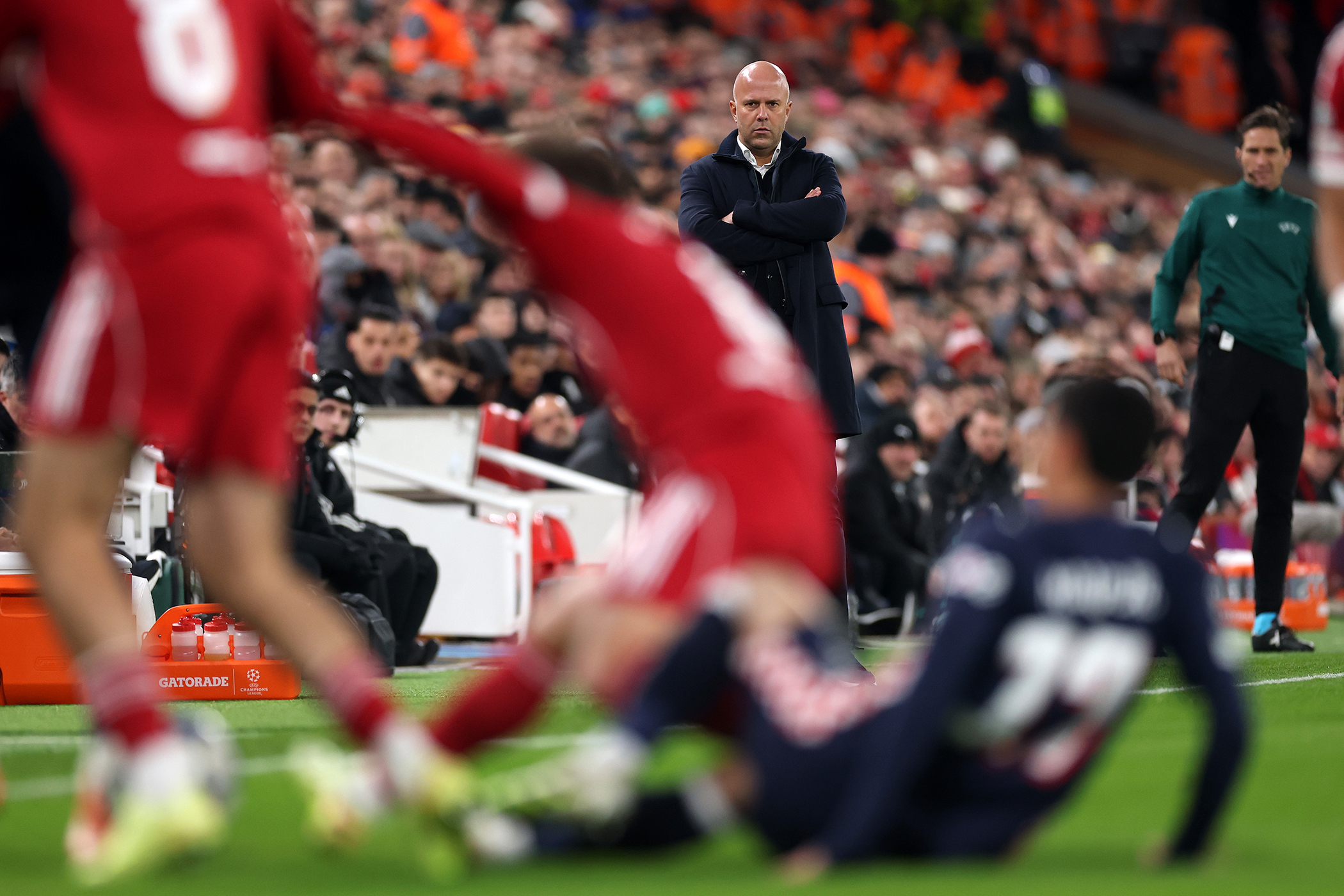

Over the course of the last 10 days, as Arne Slot has endured what is very likely the worst period of his professional life, he has been wheeled out to explain, defend and justify himself in front of the media no fewer than six times. Like most Premier League managers, he must feel that a surprising portion of his job is devoted to acting as his own barrister.
Last Friday, there was a pre-match press conference ahead of Liverpool’s game against Nottingham Forest. He gave another in the immediate aftermath of that 3-0 defeat. He was back again on Tuesday, before PSV Eindhoven. On Wednesday, as Anfield filled up around him, he joined Steven Gerrard, Steve McManaman and Lindsey Hipgrave for a flash interview on TNT Sports. There was a press conference after that, too. And one more, for good measure, at 3pm on Thursday, looking forward – if that is the right term, which it isn’t – to West Ham.
During all of that, Slot has faced dozens of questions, or at least roughly the same questions dozens of times, and given answers that have run into many thousands of words. It is to his credit that he has remained polite, thoughtful and candid throughout. He has not, at any point, screamed in frustration. Slot is not in a position to overlook the smallest win.
The whole Sisyphean ordeal, though, can probably be boiled down to a single sentence. It came in response to the very last question he was asked after Liverpool’s defeat to Nottingham Forest last Saturday, the one that immediately preceded the defeat to PSV Eindhoven on Wednesday. That represented a ninth loss in 12 games for the Premier League champions, Liverpool’s worst run of form since Suez in 1956, a patch of form that, in the assessment of Curtis Jones, has left the club “in the shit.”
The question centered on Slot’s decision, 55 minutes into the game against Forest, to remove Ibrahima Konaté – or at least the player wearing his shirt – with Hugo Ekitike. It was a substitution that had, in real time, smacked of desperation; his inquisitor, not unreasonably, wanted to know the thought process behind it.
Slot’s answer was telling. He had, he said, done exactly the same thing against the same opponent last season. On that occasion, Konaté had come off for Diogo Jota, who promptly scored an equaliser with his first touch. This time around, Ekitike simultaneously did little of note and was also among Liverpool’s better players. What had looked “brave” when it worked, Slot said, “looked stupid this time around.”
That, of course, is no less the lot of the manager than the unrelenting media schedule; the same move, made in basically the same situation and with precisely the same motivation, can be both a stroke of genius and proof of absolute professional incompetence, depending on its outcome.
But it is also indicative of the specific, spectacular unravelling of Liverpool’s season: Slot, last year, had the golden touch. Now nothing he does, whether new and bold or tried and tested, seems to make things better. (He would make the same substitution on Wednesday, as soon as Konaté had gifted PSV a third goal. Liverpool would still find a way to concede another.)
Related articles:
The causes for this – what is rapidly turning into a historically weak defence of a championship – have been discussed ad nauseam. They include but are not limited to: a botched attempt to change the team’s style and shape; ill-judged and expensively erroneous recruitment; the unceremonious dumping of half the squad that had won the title; the overnight ageing of Mohamed Salah and Virgil Van Dijk; and, of course, the death of Diogo Jota, the incident that is rapidly turning into a Rorschach test for whether we, as a country, believe footballers deserve to be treated as humans or not.
But while the precise weighting of those various factors is a matter of personal taste, the consequences are not. Last season, Dominik Szoboszlai – the lone Liverpool player who can consider himself beyond reproach for what is currently unfurling around him – gave an interview to Men In Blazers in which he seemed to capture the secret of Slot’s instant success.
Newsletters
Choose the newsletters you want to receive
View more
For information about how The Observer protects your data, read our Privacy Policy
In Szoboszlai’s eyes, Slot’s demeanour on the touchline, his unflappability, his coolness, was such a stark contrast to the mania of Jürgen Klopp that it had a pronounced effect on the players. When they looked at him, he said, they saw someone who was in control of the situation, someone who had a plan.
Nobody has said as much, at least not in public, but it is hard to see how it is possible that feeling has survived the chastening events of the last two months. If the fans have noticed that whatever Slot does no longer works, then it is all but certain that the players have, too.
As a rule, that only ends one way. Liverpool is one of those clubs where the manager occupies a curiously exalted position. It has never sacked a title-winning coach. That is just as true in its modern guise, under the ownership of Fenway Sports Group and the aegis of Michael Edwards and Richard Hughes. Its self-image is of rationality, of process, of avoiding the emotional reflexes that lead to poor decisions.
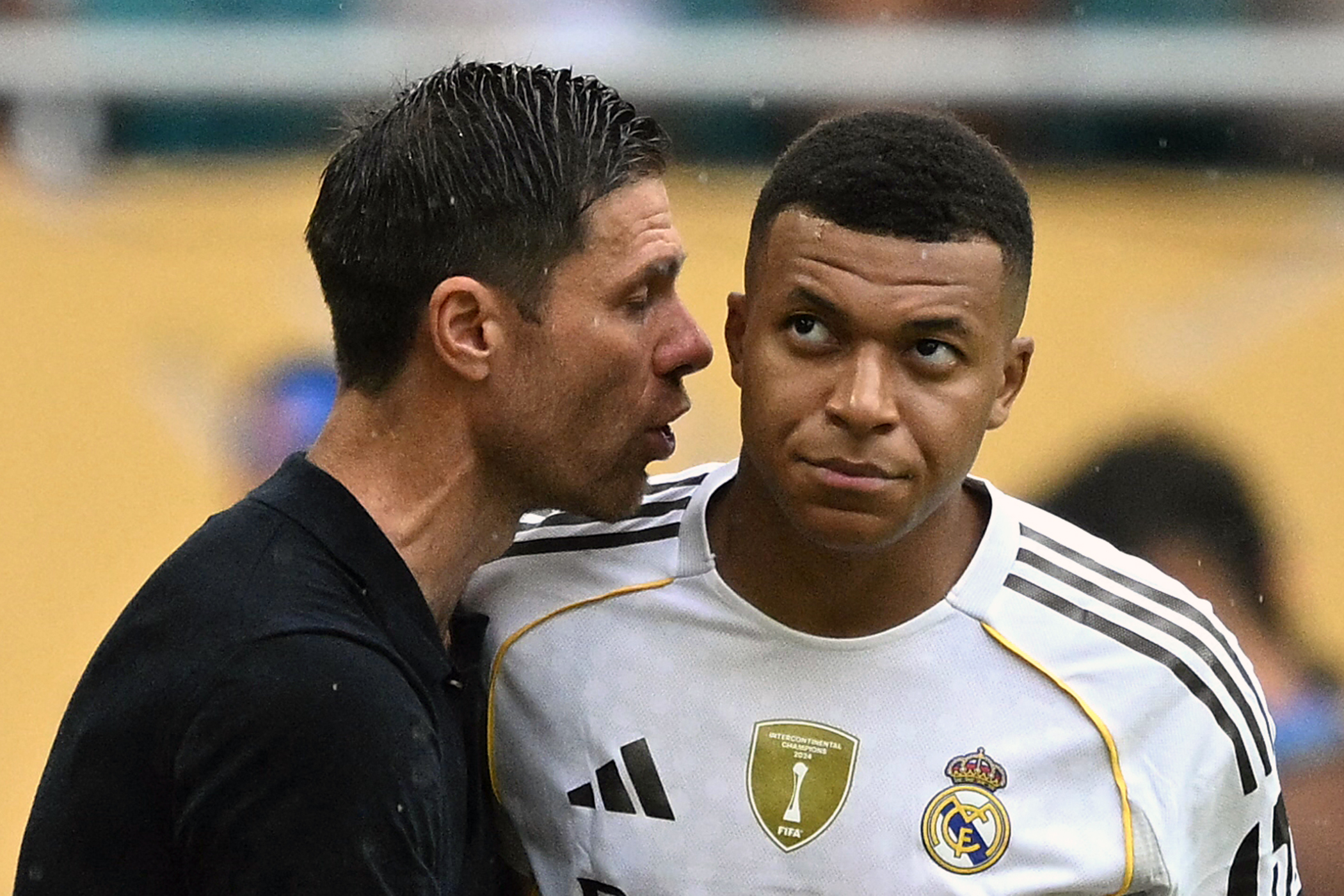
As well as a keen awareness of the strained circumstances in which Slot is operating, that is likely what has allowed him to stay in position so far. Xabi Alonso’s position is under scrutiny at Real Madrid because his team – top of La Liga – did not win for three games. Barcelona, Bayern Munich, Chelsea, Manchester United, the teams Liverpool see as their peers: none of them would have been encumbered by gratitude for what Slot achieved last season.
But Liverpool are not that different. They remain, at heart, an elite institution, with the expectations and standards to match. It would be a cause of considerable embarrassment to part company with Slot, to acknowledge that the sun-bleached euphoria that consumed Anfield in the spring has evaporated into only sadness and regret, but it is also inevitable if he cannot find a solution, and relatively quickly.
He has not transformed into a bad manager overnight. But being a manager is not just a matter of objective truth; it is also about perception, feeling, and faith. All of those press conferences are there to shape their reality. And just at the moment, Slot’s reality is that the line between success and failure, between brave and stupid, is very fine indeed.
Photograph by Carl Recine/Getty Images