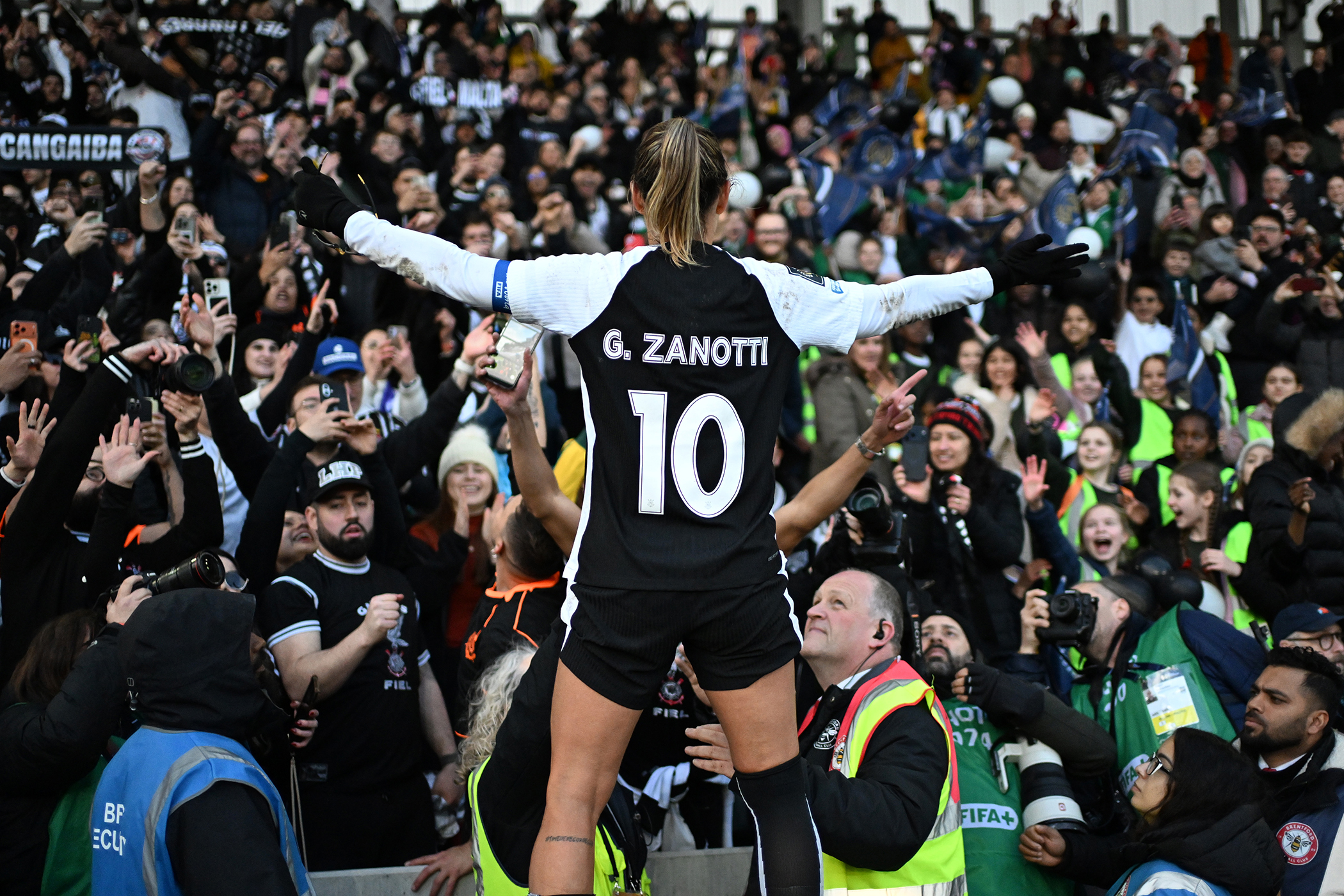

It is 2pm on a Wednesday afternoon and 40-year-old Gabi Zanotti is standing on the hoardings at Brentford Community Stadium celebrating. She is being cheered on by a motley crew of west London school children and Corinthians ultras. Her teammates are on their knees bowing down to her. Welcome to the inaugural edition of the Fifa Champions Cup.
It has been a long road to an intercontinental competition of this kind. From 2012 to 2014, Japan hosted its own, hoping for a Fifa endorsement that never came. There have been various invitationals throughout the years before Gianni Infantino, the president of Fifa, said at the end of the 2019 World Cup that there should be a Women’s Club World Cup as soon as possible.
A date was eventually set for 2026, with the intention of playing the competition every four years, with a Champions Cup for the continental confederation competition winners due to be played every year in between. That was subsequently postponed, the Champions Cup was brought forward, and that’s how the children of west London got a trip to the football this week.
Zanotti’s goal was the only goal in Corinthians’ semi-final victory over Gotham FC. As the first ever meeting between a Brazilian team and an American team in the women’s game, the pride in the result was exuberantly celebrated as South American footballing victories tend to be. The result means that Sunday’s final will be contested at the Emirates between Arsenal and Corinthians, after the European champions brushed aside Morocco’s AS FAR with ease.
The politics of a Club World Cup is a bit different within the women’s game. The historical power of the USA in women’s football means that there is not the same kind of European primacy that there is in the men’s game. In fact, one of the most surefire ways to set women’s football social media ablaze is to suggest that either the USA or Europe is better at the sport.
The debate has turned pre-season friendlies into Battles of the Continents. There is even a fantastic conspiracy theory that the United States’ English manager Emma Hayes has been telling her team to go and play in Europe, contributing to a talent drain of the American league. The fear of European supremacy recently led to the National Women’s Soccer League (NWSL) ripping up their rule book in order to keep hold of Trinity Rodman by allowing the Washington Spirit to make her the best-paid women’s player in the world.
Given the genuine competitive nature between confederations, an international club competition is welcome. But that doesn’t mean it has avoided being Fifa-fied. The differing calendar for seasons, with North American teams playing from February to November while European teams play from September to May means that the integrity of the competition will always be questioned.
It was something mentioned by both Gotham goalkeeper Ann-Katrin Berger and defender Jess Carter after their shock loss. “There should be a better system where everyone arrives fit enough into the competition,” Berger told reporters after the match. “You want to play against the best teams.”
Related articles:
The Fifa Champions Cup only involves the teams over in England playing two matches – there is a third/fourth-placed play-off on Sunday as well as the final – but the Club World Cup which is also slated to take place in January will be far more extensive.
The Women’s Super League [WSL] is concerned about the commercial and sporting impact of having to move potentially five gameweeks in 2028 to enable Arsenal to participate. They expect there is a likelihood that Chelsea will also be invited given their Uefa club coefficient ranking. Despite Fifa’s claims that they have extensively consulted leagues, the WSL feels that they have simply been told what is going to happen. They would prefer to wait until the new international calendar comes round rather than rushing to fit the competition into the existing one.
Newsletters
Choose the newsletters you want to receive
View more
For information about how The Observer protects your data, read our Privacy Policy
The WSL is in a unique position when it comes to objecting to the placement of the competition, given that they are an independent company. While they believe that other European leagues also have concerns, the majority are run by the national federation, making it harder for them to object to Fifa.
Yet there are also conflicts of interest for the league. Prior to the tournament starting, Kynisca was announced as the presenting partner. This is the multi-club ownership group run by Michele Kang which is a shareholder in the WSL by virtue of owning London City Lionesses. The group also runs Washington Spirit and OL Lyonnes.
Kang is widely fêted for her significant investment in the women’s game, having donated $30m to US Soccer: her supporters argue that there is no issue with her sponsoring a tournament that her teams are not participating in. That feels like a wilful ignorance of the issue at hand and it is hard to imagine it being an acceptable excuse in the men’s game.
There is an inevitability to the way this will play out. The Cup is unlikely to be taken seriously
There is an inevitability to the way this will play out. The Cup is unlikely to be taken seriously
There are also concerns around where the tournament will be held, with Qatar having been rumoured. Fifa’s chief football officer Jill Ellis said that she would be “careful not to throw stones in glass houses” when asked about the location given its record on LGBTQ+ issues. That was in reference to the rollback of LGBTQ+ rights in the US.
There is an inevitability to the way all of this will play out. The Champions Cup is unlikely to be taken very seriously outside South America, as has proved to be the case on the men’s side, but the more limited disruption it causes also makes it relatively harmless. When Corinthians face Arsenal in the final on Sunday evening, it will be a genuinely great moment for international women’s club football. But it is a sign of what is to come, none of which feels as if it is in the long-term interests of the women’s game.
Photograph by Harriet Lander/Fifa via Getty Images