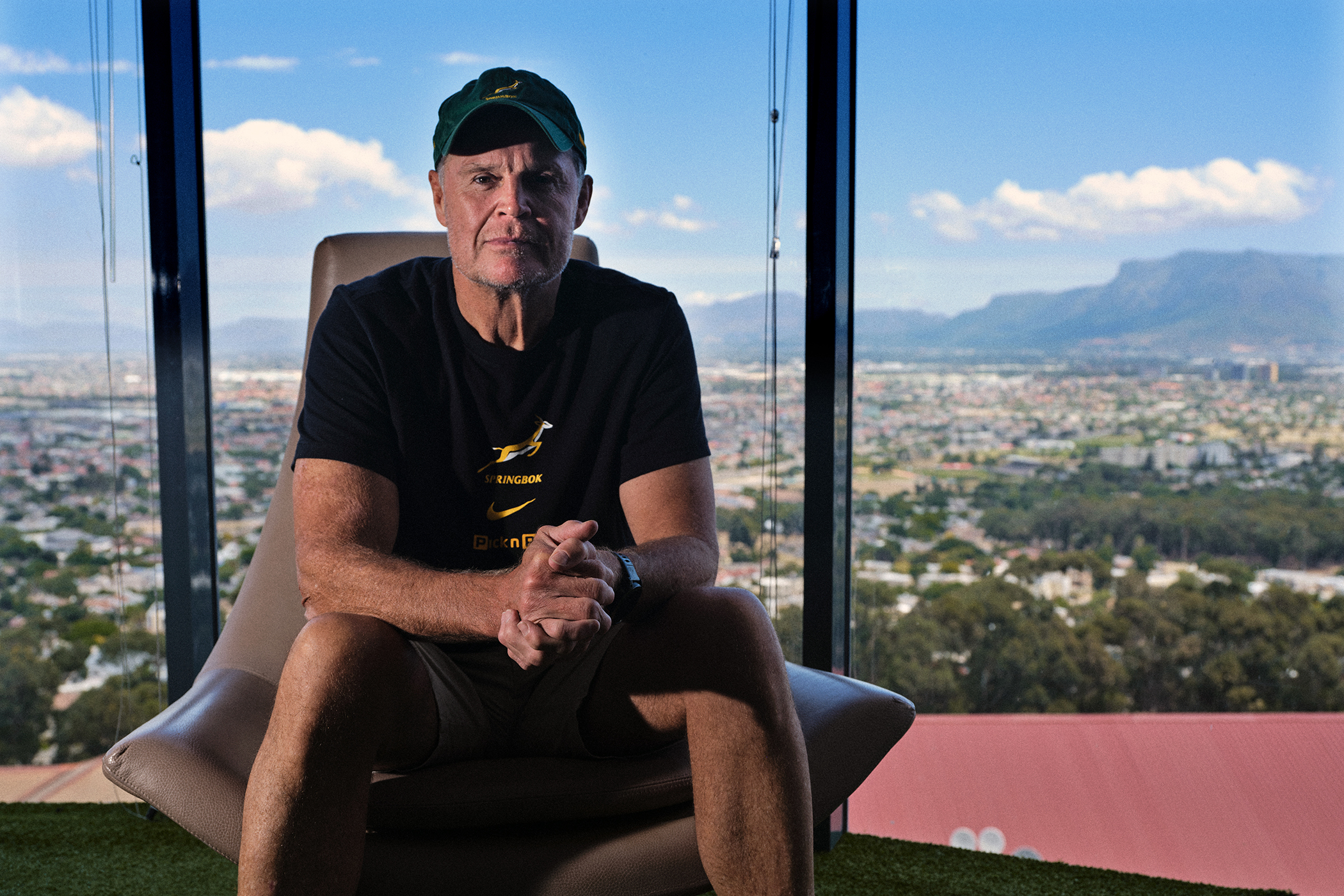

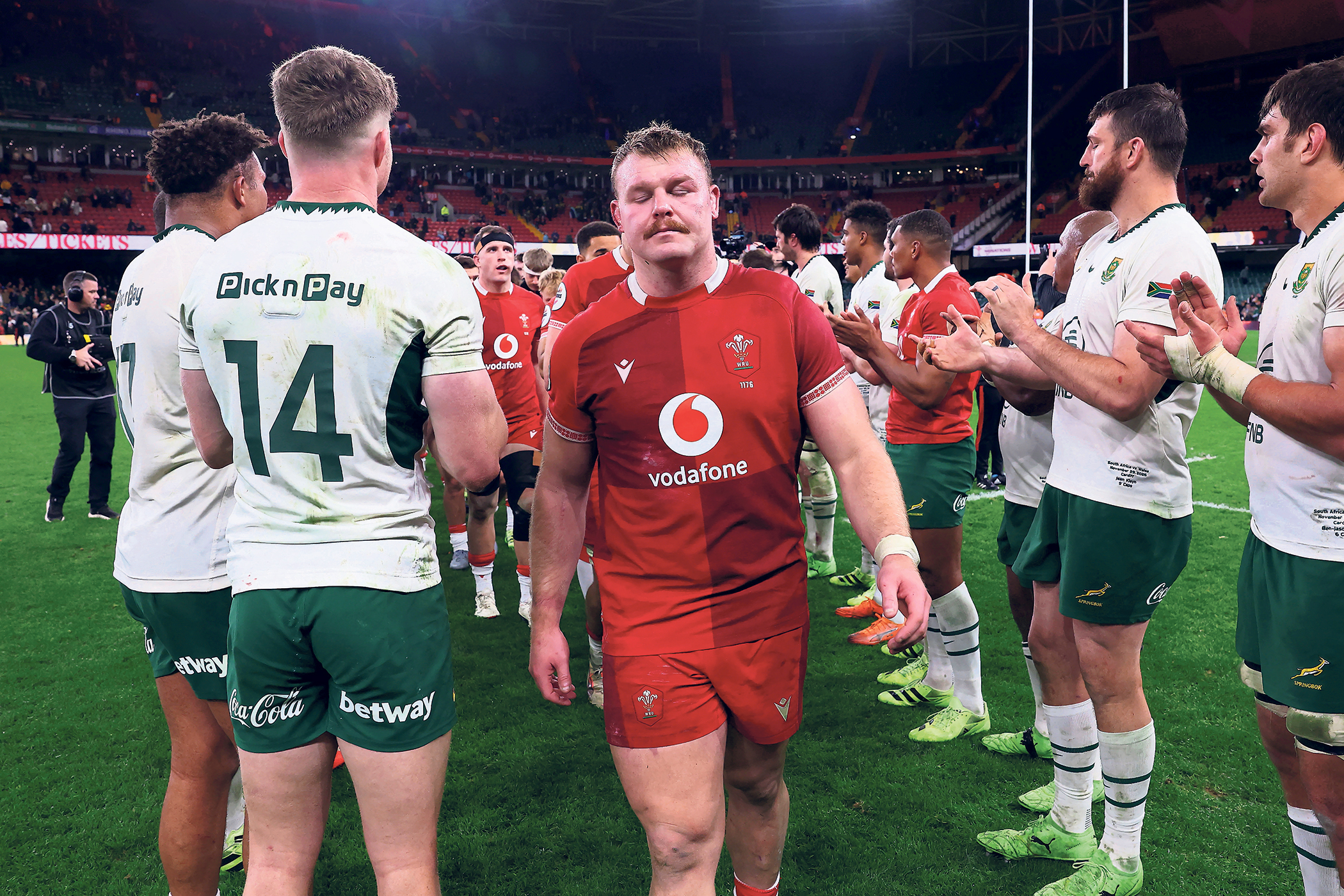
Rassie Erasmus has been talking for around 45 minutes, sat in the boardroom of South Africa [SA] Rugby’s offices north of Cape Town, addressing more immediate topics – Scott Robertson’s firing as New Zealand coach, England’s form, the state of his relationship with World Rugby – but also deeper subjects, like the build-up to a Test when he told those around him he would step down if South Africa went on to lose.
So, it feels like a good time to ask something a little lighter, about an anecdote told by Percy Montgomery, his former Springbok teammate, on a podcast earlier this year, revealing that Erasmus does not like fruit and that the squad would light-heartedly hide bananas in his team blazer as a prank.
“If one day I was in the army and they captured me, and they want me to talk,” Erasmus begins to answer. “Don’t put a gun there [on the table]. Just put a fruit.”
He is not the only Erasmus affected by fructophobia. His youngest daughter wanted to tease him about it by putting a fruit in front of him, but had to do so wearing a glove, “because she also cannot touch it.” His grandfather was the same. “It’s a texture thing, that you can’t handle it.”
What does this have to do with the Springboks? Nothing, really. It is, however, one of a few examples during our conversation that there is often more to Erasmus than meets the eye. More depth beyond his social media posts, with the one of the latest offerings being an AI video of his attack coach, Tony Brown, in a scene from the film ‘The Wolf of Wall Street’ where the character Jordan Belfort informs the office “I’m not fucking leaving”. It was Erasmus’s way of confirming that Brown, under contract until after the next World Cup, will not be returning to New Zealand to replace Robertson.
“I haven’t mastered [AI]. That was the first attempt,” Erasmus says, smiling broadly. “I just was frustrated and thought we can’t put something out there, and also thought we couldn’t put him on the spot because Tony didn’t say it officially, he just told me. So I thought we can put it in a way where it was just fun.”
While he would prefer to “keep quiet” about the circumstances regarding Robertson’s departure until knowing the full story, Erasmus does offer this. “I think he's a great coach. You don’t win six or seven Super Rugby titles without being a great coach. So, I'm sorry for him. I was surprised that it happened.”
England are South Africa’s next opponents in July, although the noise this week suggests that the Springboks will try to line up a warm-up fixture in advance. England are hoping that by July they will be Six Nations champions, and while Erasmus will not go as far as to offer a prediction for the championship, there is admiration there for England’s 11-Test winning run. “They are the real thing now.”
Related articles:
Tom Curry is “a tough bastard”. Maro Itoje “has always been a guy that disrupts your play”. Tommy Freeman, Fin and Marcus Smith are all mentioned when discussing how England have “so many different” players within their squad. “I just think they’ve got a nice balance. There is grunt and power and flair. They’re impressive,” he explains. His description of Henry Pollock as “on the scene” is inadvertently perfect given Pollock’s current grip on English rugby. And the Pom Squad, England’s version of South Africa’s heavy artillery arriving off the bench en masse? He seems genuinely thrilled.
“I think it’s lekka when people stop analysing what’s wrong and what’s right, if things are within the laws. You adapt to it and kind of embrace it. It’s a nice feeling. Not because you feel when everybody’s criticised us at that stage that we’re now being proven right, it’s not that. I’m glad that people are trying to not find a problem with that.
Newsletters
Choose the newsletters you want to receive
View more
For information about how The Observer protects your data, read our Privacy Policy
“They might find something different. They might go with four forwards and four backs, and then I might look at that and think ‘that might work’. We’re all stealing from each other and learning from each other. None of us have all the answers.”
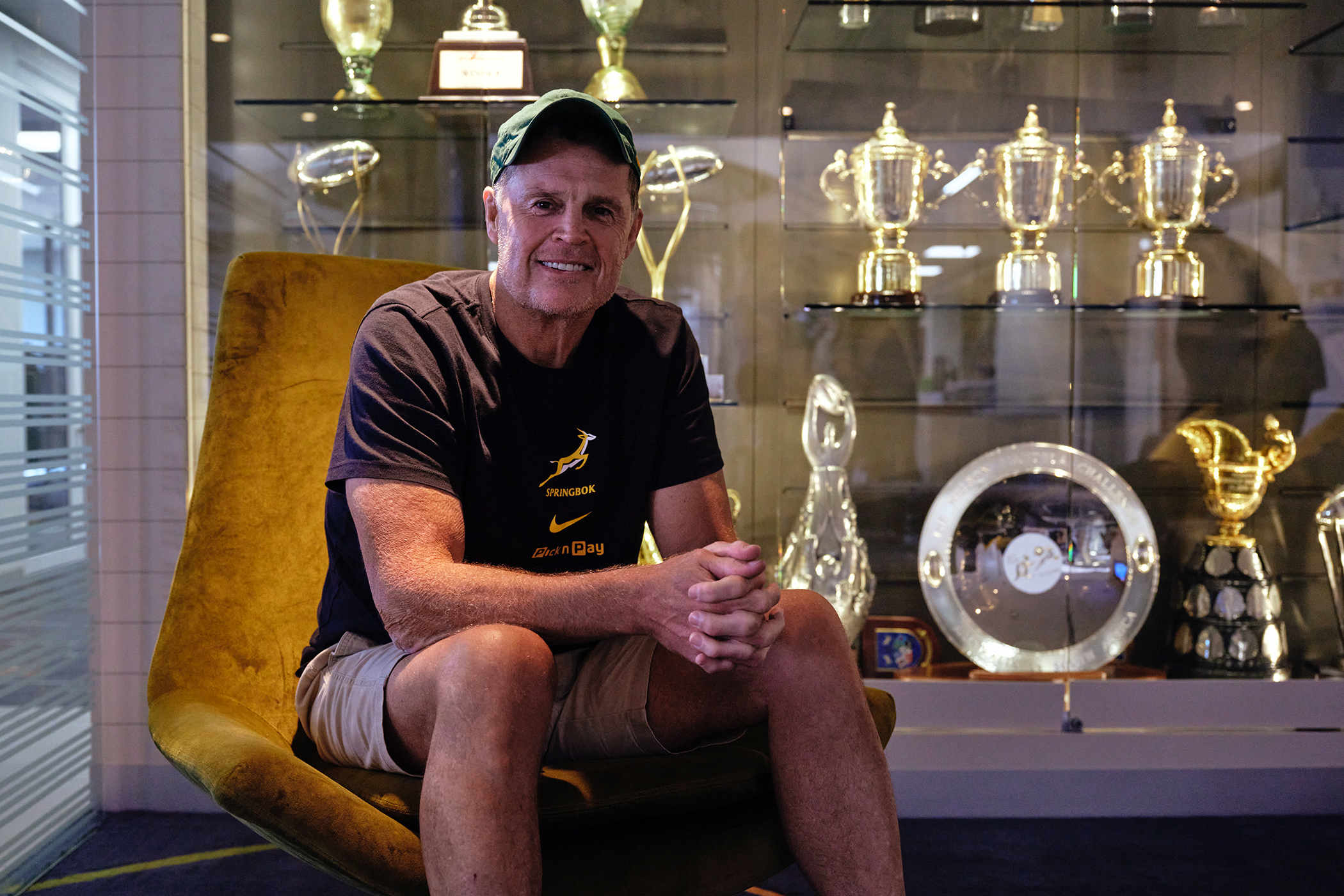
This amenable version of Erasmus obviously marks a change from the coach being suspended by World Rugby twice in two years for his opinions on match officials. I ask whether it is fair to say his relationship with the governing body is at an all-time high. He responds: “There was a stage where it couldn’t get worse!” It took conversations with Eddie Jones, the former England head coach, and Nigel Owens, the former referee, along with hiring another former referee in Jaco Peyper to be a laws advisor, to give him a different perspective.
“I don’t think I did something really bad there, but I was very selfishly driving a South African narrative. I don’t think I’ve massively changed, but sometimes you say in the long-term, what is going to work out for the best? In my opinion and I hope in World Rugby’s opinion, you’re getting better at trying to understand how other things work. You can’t always go upstream. Somewhere you are going to get tired of that.”
Why, having become the first coach to win two Rugby World Cups – even if he was technically director of rugby in 2023 – was Erasmus still here when most people would have walked off into the sunset. And which is tougher; turning the Springboks around in 2018 from their lowest ebb, or successfully regenerating the side as so many of those double World Cup-winners enter their mid-30s and face retirement. Here’s Erasmus on the first part.
“The honest answer, and you’re going to think I’m just saying it, is I really just enjoy watching the people of South Africa being happy,” he begins. “No man, it was always frustrating when you couldn’t make it work. Hopefully the world sees sometimes that we’ve got challenges here. For people it can feel like we’re beating that drum over and over and over again. But if we don’t beat that drum, then it is easy to fall back into a thing of ‘oh, we’ll just survive and worry about tomorrow’.
“For me, lifting a World Cup, having a photo, is awesome, man. It’s really lekka. But it’s much nicer to walk into a mall on a Friday and see everyone in Springbok jerseys. People sing the songs and they know Siya [Kolisi], but they also know Sacha [Feinberg-Mngomezulu]. Frans Malherbe can walk into a tavern in Despatch and people know him. That part I love. Hopefully people will tell you that the glamorous part, it’s besides the point for me. It’s that feeling that everything is going alright.”
That is certainly a departure from when Springbok supporters “burned the jerseys and they didn’t want to see you”, a memory that seems to have stuck with him. Maintaining standards, securing those structures for long-term success, gives him the most satisfaction, and the roots of that date back to his time as technical specialist for SA Rugby back in the early 2010s before he left to join Munster.
“If you don’t have things sorted out at the bottom, but then you have success at the top, it’s almost luck. Then when the boat sinks at the top, you have to reengineer the whole thing. Not just the players, but the culture, the work ethic. At some point, the Springboks will lose and will lose a lot. I mean some time in the future, hopefully in 2080. But at some point they are going to lose and they’re going to go, how do we get this back on track? And then if you don’t have something to fall back on… the challenge for us as SA Rugby is actually we’re doing pretty well now, but say all of a sudden it goes pear-shaped, instead of reinventing, we just have to fix it. Add in an Under-23 tournament, or change this academy setup. The challenge is to foresee the problems.”
As for that 2018 versus now question, South Africa during that first Rugby Championship under Erasmus were “thrashed” by Argentina – his words – and then lost to Australia in Brisbane, creating a conundrum when they travelled to face the All Blacks in Wellington. Erasmus as a head coach has never lost three games in a row, at any level. “And I remember going to New Zealand and thinking if we lost three in a row, I would sort of lose self-belief.”

He continues: “I think I said in that week, ‘well, I’ll go if we don’t beat the guys there’. I’m not saying it was ballsy or gutsy, but I really believed that. Full-on believed that.
“I think players see it in your eyes and the way you talk when you really believe in something. And they also feel it when you’re bullshitting a bit and just saying something because you think it will be cool in the moment and motivate them. But if you really believe ‘hey man, my plan does not work’...”
When South Africa fell 12-0 behind inside the first 15 minutes, Erasmus remembers being “in the coaches box and you think ‘I’m gone, it was nice and clever to say that’”. He recalls something his dad used to tell him. “If you love something so much and you realise you can’t contribute anymore, and you’ve got the guts to walk away, then you really love something.”
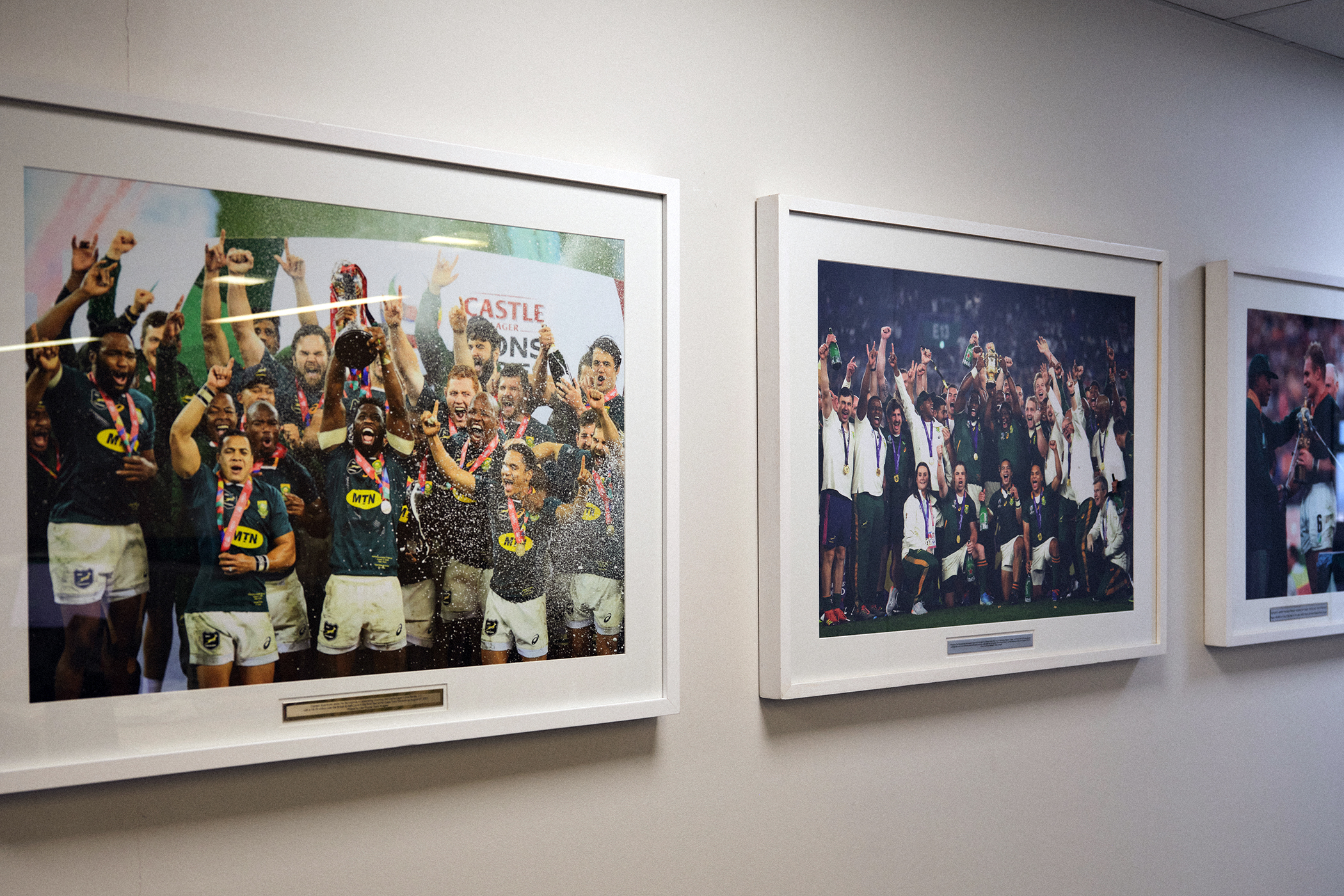
South Africa came back to win 36-34 in a classic, the first win in New Zealand since 2009, a remarkable reversal having lost 57-0 to the All Blacks the year before. That win injected belief back into the squad. A year later, in Yokohama, they were world champions.
Will all of those players make it to Australia in 2027? “The answer is honestly I don’t know,” Erasmus admits. Pieter-Steph du Toit, the two-time world player of the year, has just had surgery on his other shoulder. Malherbe has not played since last April due to a back injury. “We don’t know if he’s going to come back”.
Kolisi, Eben Etzebeth, Cobus Reinach and Franco Mostert will all be in their mid-30s, so the challenge is on to rebuild. For a new wave led by Feinberg-Mngomezulu to take South Africa forward. He instantly reels off a list of prospects - Markus Muller, Ethan Adams, Haashim Pead, Riley Norton. Kai Pratt is an “18 year old surfer, benches 200kg, carries like a demon” – who could be in the mix in the next four years.
Erasmus’s innovations – the 7:1 bench, the traffic lights from the coaches box, calling scrums from a mark – grab attention, but listening to those coached by him, the secret to his success seems to be his honesty.
Almost everything within the Springbok camp is out in the open, partly so information cannot be misinterpreted. Selections announced on a big screen in the team room. Barely any one-on-ones. Erasmus reckons he can only have held 20 in the past eight years. “When you sit with a player alone, after a while you feel sorry for him, or want to tell him something to keep him positive. I don’t think it’s communication so much as being transparent. That’s the secret.”
At times those messages can be excoriating, like the fall-out after losing to Ireland in the pool stages of the last World Cup: ‘You are false. You pretend that you will die for your country but you will not’. Watching it feels excruciating. Imagine being on the end of it.
“Listen, I’ve said many things that I regret. Imagine we didn’t go on and win that World Cup. [People] would say ‘you lost it there’, you lost the team. You were shouting at people, you made it personal. There’s many things I said that didn’t work.” That time, it did.
A personal favourite clip of Erasmus is the sight of him overcome with emotion walking through the airport in Johannesburg after winning the World Cup, wiping away tears before looking up at the hundreds of fans packed into arrivals.
“Have you seen South Africa on a Friday before a Test match? How privileged are we to have that. We can give it back with a performance on Saturday. That’s the drive.”
Erasmus is signed up until 2031. While he remains in post, the Springbok juggernaut will continue to rumble. Just do not offer him an apple.
Photography by Lee-Ann Olwage for The Observer