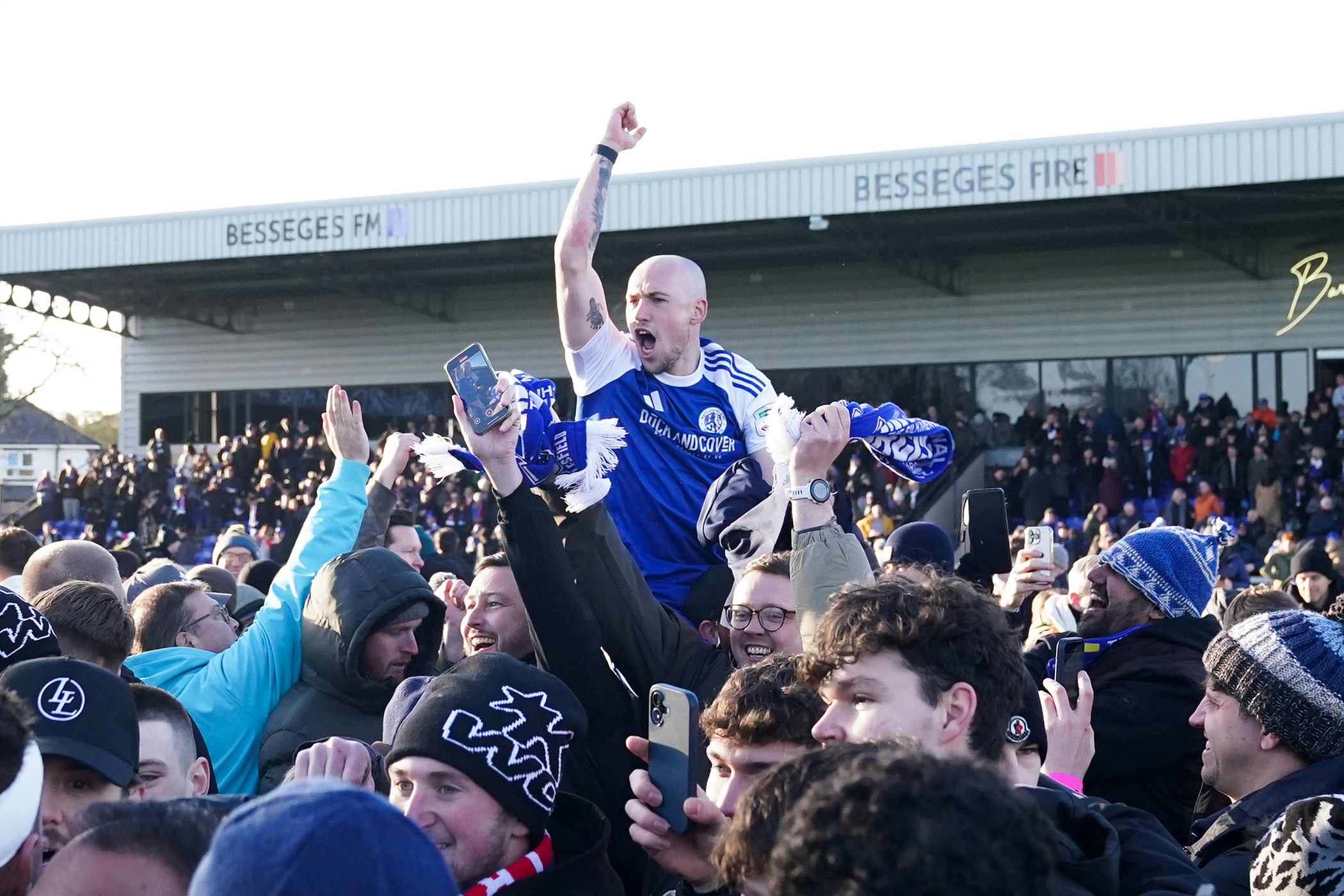



In an age of impermanence, of the immediately gratifying and instantly forgettable, of brainrot and slop, those images will endure. In the foreground: John Rooney, the Macclesfield manager, a study in euphoria. In the background, hovering on the edge of focus: mayhem, hundreds of fans swarming the rubber-flecked pitch at Moss Rose, revelling in a moment that will last forever.
There is, for every generation, a game that comes to encapsulate the indelible appeal of the FA Cup, a memory that is summoned every January to explain the blend of unpredictability and egalitarianism and random chance that characterises the third round of this competition, the one that feels and looks and may as well be magic.
They are so deeply etched in our collective, cultural consciousness that they warrant no more than a word or two of explanation. Boomers have Hereford: the muddy pitch, Ronnie Radford, John Motson. Their successors in Generation X have Bournemouth, conquerors of Manchester United, and Sutton, the non-league giantkillers that eliminated Coventry City.
A couple of years later, Wrexham knocked out Arsenal, the final few minutes lived vicariously through Final Score and Grandstand by those of us who would grow up to be millennials. A decade afterwards, even as lamenting that the competition’s diminishing status had become an annual tradition, Shrewsbury eliminated Everton.
There is, for every generation, a game that comes to encapsulate the indelible appeal of the FA Cup
There is, for every generation, a game that comes to encapsulate the indelible appeal of the FA Cup
The scale of what Rooney and his team achieved at Moss Rose can best be gauged by how familiar all of those games remain. It is more than half a century since Hereford beat Newcastle, almost 40 years since Sutton. Depressingly, it is 34 since Wrexham’s Mickey Thomas and Steve Watkin stunned Arsenal.
Macclesfield’s achievement, in fact, may well outstrip them all. The details were repeated, over and over again, as the minutes ticked by yesterday, an attempt to process the impossibility of what was unfolding. Macclesfield are in the sixth tier. Macclesfield are semi-professional. Macclesfield are 117 places below Crystal Palace in the pyramid.
And yet Macclesfield beat them, and beat them well, to become – deep breath – the first side from the sixth tier to eliminate a top-flight team in the competition’s history, the side to have overcome the greatest difference in league position to win, and the first non-league team to knock out the holders since 1909. The FA Cup does a wonderful line in irony: guess who the giant-killers were on that Edwardian day?
That sort of trivia, though, does not fully capture the extraordinary nature of Macclesfield’s story; reducing their triumph to the raw mathematics of the league pyramid drains the colour from the complete picture. This is a club, after all, that had ceased to exist five years ago, pushed into liquidation by debts that they had no means to pay and expelled from the National League. The Macclesfield that beat Palace might share a stadium, a nickname and a fanbase with that team, but legally they are a separate entity: a phoenix club.
Related articles:
And they are a team who are in the grip of tremendous grief. Ethan McLeod, the club’s 21-year-old striker, was killed in a car accident on the way back from an away game in Bedford a few days before Christmas. He had only joined Macclesfield in the summer, an “absolute diamond of a kid”, as Rooney put it, “the life and soul of the changing room”.
His absence, his team-mates’ pain, hung over the occasion. A banner bearing his image had been placed in the stand; his grieving parents were in attendance. It was McLeod that Isaac Buckley-Ricketts thought of as the final whistle blew, as the fans streamed onto the pitch. “Ethan was here,” he said. Paul Dawson, the club captain, scorer of the first, dedicated the win to him. Overcoming that requires more conviction, more resolve, more courage than can be expressed in a comparison of league positions.
Newsletters
Choose the newsletters you want to receive
View more
For information about how The Observer protects your data, read our Privacy Policy
It is saccharine to the point of cloying, hackneyed to the point of cliché, to ascribe this to the magic of the cup. And a cynic might point out that, in some ways, the new Macclesfield are not an entirely typical non-league team.
Thanks to the largesse of Rob Smethurst, their benefactor – and the unexpectedly astute management, until last summer, of Robbie Savage – their squad contains a calibre of player that does not quite fit with their place in the pyramid.
They might have been the lowest-ranked team left in the competition, but they are by no means the sort of weekend warriors who once stocked even the upper echelons of non-league. Buckley-Ricketts, scorer of the winning goal, was a Manchester City player until he was 20. He was once part of an under-21 team at the Etihad Stadium that contained Phil Foden and Eric García, now of Barcelona. He was a peer of Chelsea’s Tosin Adarabioyo.
Among Rooney’s substitutes were Luke Matheson – who once scored at Old Trafford at the age of 16, while playing for Rochdale – and Cameron Borthwick-Jackson, who played there a little more regularly for Manchester United. Max Woltman, who did not make it off the bench, once featured at San Siro in the Champions League, playing for Liverpool. Their squad contains players who came through the youth academies of Newcastle and Aston Villa, too.
And yet the effect is the same. When Palace won the cup last May, their victory seemed to mark a shift in the competition’s modern identity. It was the first major trophy that the club had ever won. The jubilation, first at Wembley and then on the streets of south London, acted as a reminder of the cup’s appeal, its power; rather than at best a consolation prize and at worst a burden, Palace restored it to an aspiration, something worth winning. Steve Parish, the club’s chairman, described it as an “inspiration”. His team lifting it, he said, was “good for the cup”.
He was right. But the magic works both ways. It will be of no consolation whatsoever now, but Palace losing to Macclesfield is just as much of an inspiration, just as good for the competition’s health, its soul.
Those images – of Rooney, of Buckley-Ricketts, of Moss Rose – will last just as long as their predecessors, as the memories of Radford, Sutton and Wrexham that echo through the years. They will serve, for an entirely new generation, as a shorthand for the glory of this tournament, this weekend. It is Macclesfield they will think of, when they think of the magic of the cup.
Photograph by Martin Rickett/PA Wire