
The first morning of this Adelaide Test, the ground staff had allocated a single pitch on the western extremity of the square for the bowlers’ warm-ups. Onlookers were treated to the incongruous sight of English and Australian bowlers politely alternating, as though involved in a casual bowl off with the same set of plastic stumps.
Except it was no real contest. When he wasn’t unobtrusively smashing the top of off, Scott Boland never strayed wider than a fourth stump line or deviated from a length of between three and five metres. Brydon Carse and Josh Tongue, meanwhile, bounced the ball one way or another, as though the stumps were not there, or in use purely for morale purposes. Just practice, of course. But England have invested a lot in practice on this tour, on the earnest inconsequentiality of nets, and you are urged always to train as you mean to play. Here we go, then…
Fast forward an hour, and Carse was bowling an opening spell featuring four no-balls and four four balls, while Tongue would fade after a promising start. Fast forward a day and Boland was bowling with such precision meanness that Alex Carey could stand up to the stumps, and, in due course, take a quicksilver rebound catch. To paraphrase Bill Woodfull in the corresponding Test of the Bodyline series: both teams are out there trying to play cricket, but one of them seems rather more serious about the skills necessary to succeed than the other.
Basics – they sound like rudiments but are actually fundamentals, preconditions for everything else. To make runs, you must be able to endure; in Australia, it’s usually advisable to defend straight and score square. To bowl to a plan, you must have a reliable stock ball; in Australia, the ideal comes through around bail height, compelling a stroke. It’s not as vibey as strike rates and speed guns; still, cricket here is won not by “style” but by substance, by batters outlasting bowlers, by bowlers harrying batters, by consistency, discipline and fitness generally. It hardly matters whether Carse is an “absolute warrior” when he struggles to bowl consecutive deliveries in the same place; Tongue may have a taste for “rabbit pie”, but execution proverbially eats strategy for breakfast. Will Jacks, meanwhile, indicts an entire system – a placeholder for nobody. That’s before we even start on the batters.
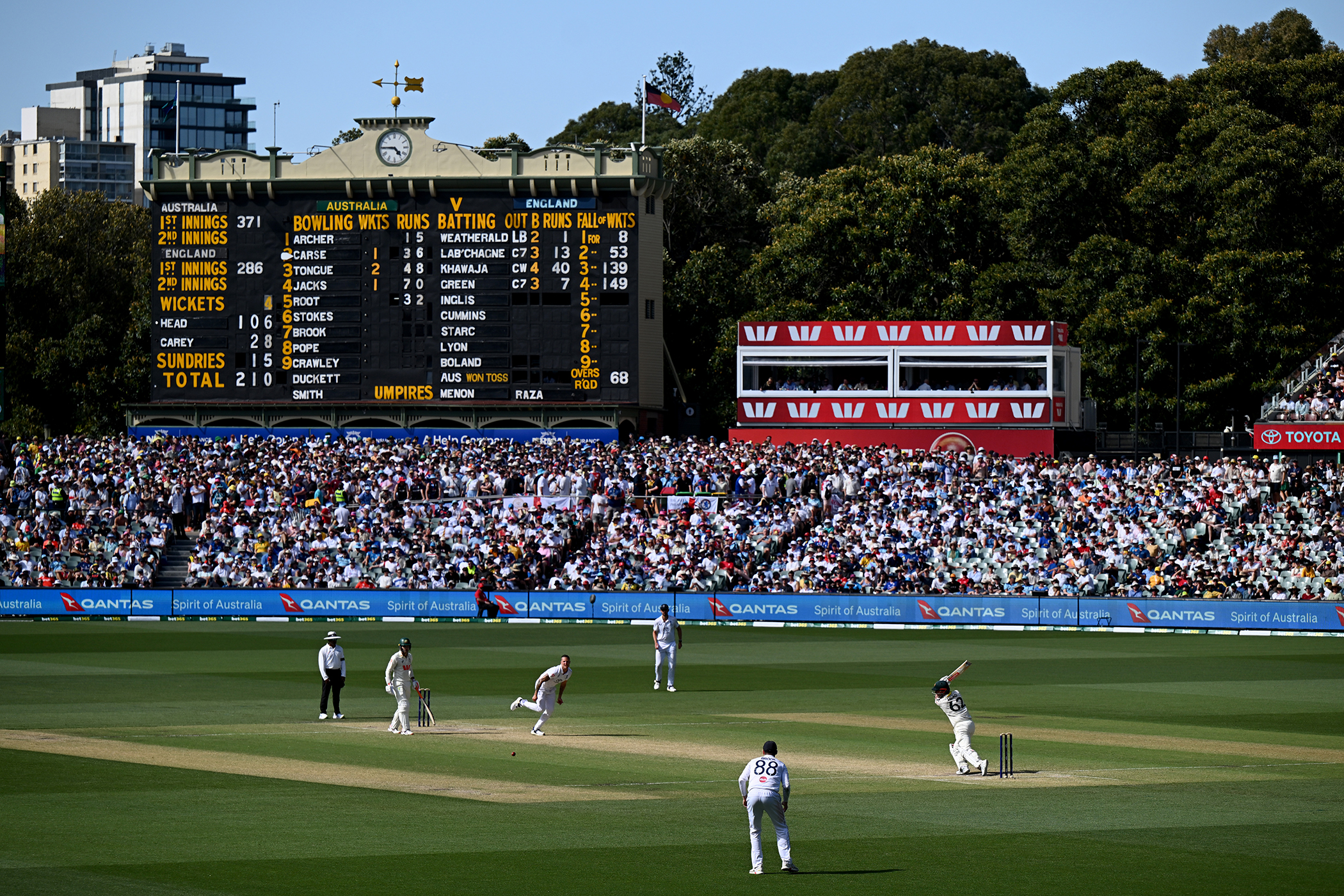
This third day of the third Test at Adelaide Oval, theoretically the mid-point of the series, again concerned basics. Though frustrated for an hour and a half by Ben Stokes and Jofra Archer before lunch, Australia’s bowlers never allowed them free rein; though checked every so often, Australia’s top order went methodically about building partnerships and turning the strike over through the afternoon. The home team was in no hurry but hardly had to be. The visitors were not ragged so much as fraying, contriving only three maidens in 66 overs. There was a touch of shadow boxing about it. Archer, England’s swiftest bowler, was rationed to 60 balls; Stokes, England’s most successful bowler of the year, did not bowl. But at the close, Australia’s lead had swelled inexorably to 356.
Related articles:
Homecoming hero Travis Head took advantage of England’s third-innings blues to peel off a chanceless hundred, his fourth in consecutive Test matches here. It had all the ease of a Sunday stroll – he even performatively walked singles to the far-flung field, as if about to start flicking the heads off daisies with a walking stick. Stokes lurched from plan to plan against him, without his bowlers suggesting the perseverance or potency to make them count. Tongue bowled with a 7-2 field, which Head still pierced when gifted a wide half-volley; Carse bowled with a 3-6 field, which Head cleared with a six to long leg; Jacks bowled with a long-off, so Head lofted for six over long-on.
The advent of Alex Carey, patriotic heartthrob of the first innings, doubled the local fun. One lost count of the number of runs scored through the unpopulated gully, even as the pace bowlers hit a length to cut and slash. When Harry Brook was finally posted in this vicinity, he dropped a straightforward chance, unaccountably moving out and in. An attempt to court popularity perhaps – Head was on 99. He advanced to his 11th hundred next over in the grand manner, with a six back over bowler Joe Root’s head.
There were further capers with the DRS, after two days in which Snicko, presented as a Cray supercomputer, has turned out to be a Mechanical Turk. This time it was Jake Weatherald electing not to use it when adjudged lbw, perhaps for fear of being given out hit wicket. Turned out he should have – the system is in players’ heads now, and not in a good way.
The big screen was turned to other purposes, throwing forward by listing the highest fourth innings to win at Adelaide Oval, by England, by anyone, in the western spiral arm of the galaxy etc. Not so long ago, in Bazball’s palmiest days, this would have been regarded as a challenge. Yet even as they have preened as lions at home, England have become lambs away – defeat here would be their 11th in their last 15 on the road. It’s not time to get bitter, but it might be to at least try getting better.
Photograph by Gareth Copley/Getty Images