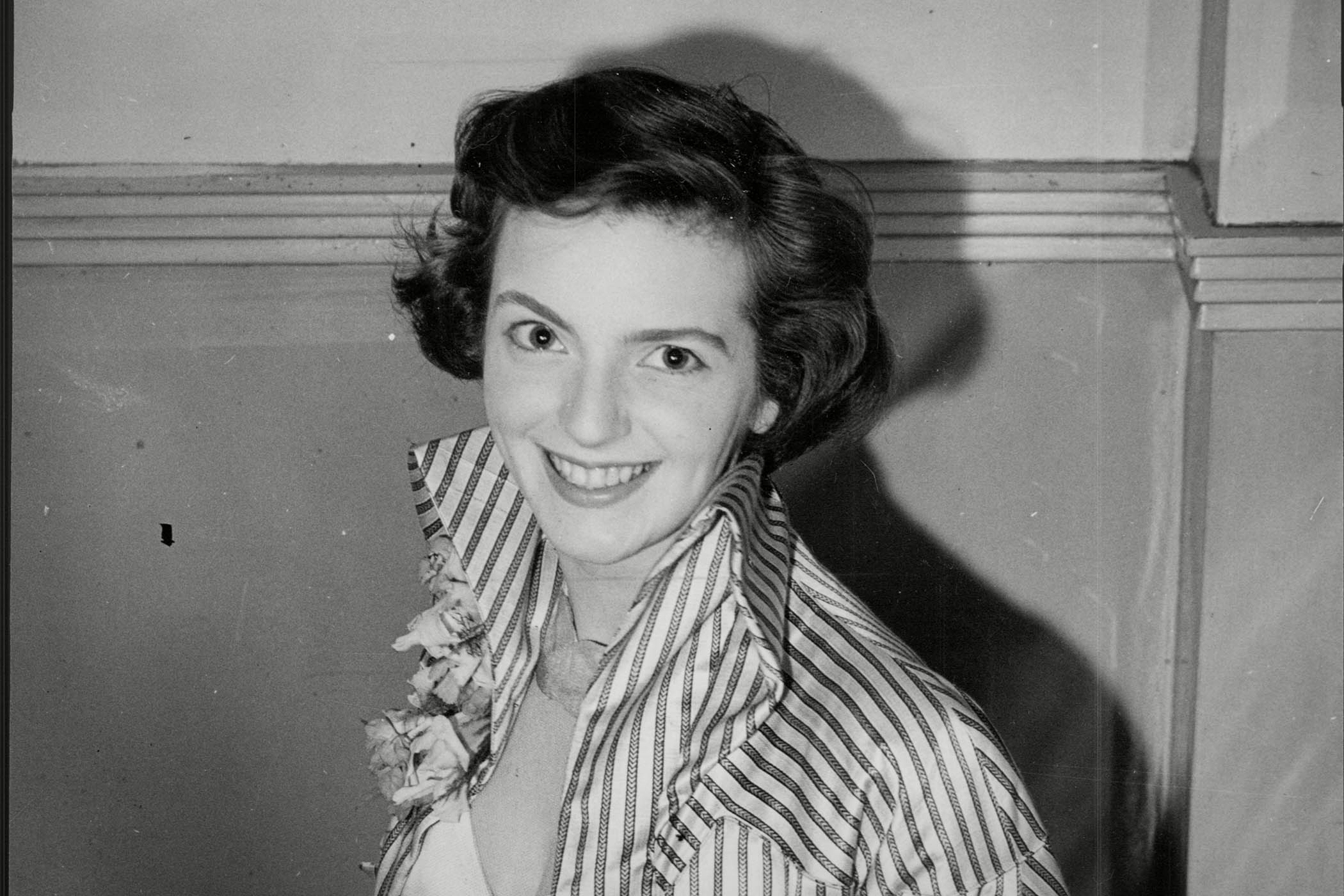

At the wedding in 1950 of June Flewett and Clement Freud, grandson of the psychoanalyst Sigmund Freud, it was the bride who had top billing. “West End star marries cook,” ran one headline. Under the stage name Jill Raymond, she had made a successful start to her career after studying at Rada, where her fees were paid by the author CS Lewis, with whom she had stayed as an evacuee during the war.
She had appeared on stage with Michael Redgrave and on screen with Jean Simmons and was starring with Ralph Richardson in RC Sherriff’s Home at Seven when she met the catering manager of the Arts Theatre Club in Soho. It was a whirlwind romance: they met in April, Freud announced their engagement in June (before he had even asked her to marry him) and the wedding was in September
Jill Freud’s acting career stalled. She narrated a children’s television series called Torchy the Battery Boy from 1959-61 but as she raised five children of her own, including the future public relations executive Matthew and the broadcaster Emma, and her husband’s career in writing, broadcasting and dog-food commercials took off, her name appeared in lights less often.
By the time that Freud was elected MP for the Isle of Ely in 1973, the billing had reversed. “MP’s wife in play” was the headline when she appeared in The Dame of Sark in Oxford.
Once her children had grown up, she returned to the theatre, forming a repertory company in 1980 and staging a season of five plays in Southwold, on the Suffolk coast, every summer from 1984 to 2010. On the first opening night, Freud told guests: “I have lost a wife this summer but Southwold has gained a theatre. It is a sacrifice which I make with the greatest pride.”
“There was so little work for actors and it dawned on me that you don’t have to sit at home waiting for someone to call,” she said in 2007. “You could do these things for yourself.” She was proud of providing summer work for a cast and crew of 70 and happy to muck in with cleaning toilets, scrubbing floors and making beds.
She also continued to perform, tap-dancing in Richard Harris’s Stepping Out at almost 80 and playing Madame Arcati in Blithe Spirit in 2003. Libby Purves described this “tireless doyenne of rep … hurling herself to the ground nightly, in a manic trance”, adding: “She looks, infuriatingly, about 52.” The same year, she had a cameo as the Downing Street housekeeper in Love Actually, written by her son-in-law, Richard Curtis.
June Beatrice Flewett was born in 1927, the daughter of Winifred and Henry, a classics master at St Paul’s, and attended convent school, where her first acting role came aged five in Little Miss Muffet. “I was well cast as the spider, being extremely thin with long hairy arms,” she recalled. Four years later she appeared in Alice in Wonderland in front of the Bishop.
Related articles:
That play came back into her life in 1940, when she was evacuated to Oxford and stayed with three ageing spinsters who said they had been “Lewis Carroll’s girls”. While it has been assumed these were the Liddell sisters who inspired Carroll’s book, only one was still alive at this stage. However, Flewett soon became her own literary muse when she moved in 1942 to stay with an Oxford University academic.
Flewett was not at first aware that “Jack” Lewis, as her host was known, wrote under his initials of Clive Staples. “Two weeks later, I saw his books on the shelf … and realised that this man I was staying with was my literary hero,” she said.
Newsletters
Choose the newsletters you want to receive
View more
For information about how The Observer protects your data, read our Privacy Policy
Lewis encouraged her interest, taking her to tea with JRR Tolkien and promising that she could buy any book in Blackwell’s and put it on his account. In 1944, she returned to London to sit her school certificate but went back to Oxford and worked as his housemaid. Lewis then paid for her to attend drama school.
Lewis published The Lion, the Witch and the Wardrobe, which would become the first of his Narnia chronicles, in 1950. More than 50 years later, his stepson wrote to Lady Freud, as she then was, and told her she was the prototype for Lucy, the youngest and kindest of the Pevensie children. In 1945, Lewis had written to her mother: “I have never really met anything like her unselfishness and patience and kindness and shall feel deeply in her debt as long as I live.”
The Freud marriage was long and complicated. In 2001, it was reported that she’d had a five-year affair in the 1970s with Jonathan Self, brother of the author Will Self, that began when he was 16. In 2016, it emerged that Clement, who had died seven years earlier, had allegedly sexually assaulted a number of women and underage girls, including one who had been living with the family. June Freud said that she was “shocked, deeply saddened and profoundly sorry for what has happened”.
Emma Freud said her mother was “feisty, outrageous, kind, loving and mischievous”, recalling that during the Covid lockdown she had taken part in a tap class every morning.
Her granddaughter, the writer Scarlett Curtis, called her a “force of nature [who] flirted, drank and laughed until the end”.
Twenty years before she died, Freud had reflected that her children were lucky. “They haven’t just got the highly sensitive, neurotic, hugely intelligent Freud genes,” she said. “They’ve also got mine.”
Jill Freud, actor, was born on 22 April 1927, and died on 24 November 2025, aged 98
Photograph by ANL/Shutterstock