
I have always loved the taste of apples, and it all started with juice. When I was a child, apple juice was a treat only available some days after school. It came in a cardboard carton, the kind you opened by peeling off a piece of foil. It was “from concentrate”, thick with sugar, precious and delicious – and something my sisters and I fought over constantly.
To avoid squabbles and inevitable disappointment, we rationed it – half a glass was our daily limit – to make sure there was enough to go around. We still affectionately call this a “Crosbie measure”, and to this day I cannot pour myself a full glass of juice without feeling the prickling of guilt, in much the same way I can’t bring myself to eat the last piece of salami from the packet when I’m home for Christmas. Experiences like these were limited by necessity – apple juice was expensive compared to cordial and, therefore, a treat – but they were also the early life events that fired the part of my brain that connected flavour with pleasure. They taught me the vital trait of savouring brilliant things.
These days I still search for apples in the drinks I love the most. Entry-level white Burgundy sings of green apple and yellow pear, and I love the texture of red apple skin in some English sparkling wines and champagnes dominated by red fruit. The warming spice of calvados in the winter. And dry, dry cider, like liquid gold.
It’s funny to think you continue to love the same things you did as a child
It’s funny to think you continue to love the same things you did as a child
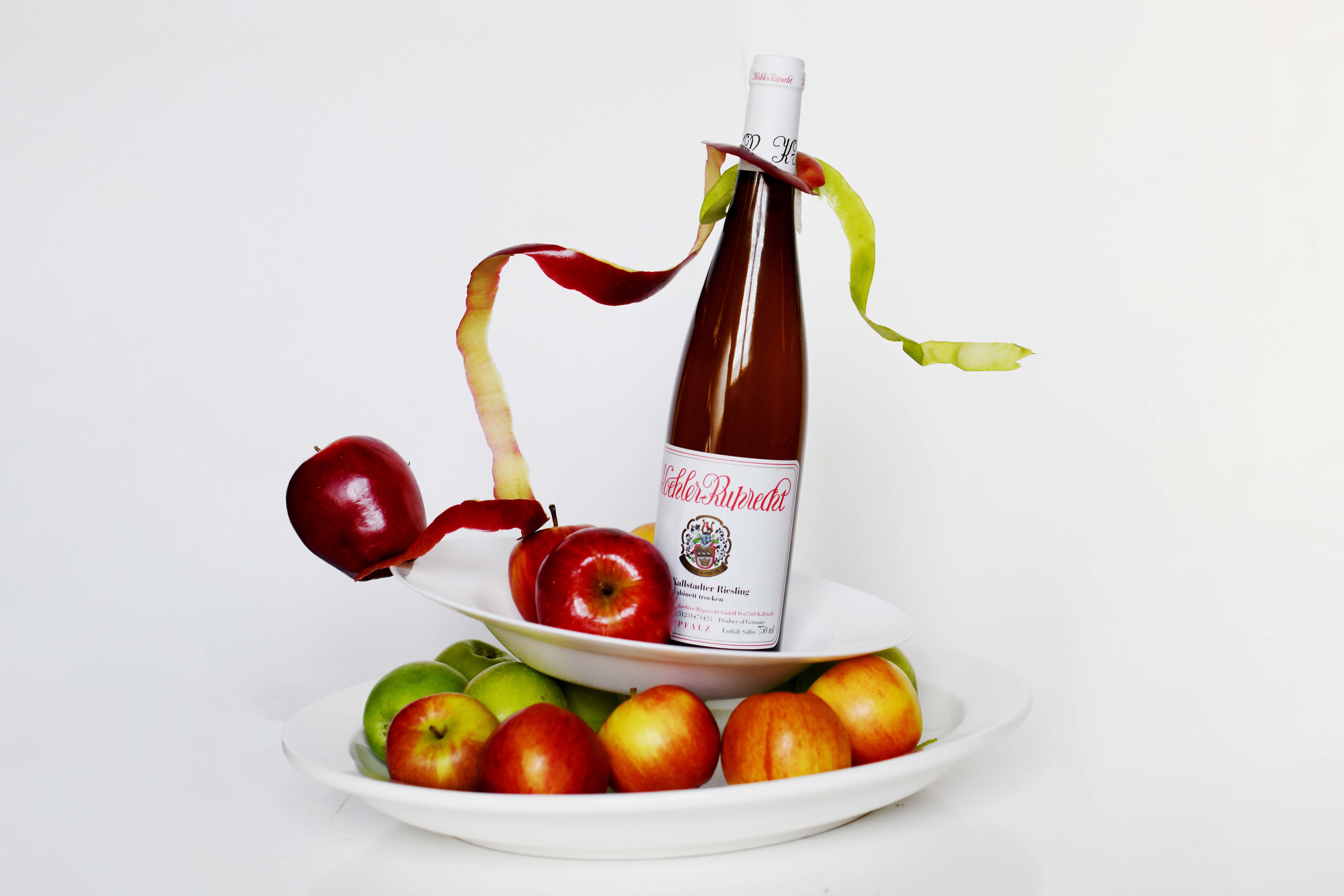
It’s funny how far you think you and your tastes have come, only to realise you continue to love the same things you did as a child. I remember once finding the sweetness of apples at a date I had at Rochelle Canteen, the London restaurant. We had ordered a Koehler-Ruprecht Kabinett Riesling, which I found incredibly familiar. When you’re learning about grape varieties, you’re taught that kabinett rieslings – the driest style on the Prädikatswein classification, a scale that indicates sweetness levels in German wines – show notes of crisp, high-acid green apples. This wine was so well defined it felt like turning over an apple in my hands, and it instantly reminded me why I adore that particular grape.
All of the above is suggestive of a well-trodden reason for why we drink: the way all kinds of drinks – apple juice or wine, beer or spirits – relate directly to us and our own experiences of the world. We all drink in our own specific ways and for our own specific reasons, and often for reasons that link to our unique memories and internal worlds. But I think what we drink and how we drink can paint a much broader picture: about our place in the world, about the people we are now and the people we want to be, about how much money we have, where we live, what we consider cool and what we consider uncool. They can tell us, too, which way the pendulum is about to swing. Why is everyone suddenly drinking Guinness? Might Newcastle Brown Ale be next?
Our choices tell us much more besides. Why did we add a specific wine to our basket? Was it because we received a book on Italian grape varieties as a recent birthday gift? Because a sommelier’s smart decision ignited in us a new obsession? Because we saw it as product placement on a major television series? Because we saw it being duped on TikTok? Or are we simply drinking it because our friends are? All of these questions are worth exploring, and this column will be the place for it.
Related articles:
Newsletters
Choose the newsletters you want to receive
View more
For information about how The Observer protects your data, read our Privacy Policy