

When chefs talk about the places they love to eat, one perhaps surprising name comes up time and again: Brawn, a neighbourhood restaurant on Columbia Road in east London. “It’s your favourite restaurant’s favourite restaurant,” Gabriel Pryce, co-owner of Rita’s, in Soho, told me recently. He was adamant that it is also the most influential restaurant in London.
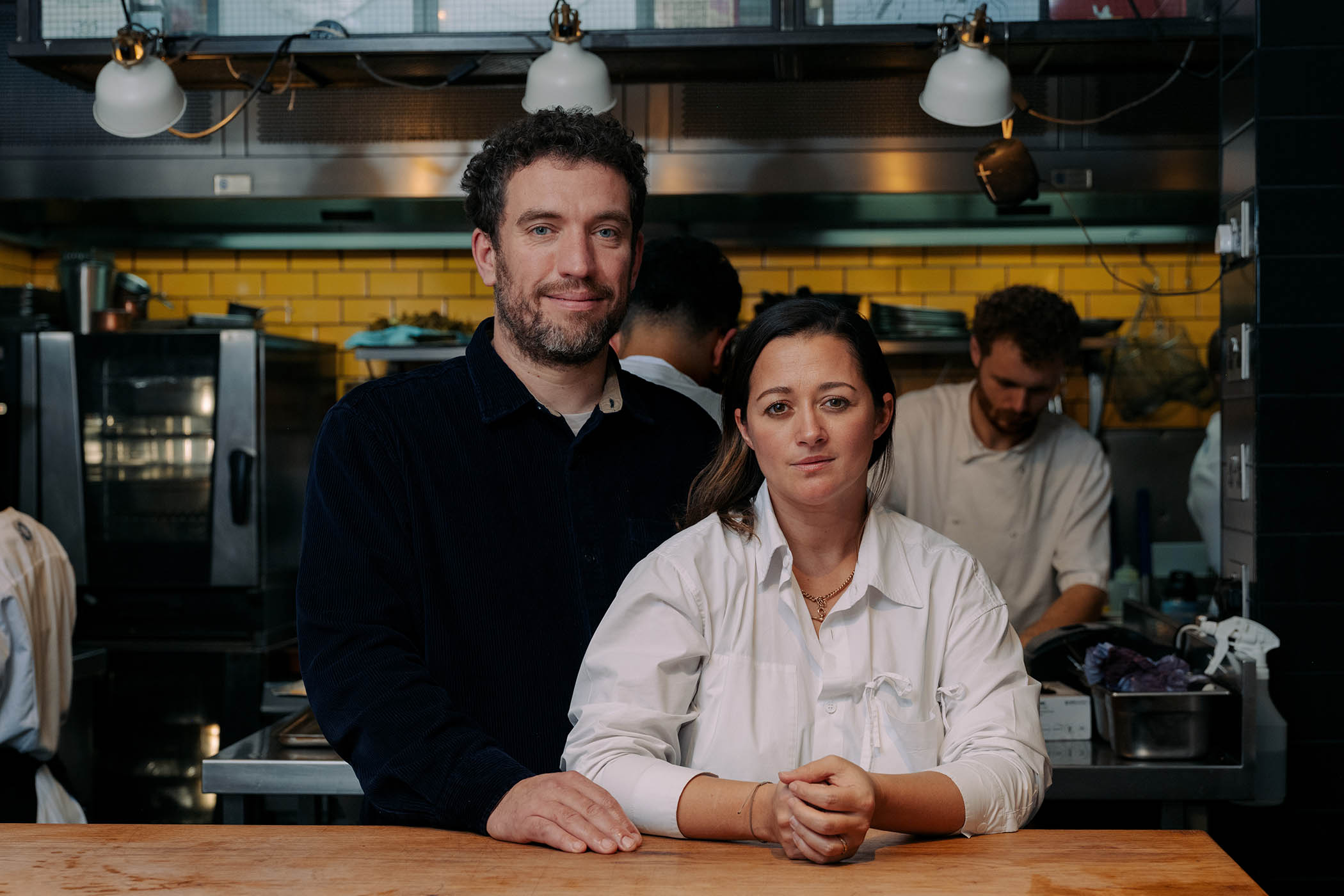
Brawn turned 15 at the end of last year. It has been run by the 49-year-old chef Ed Wilson since its inception, and latterly with his partner Josie Stead, who oversees front-of-house operations. When I bring up Pryce’s comments, Wilson seems warmed by the praise. He recalls making his take on a classic beurre blanc for Tom Kerridge, who took him aside to tell him it was (cue Kerridge impersonation): “A three-star sauce, that sauce.” Kerridge later re-appropriated the recipe, with a nod to Wilson, for a dish in his Hand and Flowers Cookbook.
Another time, Wilson cooked for Russell Norman and Tom Oldroyd and chatted with the pair about the casual Venetian restaurant they planned to open. That became Polpo, the spot that popularised the small-plate trend that dominated the British food scene during the 2010s. Norman, who died in 2023, always credited that meal with Wilson as a lightbulb moment.
Not everyone, it should be acknowledged, has fully appreciated what Wilson is doing. He remembers when a very celebrated French chef (whom you’ll 100% have heard of, but who Wilson is too discreet to name) came to Brawn. At the time, Wilson was obsessed with mozzarella and was engaged in a slightly deranged enterprise where he would have a few balls flown over from Italy at great expense every Friday afternoon and, crucially, never refrigerated. These would then be served on Saturday lunch: single 125g milky-white spheres on a plate, all squeaky and chewy, with just a drizzle of Sicilian olive oil.
The dish summed up everything that Wilson believes outstanding food should be: superior produce treated with reverence. But the French chef was confounded. “He couldn’t get his head round it,” Wilson says, laughing at the memory. “He was like, ‘What else are you serving with it?’ Afterwards he came to me and said, ‘That mozzarella – Wilson mimics a confused headshake – it was very, very hard.’”
Did the response make Wilson question his principles? “It made me reflect in a way, and obviously I’m very sorry he didn’t enjoy it,” he replies. “But hopefully at some point in his life he’ll have a real mozzarella, maybe he’s in Naples and he’ll eat one, and that might trigger a memory of like, ‘Oh, fuck, I had that, but I didn’t get it at the time.’”
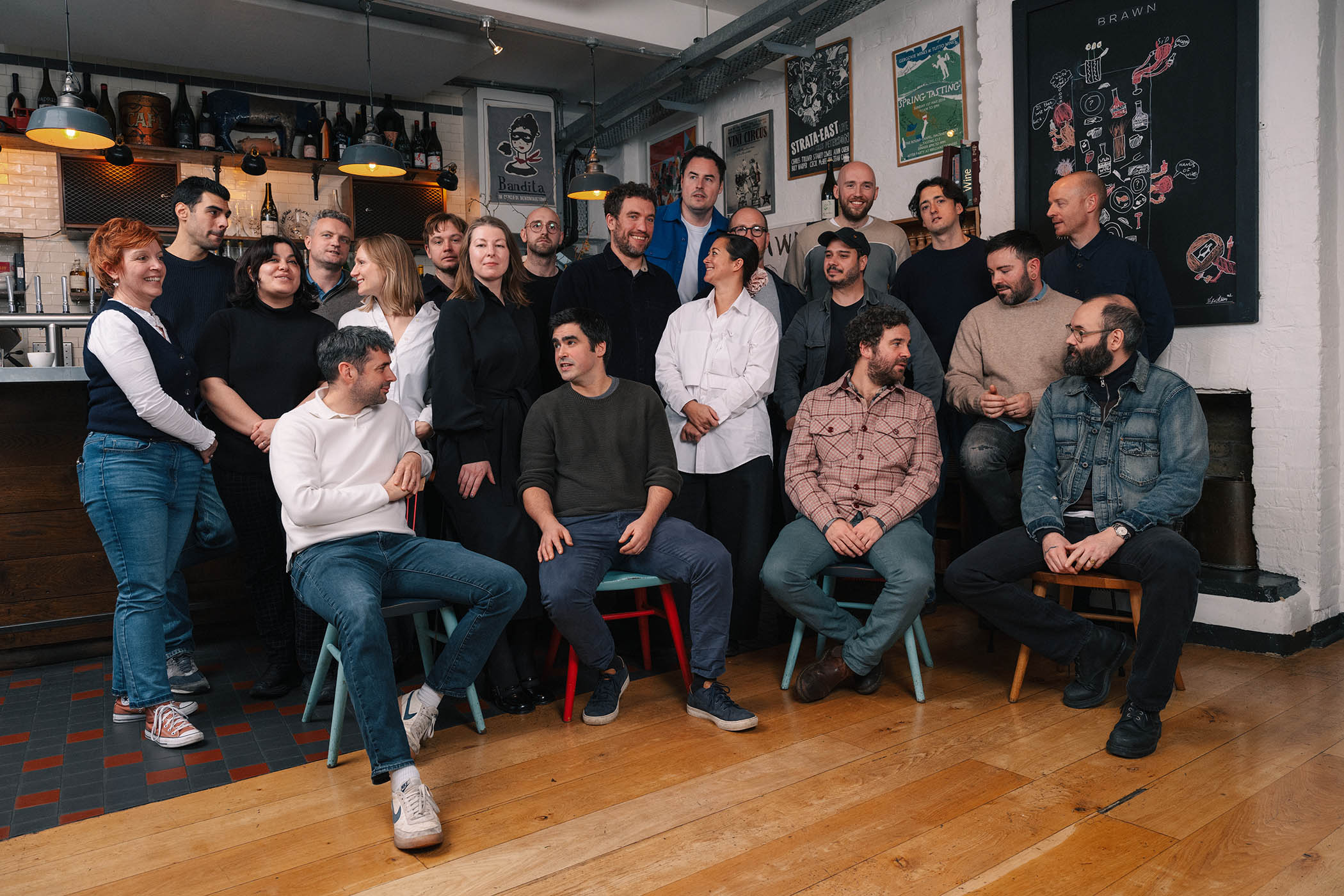
The Brawn alumni: (from left) 1. Cécile Mathonneau 2. Damiano Fiamma 3. Dara Klein 4. Owen Kenworthy 5. Rob Sachdev 6. Sara Thomson 7. Alex Whyte 8. Anna Frost 9. Chris Trundle 10. Doug Rolle 11. Ed Wilson 12. Michael Lavery 13. Josie Stead 14. Oli Barker 15. Giuseppe Belvedere 16. Will Gee 17.Cavan O’Keeffe 18. Jono Wingfield 19. Patrick Campbell 20. Wesley Triggs 21. Gabriel Pryce
It’s a rainy December morning and I’m sitting at a corner table at Brawn with Wilson and Stead, just before the couple hosts a lunch party to celebrate the restaurant’s 15th birthday. In the early days, the tables were named after the regulars who used to eat there. Back then, the one we’re sitting at was called Arctic. “Alex Turner lives round the corner and the Arctic Monkeys used to come here,” Wilson says. “Well, he still does, but it’s not called Arctic any more, it’s called table four.”
The change was initiated by Stead, who joined Brawn in 2017 after relaunched the Quality Chop House in Farringdon. “We’re a bit more traditional now,” says Stead, who grew up in Australia and still has faint traces of the accent. “Without changing the culture too much.”
Related articles:
For the birthday lunch – a gigantic cassoulet made by Wilson – two dozen Brawn alumni have made their way to east London from the likes of Bath, Manchester and Cork. Apologies for non-attendance have come from former staff who now run restaurants in France, Melbourne, Winnipeg and Auckland.
The London restaurants that are perhaps most famous for incubating young talent are the River Café in the west, St John in the east, and Gordon Ramsay at Royal Hospital Road – and this is correct, certainly in the fine-dining sphere. But Brawn has quietly, stealthily become a place of pilgrimage for dozens and dozens of aspiring chefs and restaurateurs looking to perfect a refined but relaxed neighbourhood vibe.
One of these is Dara Klein, who worked at Brawn on and off for two years until 2020, and this month opens her own restaurant, Tiella Trattoria and Bar, also on Columbia Road in Hackney. “For any chef who is cooking produce-driven modern European or modern British food, it’s something of a mecca,” she says. “It’s a restaurant that gives you a blueprint for how you should carry on as a chef.”
Pryce believes there are “at least” 50 restaurants just in the capital whose kitchens can trace a direct lineage to Brawn. Jeremy King, the fabled London restaurateur, who brought Wilson in as a chef to open the Wolseley in 2003, describes him as “a beacon of calm, but obsessively dedicated to food and someone who was clearly bound for success.” He goes on: “I was so sad to inevitably lose Ed, but thrilled for him and the London restaurant scene, which he continues to enrich.”
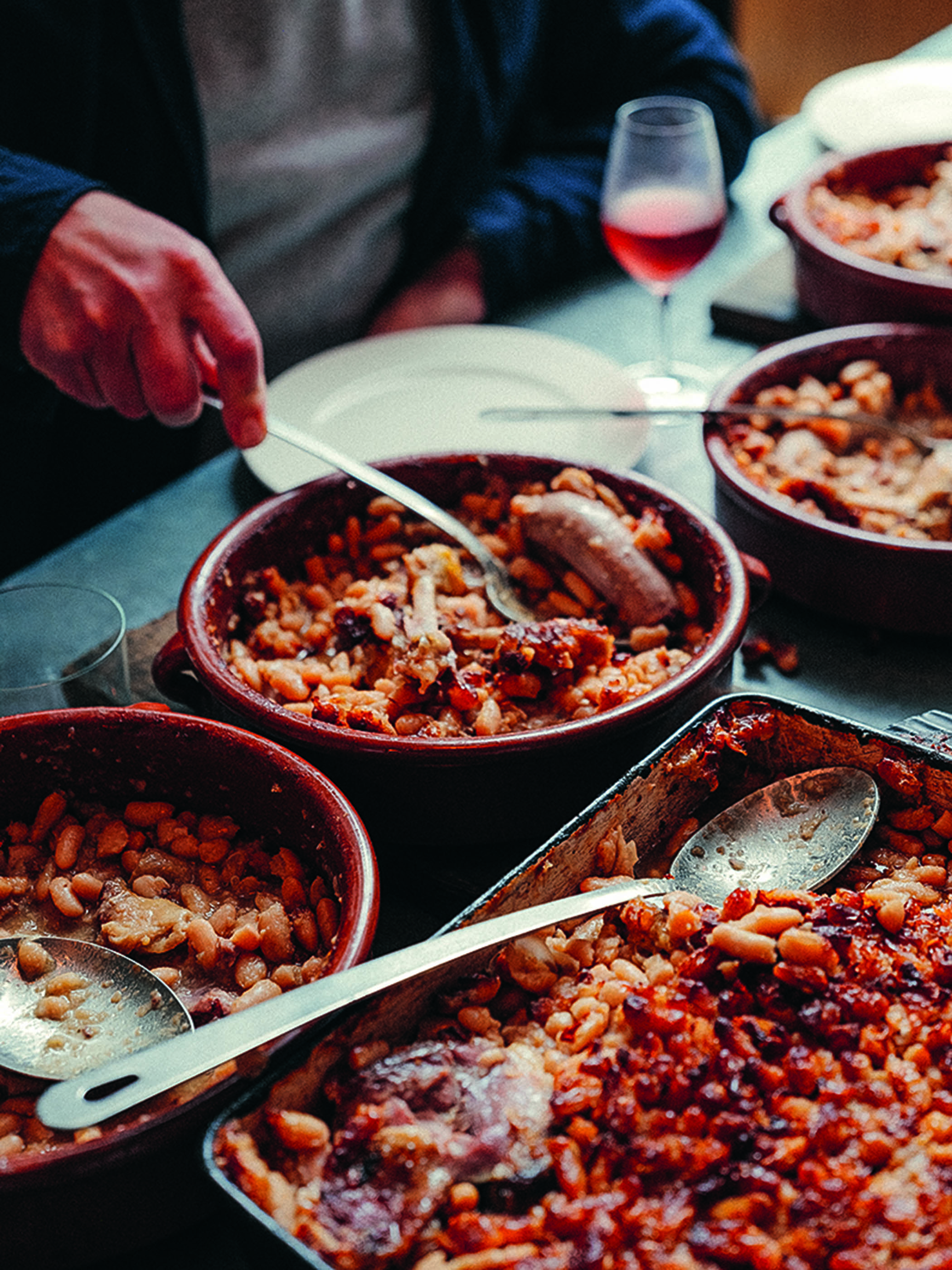
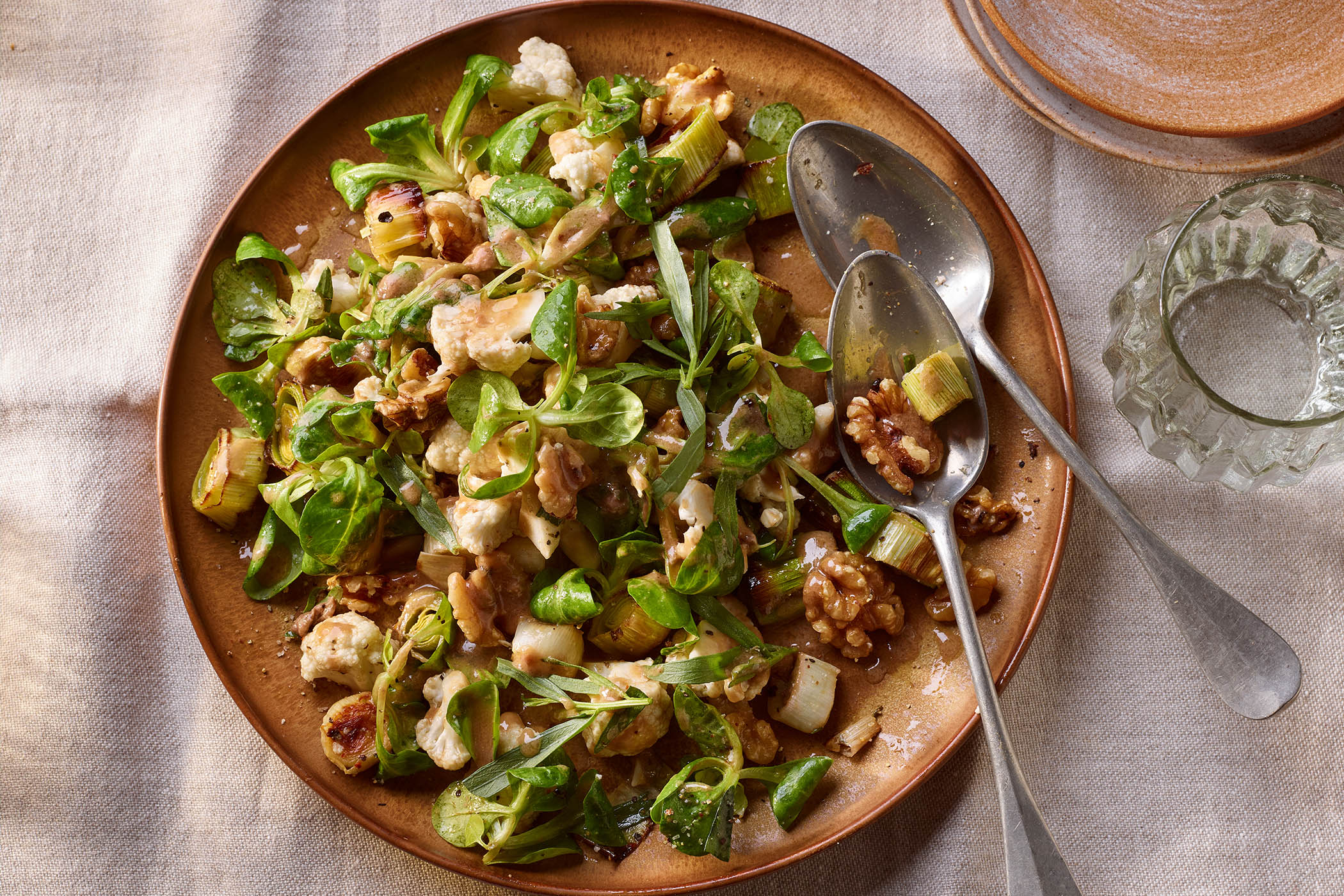
Full of beans: the huge cassoulet made by Ed Wilson to celebrate Brawn’s 15th anniversary
Wilson, whose tendency is to deflect compliments, reluctantly concedes that, a decade and a half in, Brawn has made its mark. “I would call it under-the-radar influential,” he says.
The turnout this inclement morning is a clear indication of the affection a generation of workers in hospitality holds for Wilson and Stead. It’s also a reminder of the far-flung reach Brawn has had. “I always say it’s a neighbourhood restaurant with a worldwide audience,” Wilson says.
Brawn’s opening in 2010 coincided with a dramatic upturn in the quality of produce available to British chefs. Wilson had been schooled in classic French cookery, but he found that many of those techniques could be used more sparingly. “You really were getting much fresher ingredients, every day,” he says. “You didn’t have to transform it, cover it in butter, to make it taste good.”
Brawn settled on a style that Wilson calls “elevated comfort food”. He says: “For me, life is about benchmarks. Everyone remembers the best steak they’ve ever eaten. I’m always in pursuit of giving people the best example of something, so it becomes their reference point. I think that’s a nice way to cook things.”
Brawn isn’t the first time that Wilson has shifted the dial on the British restaurant scene. That happened in 2008, when he was brought in as head chef of Terroirs, a new wine bar in London’s West End that specialised in low-intervention wines. Natural wines were beyond niche at that time in the UK, but from Terroirs’ large zinc bar you could be served 450 obscure varietals, including orange sauvignon blancs, chilled reds and not a single bordeaux. The weirdest wines came – for reasons best known to the Terroirs team – with a horse symbol next to them on the menu.
Wilson, who had previously cooked at Galvin as well as the Wolseley, had to come up with a menu that paired with Britain’s most bewildering wine list. His hand was forced by the space, a tiny “pocket” kitchen that demanded simple, fast, small plates, such as you might find – if you’re lucky – in a Parisian bistro. Terroirs was an immediate hit, especially with critics and chefs, such as Heston Blumenthal and Gordon Ramsay, who came to check out its unfussy bacchanalia and enjoy its famous lock-ins. That’s also where Wilson met Russell Norman.
‘It’s your favourite restaurant’s favourite restaurant’
‘It’s your favourite restaurant’s favourite restaurant’
Gabriel Pryce
Did Terroirs receive enough credit in the small-plates origin story? “No, I don’t think it did,” says Wilson, though not huffily. “Russell did a great job with Polpo. Sadly it took his passing for the reference point of what he’d created to be acknowledged. All of a sudden it was, ‘Russell Norman created the small-plates phenomenon.’ And I go, ‘Yeah, he did, but he saw it first at Terroirs.’”
Wilson is also enough of a food historian to know that there are very few truly original concepts in restaurants. The small-plates idea clearly owed a debt to what the French call “cuisine du marché” or “cooking from the market”, a term popularised in the 1970s by the legendary Lyonnaise chef Paul Bocuse. Before setting up Terroirs, Wilson became obsessed with traditional Parisian bistros and wine cellars, such as Racines and, especially, Le Verre Volé in the Canal Saint-Martin district, with its rickety tables, unexpectedly delicious food and staff who very casually seemed to know about and had sampled everything in the vast wine cellar.
“Terroirs became hugely successful without any rhyme or reason,” Wilson says. “We didn’t go there with a masterplan; it was just this perfect Venn diagram of food, wine and service, and it created this magical little spot.”
Looking back, Wilson accepts he should perhaps have capitalised more on the popularity of Terroirs: written a cookbook, rolled out four or five Terroirs across London.
“But you’re much more of a head-down rather than a front-facing chef,” says Stead. “I don’t think you guys shouted about what you were doing.”
“We were too busy,” Wilson says. “And I just… I don’t chase that. We didn’t want to build a brand.”
From Terroirs, Wilson and his business partner, the wine importer Eric Narioo, opened Brawn. There was a clue in the name, and in the beginning, the menu “probably was quite meaty”. But over the years, Wilson thinks the food has evolved and now has “a balance of much lighter touches”. In 2012, Wilson and Narioo also collaborated on Green Man & French Horn, a Covent Garden pub that served only food and wine that had connections with the River Loire in France. It is closed now, but retains a special place in Wilson’s heart. “It was the best project we did, in a way, because it was so focused,” he says. “It’s this example where, by actually limiting yourself, you discover more.”
‘It’s the restaurant that gives you a blueprint for how you should carry on as a chef’
‘It’s the restaurant that gives you a blueprint for how you should carry on as a chef’
Dara Klein
In all of Wilson’s ventures, wine has occupied just as central a part of the concept as the food. That might not sound unusual, but the degree to which he fixates on how they come together on a menu probably is. “Where I probably stand out, slightly different to a lot of chefs, is the fact that I appreciate wine as much as I appreciate food,” he says. “When I’m cooking, I’m always thinking: ‘What am I going to drink with this? How’s that going to pair?’”
Andy Ainsworth, who worked with Wilson as a sommelier at both Terroirs and Brawn, before moving to the Central Victorian Highlands in Australia, where he opened a restaurant called Bistro Merenda and started to make wine, agrees. “Lots of chefs want to show what creation they can make, and lots of restaurants operate with the back-of-house and front-of-house quite separate,” he says. “But at Brawn it was totally different. I’d never met someone who understood the intrinsic, cultural link between food and wine at the table as Ed did. He taught me that it’s more than just a plate of food and a glass of wine – there’s a story behind all of it and that has to be given the utmost reverence. It became the way I live my life.”
Back at Brawn, guests have started to arrive for the birthday lunch, including colleagues from the earliest days. The atmosphere of the reunion is a little stilted at first – “It’s like a school photo,” says one, as the group pose awkwardly for a portrait – but it quickly loosens up, probably not unrelated to the opening of many bottles of very good wine. The party will end, hours later, at a club in Dalston called Om, where Wilson DJs and hosts a night every Monday. Wilson’s primary concern when we speak is how a big lunch of cassoulet, a famously gassy food, will digest, and he wafts a hand under his nose.
It’s clearly an emotionally charged occasion, not least for Wilson and Stead, whose relationship started in 2012 when Stead was a regular at Brawn. “I lived around the corner and I’d come on a Monday night and sit at the bar on my day off and have a plate and a glass,” she says to Wilson, “and that’s how I met you.”
“There we go, that’s a different story,” smiles Wilson. “What’s interesting is that everyone has such fond memories of this restaurant. And it’s not just about what they ate, but the actual place. People have met their partners here, they’ve had children after coming here. It’s just the space.”
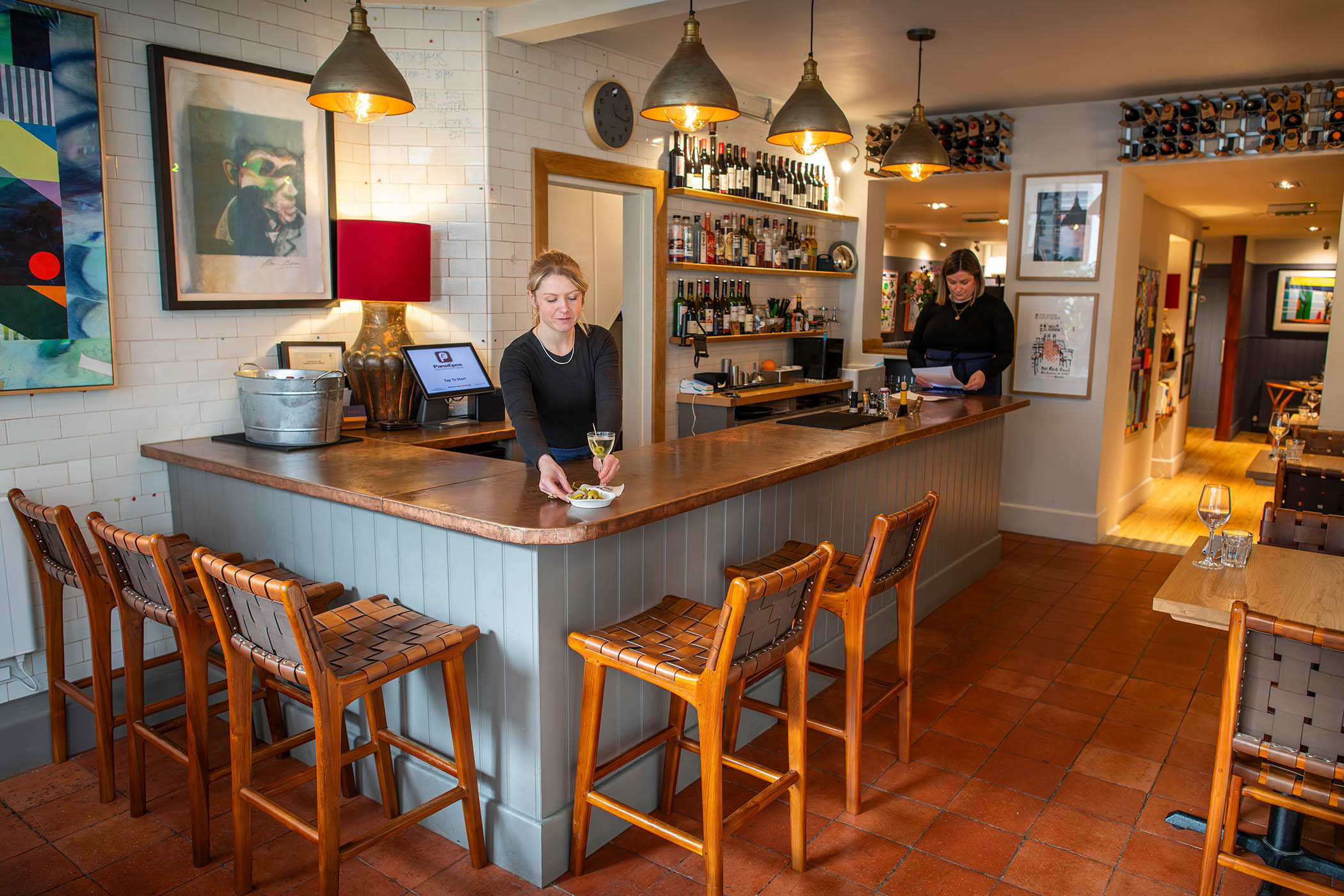
Wilson is right, the space is excellent: light-filled during the day, moody and romantic at night. The couple lives round the corner and have two children now, and Brawn has effectively become their dining room. “We leave there, we come here, it’s like walking into our other home,” Stead says.
‘Ed continues to enrich the London restaurant scene’
‘Ed continues to enrich the London restaurant scene’
Jeremy King
The fondness and regard for the couple from former staff members is effusive. Among them is Rob Sachdev, who was senior sous chef at Brawn from 2018 to 2021; he now runs Landrace in Bath. “The confidence Ed has just to serve five anchovies on a plate,” he says. “It was like, ‘Wow!’ Nobody was doing that at the time, but now everyone does it. And it’s such a delicious start to a meal. His understanding of good produce and being proud to just serve it as is, is quite special.”
“Anyone who has worked with Ed and Josie leaves with a deep knowledge of product, a love for the very best produce presented via classic recipes and an uncompromising approach to wine and service,” says Ainsworth. “How could you not? It’s the Brawn DNA!”
Pryce, who worked at Brawn for six months in 2017, credits his stint with changing his approach to food. “There’s a confidence to say, ‘I know this is delicious and I’m pretty sure that you’ll also agree it’s delicious,’” he says. “Brawn is one of my favourite restaurants of all time.”
Both Stead and Wilson are clearly revered as mentors. “Ed’s a formidable force to be reckoned with, he really is,” Klein says. “He’s a perfectionist, but there is a massive heart. And the word I would use to describe both of them is ‘integrity’. I’m proud I worked at Brawn. It’s a restaurant that provided me with a really solid foundation to my craft.” She thinks that many staff who have passed through would see Brawn as the “mothership”.
Wilson is in many ways the antithesis of the celebrity chef: everyone I speak to mentions his unusual lack of ego. He is firm in the kitchen, demanding the highest standards, which goes some way to explaining why Brawn has produced so many talented, ambitious chefs and front-of-housers. “You’re not a mate’s mate chef,” Stead says. “You don’t like people calling you ‘mate’ in the kitchen. So there is that discipline.”
“I’m old-fashioned,” nods Wilson. “I respect the industry and respect the history and respect the traditions.”
As he approaches 50, Wilson remains ambitious. He would like finally to write that cookbook, and continue collaborating with the BBC Radio 6’s Gilles Peterson on his festivals – We Out Here in Dorset and Ricci Weekender in Sicily. He and Stead have also started to wonder if there’s a version of Terroirs that could be revisited.
As they head off to join the party, Wilson signs off: “I’m a great believer that if you do good things, good things happen.”
The Brawn diasporo
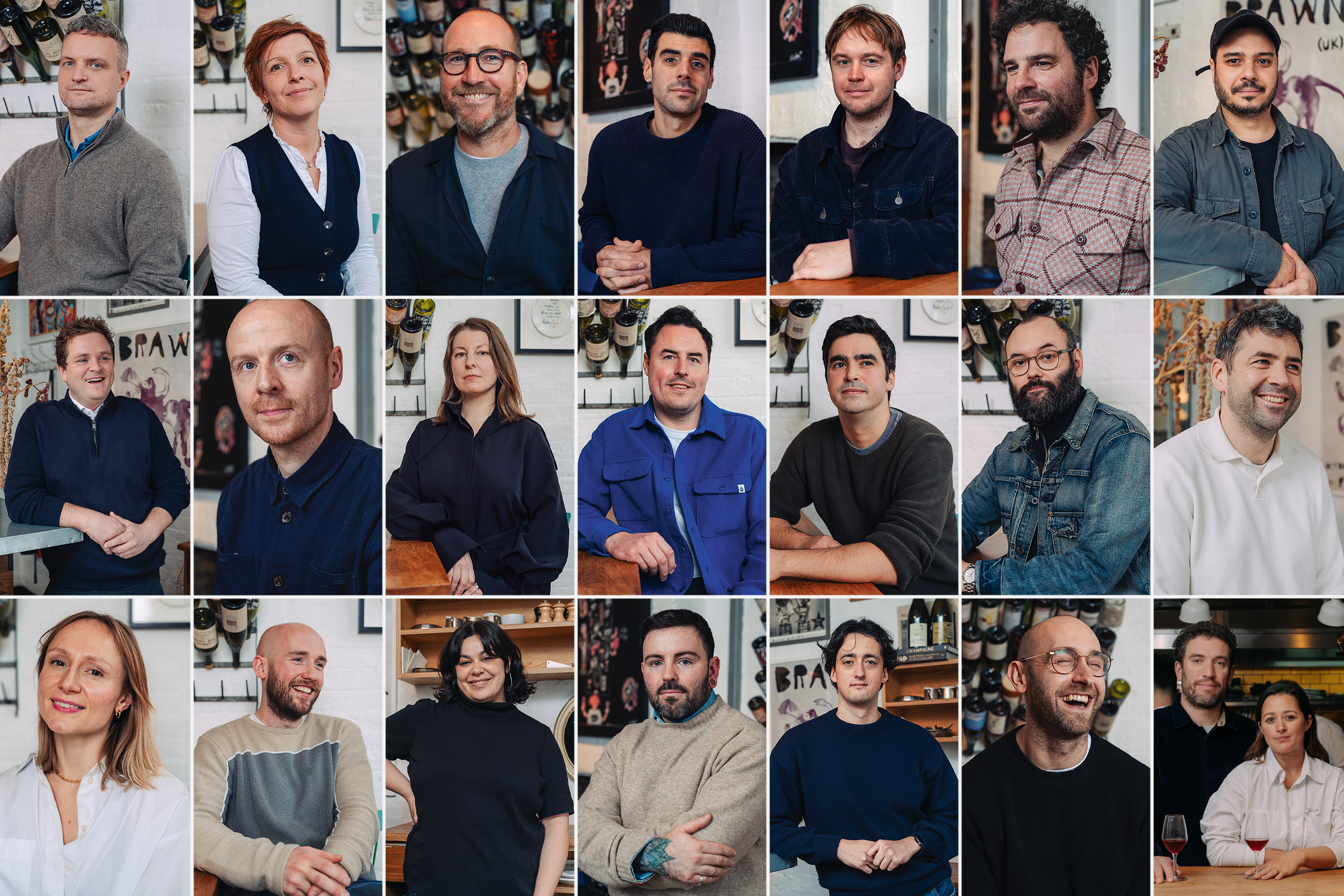
The class of 2010-2026: (from top left)
Owen Kenworthy, 2010-2015, head chef, now at Julie’s, Holland Park
Cécile Mathonneau, 2010-2015, operations manager, now at Cups and Jars, Forest Gate
Oli Barker, 2010-2024, partner, now at Hope Cove House, Devon
Damiano Fiamma, 2010-2012, sommelier, now at Tutto Wines, UK importer
Alex Whyte, 2010-2012, sommelier, now at Tutto Wines, UK importer
Jono Wingfield, 2012-2015, bar manager, and 2015–2019 general manager, now at Leo’s Restaurant & Bar, Clapton
Giuseppe Belvedere, 2015-2017, head chef, now at Leo’s Restaurant & Bar, Clapton
Tom Hurst, 2015-2017, junior sous chef, now at Cloth, City of London
Wesley Triggs, 2015-2021 and 2021-2023, restaurant manager and general manager, now at The Glass Curtain, Cork
Anna Frost, 2015-2018, sommelier, now at Where the Light Gets In, Stockport
Michael Lavery, 2015-2016, sous chef, now at Forza Wine, London
Doug Rolle, 2017-2022, head chef, now at Sohaila, Shoreditch
Gabriel Pryce, 2017, chef, now at Rita’s Dining, Soho
Rob Sachdev, 2018-2021, senior sous chef, now at Landrace, Bath
Sara Thomson, 2018-2021, chef de partie, now at Little Duck The Picklery, Dalston
Will Gee, 2019-2022, bar manager, now at 107 Wine Bar, Clapton
Dara Klein, 2019, chef de partie, now at Tiella Trattoria & Bar, Bethnal Green
Patrick Campbell, 2019-2021, general manager, now at JKS, London
Cavan O’Keeffe, 2020-2023, sous chef, now at Planque, Haggerston
Chris Trundle, 2022-2024, head chef, now at Climat, Manchester
Ed Wilson and Josie Stead, since 2010 and 2017, chef patron and operations director, co-owners Brawn
Newsletters
Choose the newsletters you want to receive
View more
For information about how The Observer protects your data, read our Privacy Policy