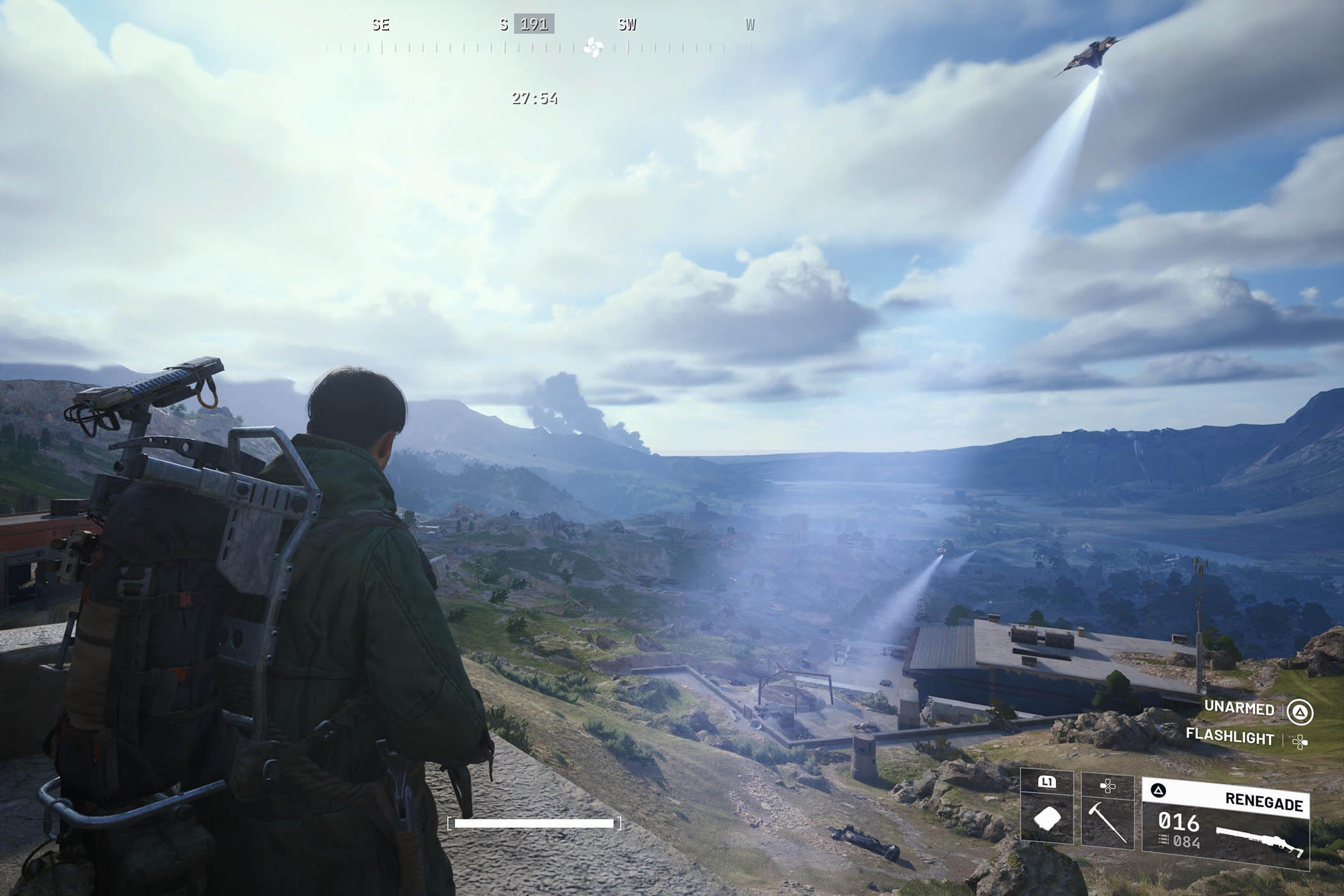


That the most popular online video games of today revolve around desperate groups fighting over dwindling resources in increasingly uninhabitable worlds reveals something essential about how we imagine our future. We sense ourselves to be an imperilled species: our entertainment reflects that unease. Scarcity, precarity and mistrust are felt not only in the political strategist’s war-room, but also the playroom. No surprise, then, that Arc Raiders has swiftly become one of the most played games on our anxious planet.
On paper, it sounds almost perversely unglamorous. You make repeated trips into post-apocalyptic zones, rummaging through bins, drawers and abandoned cars in search of sticky tape, springs, syringes, scraps of rubber – trinkets that must be carried out safely before the 20-or-so-minute clock expires. The fantasy here is not heroism but salvage.
But when played, the game is irresistible. Released in late 2025, it rose rapidly to the top of Steam’s charts, a feat that has begun to feel almost anachronistic in an era when so many “live service” games – designed with the purpose of keeping people playing – arrive with corporate fanfare and depart in embarrassed silence (Sony’s Concord, which reportedly cost more than $200m to make, was closed down after just two weeks). Its success is not the product of novelty alone. Rather, Arc Raiders demonstrates how familiar, even dull, components – inventory management, scavenging, risk-reward loops – can be reconfigured into something nervy, stylish and compulsively alive.
The stakes can feel insultingly small. You are not looting mythical artefacts, but screws and tape. This ought to be tedious
The stakes can feel insultingly small. You are not looting mythical artefacts, but screws and tape. This ought to be tedious
The game is almost modest in scale. Its ruined landscapes – sun-bleached suburbs, skeletal office blocks, flooded subway stations – are forlorn but beautiful, designed to unsettle with their off-kilter familiarity. The enemies patrolling them are alien machines – buzzing, drone-like guards that are manageable alone but overwhelming in groups. Among the smartest design ideas is the Snitch, an aerial enemy with no offensive capability whatsoever. It will spot you, flee and summon lethal reinforcements.
The stakes can feel insultingly small. You are not looting mythical artefacts, but screws and tape. This ought to be tedious, like pawing through a shed during a house move. But when your rucksack is full, those banal items become charged with meaning: they can be used to improve your gear, and thus the chances of future success. Lose them, though, and you squander the time, effort and fragile sense of progress you have been tending.
Nowhere is this clearer than in the extraction itself. You descend into a subway station, say, and summon a train. Sirens blare. A countdown begins: 90 seconds that stretch towards panic. Other players may arrive. They may call out to you, promising not to shoot. They may mean it. Or they may wait until your back is turned and betray you. Judgments are made in seconds; the fear feels elemental. The result is a system built from tedium that somehow produces suspense.
It helps that the game’s monetisation is gentle to the point of politeness. Money buys outfits or small expressions of individuality (a pineapple, or a six pack of beers) dangling from your backpack. There is no sense of extortion, no pressure to pay to compete. The systems, too, are softly forgiving. A mechanical chicken reliably produces basic items after each excursion. If you die too often, the game provides a free loadout consisting of a weapon and some bandages to get you back on your feet. Even the game’s frustrations – cluttered inventories, unclear crafting priorities – feel more like growing pains than design failures.
Arc Raiders arrives at a moment when the live-service model – which prioritises monetisation and player retention above all – has begun to look exhausted. Yet the game’s success suggests players are not tired of persistence, progression or multiplayer tension; they are just overfamiliar with how those elements are arranged. In the rush for the next forever game, here is proof that something smaller and stranger can still cause a stampede at the server door.
Related articles:
Arc Raiders by Embark Studios is available on PC, PlayStation 5, Xbox
Photograph by Embark Studios
Newsletters
Choose the newsletters you want to receive
View more
For information about how The Observer protects your data, read our Privacy Policy