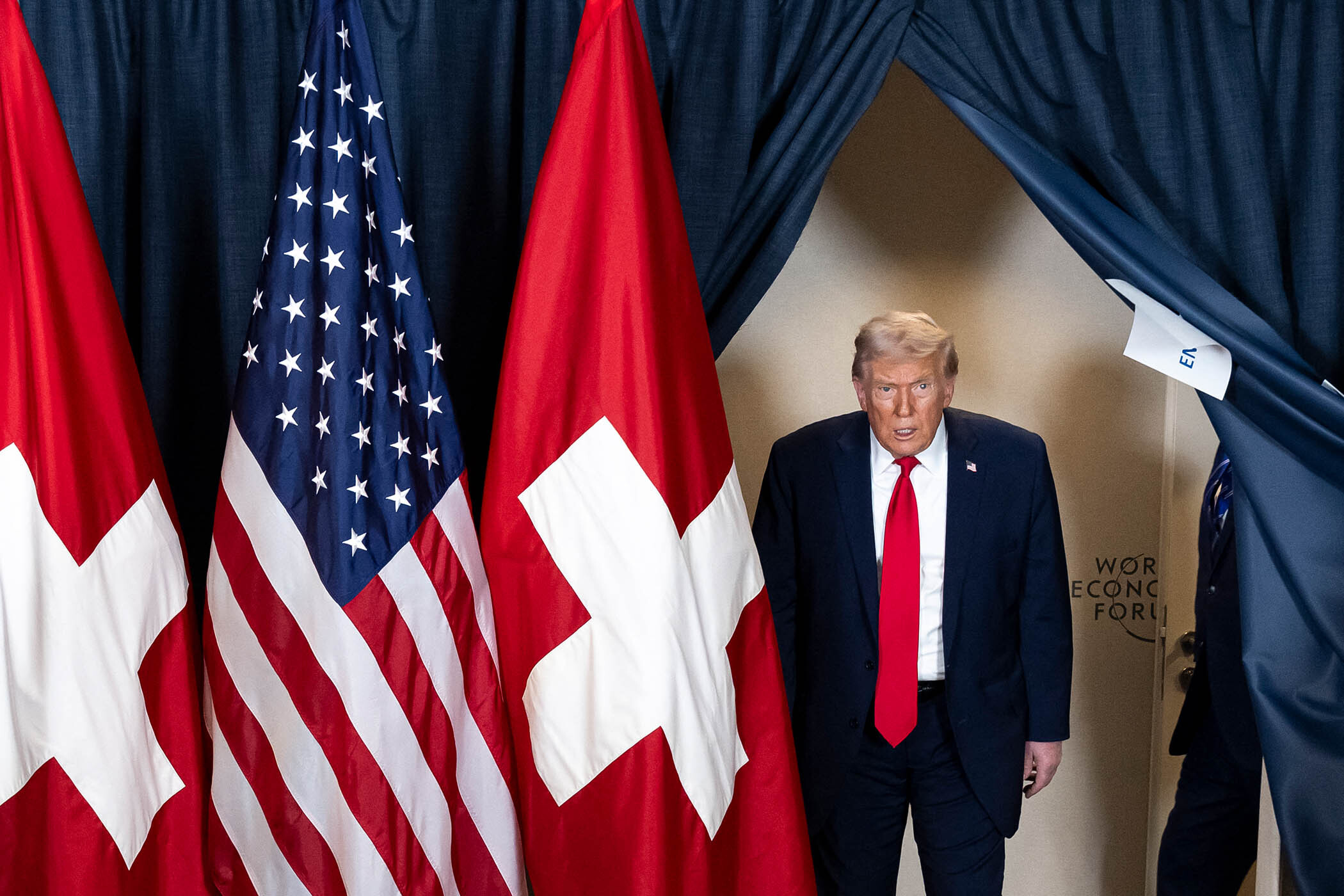
President Trump arrived at Davos yesterday to bury the idea he was going to invade Greenland, but not to praise Europeans for their appalled reactions to the idea. On the contrary, he delivered a vintage Trump lecture on European ingratitude, and added a series of gratuitous insults for good measure.
Afterwards, he climbed down not only from invading, but also from imposing tariffs on countries that opposed him.
In the speech, he remarked casually that he wasn’t sure America’s Nato allies “would be there for us” in US-led military operations, apparently forgetting the British and other soldiers lost in Iraq and Afghanistan.
Later he said of Somali pirates: “They turned out to be higher IQ than we thought.” Governor Gavin Newsom of California, who was in the audience, called the line “disgusting”.
But Greenland was the consuming focus of his audience’s attention, and Trump knew it. The warm-up took about 40 minutes. It was mainly campaign-style fodder about the American economy and the evils of “windmills”, and then four words: “I won’t use force.”
A sense of relief in the packed hall was palpable. This was the moment the president took the military option off the table. In doing so he defused a crisis of his own making that has diverted attention at home from rising prices and the Epstein files, and left the wider world aghast.
Trump hinted at what was coming. After a factually tendentious account of Greenland’s role in the second world war (he claimed US forces “saved” Greenland and that Washington unwisely “gave it back”), he said he would be “seeking immediate negotiations” to acquire it.
Then: “We probably won’t get anything unless I decide to use excessive strength and force, where we would be frankly unstoppable. But I won’t do that. I don’t have to use force. I don’t want to use force. I won’t use force.”
Related articles:
At this point he switched quickly to battleships – a fleet of ships “hundreds of times more powerful” than those of the first world war to be built on his orders and in his name, he said.
Two questions about Greenland were left hanging: whether there would in fact be “immediate negotiations”, and if so, what leverage other than force the US would use? Trump did return to the subject. “We want a piece of ice for world protection, and they won’t give it,” he predicted. “You can say yes and we will be very appreciative, or you can say no and we will remember.”
Newsletters
Choose the newsletters you want to receive
View more
For information about how The Observer protects your data, read our Privacy Policy
There were several senior moments in the speech, and a half-hearted effort to reconcile with his mainly European audience as “partners”. Trump repeatedly referred to Greenland as Iceland, to the point that it was not obvious he was not doing so on purpose. He called Azerbaijan “Aberbaijan”, and in one rambling section confused interest rates and tariffs.
As for Europe, he professed to be an admirer but repeated his now-familiar critique of its migration policies. “Certain places in Europe are not recognisable any more… in a very negative way,” he said. “I love Europe, but it’s not heading in the right direction.”
For the UK he reserved a broadside on its energy policies, misconstruing a net reduction in British energy production since 1999 as a bad thing when energy efficiency is integral to legally binding net zero targets. The UK energy market is characterised, he said, by “catastrophically low [production] levels and high prices”.
On the way into the conference hall, a barely controlled crowd of more than 1,000 showed that, love or loath Trump, he remains a magnet for other leaders, policymakers and tycoons.
Brian Armstrong, the young billionaire founder of the Coinbase crypto platform, paused to say to Michael Dell, founder of the computing giant that bears his name: “I need to get Bitcoin on the Trump accounts” – apparently a reference to children’s savings accounts Trump is badging with his name.
On the way out, the former US vice-president Al Gore came to the UK’s defence. Asked about Trump’s criticism of successive British governments’ efforts to pivot away from North Sea oil and gas to renewables, he said: “Of course I disagree with it,” and noted that the US under Trump was clinging to depreciating assets in its rush for more domestically produced fossil fuels.
On the speech overall, Gore said: “I’d hate to be the fact-checker” – and some fact-checking was instantaneous. Trump drew laughs with a caricature of China’s wind turbine industry as an opportunistic bonanza for Beijing of high-priced equipment it would never use itself.
“They sell them to the stupid people,” he said. In fact China has the largest installed wind power capacity of any country in the world.
Newsom, the Democratic governor who is also a potential presidential candidate for 2028, said Trump’s climbdown on Greenland proved that “he exploits weakness, and responds to strength”. What strength? Newsom pointed to speeches in Davos yesterday by France’s Emmanuel Macron and Canada’s Mark Carney, both of whom said any effort to use force or blackmail against Denmark, a Nato ally, would be unacceptable.
“He removed the one card that we knew was never really on the table anyway,” Newsom said. “The whole thing is bullshit.”
Photograph by Laurent Gilliéron/AFP/Getty Images