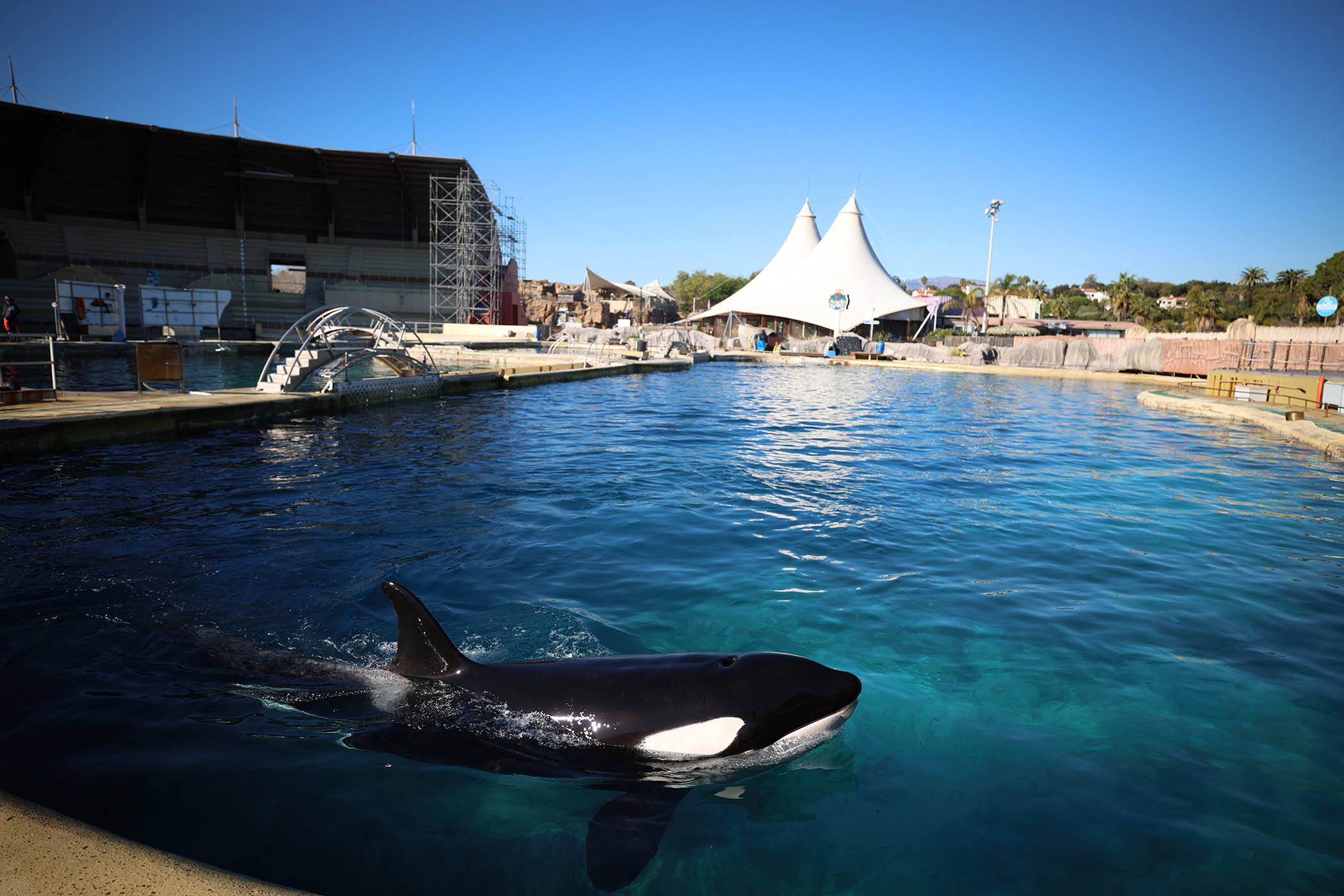


The stands are empty and the tanks are beginning to crumble. Yet behind the walls of Marineland on the French Riviera, two orcas – Wikie and Keijo – swim on.
The marine park has been closed to the public since January. The hubbub of visitors has been replaced by the noise of workers trying to maintain the cracked tanks and the occasional whine of the drones that activists and influencers periodically fly over the park to capture footage of the captives.
Marineland Antibes closed its doors in anticipation of a ban on performing cetacean shows in France that takes effect next year. Since the closure, the mother and son have been looked after by a crew of about 30 animal carers while the park, European governments and environmental groups argue about their fate.
While everyone agrees this is no place for Wikie, 24, and Keijo, 12, no one can decide where they should go. Twelve dolphins are also confined to the park, but it is the orcas that have provoked outrage on social media: the aerial footage of them in their tank regularly goes viral. Their presence raises the question: what do you do with performing whales when public opinion turns against the spectacle?
Valentin Ducros, a spokesperson for Marineland, said the situation was urgent. “The orca tank is at the end of its life and the animals could die at any moment,” he said, adding that the animals were in good health.
Marineland’s management has pushed for Wikie and Keijo to be transferred to Loro Parque in Tenerife, home to four orcas, where there are performances twice a day.
But a move to another marine park has been forcefully opposed by environmental NGOs that have campaigned for years to end captivity for whales and dolphins in France and don’t want to see them in another performance pool over the border.
In April, the Spanish government blocked any transfer of the orcas, while the French government has similarly ruled out sending the whales to Japan due to welfare concerns.
Related articles:
But anyone harbouring Free Willy-type fantasies of freeing the whales should abandon them now: it is out of the question to release orcas born in captivity into the wild.
You simply cannot put all these animal back into the ocean. They will not survive
You simply cannot put all these animal back into the ocean. They will not survive
Annemarie van den Ber, cetacean expert, Netherlands
“You simply cannot put all these animals back into the ocean,” said Annemarie van den Berg, a cetacean expert who until recently ran a dolphin rescue organisation in the Netherlands. “They will not survive.”
Newsletters
Choose the newsletters you want to receive
View more
For information about how The Observer protects your data, read our Privacy Policy
Van den Berg said the orcas would not know how to navigate sea currents or find their own food. The animals live in matriarchal pods where they hunt together and communicate using clicks and whistles. A captive orca would have no idea how to “speak” to its wild brethren if released.
Nevertheless, a Free Willy-adjacent proposal is in the works and it’s one that is backed by French environmental groups. Members of the same team that returned Keiko – the orca that played the titular role in the 1993 blockbuster – to the ocean are constructing a sanctuary in Nova Scotia, eastern Canada.
The Whale Sanctuary Project is a 40-hectare sea pen designed to house captive orcas in a near “natural” environment after their performing days are over. “It’s the only and best solution,” said Muriel Arnal, the president of One Voice, an animal charity that has campaigned for the end of cetacean captivity in France.
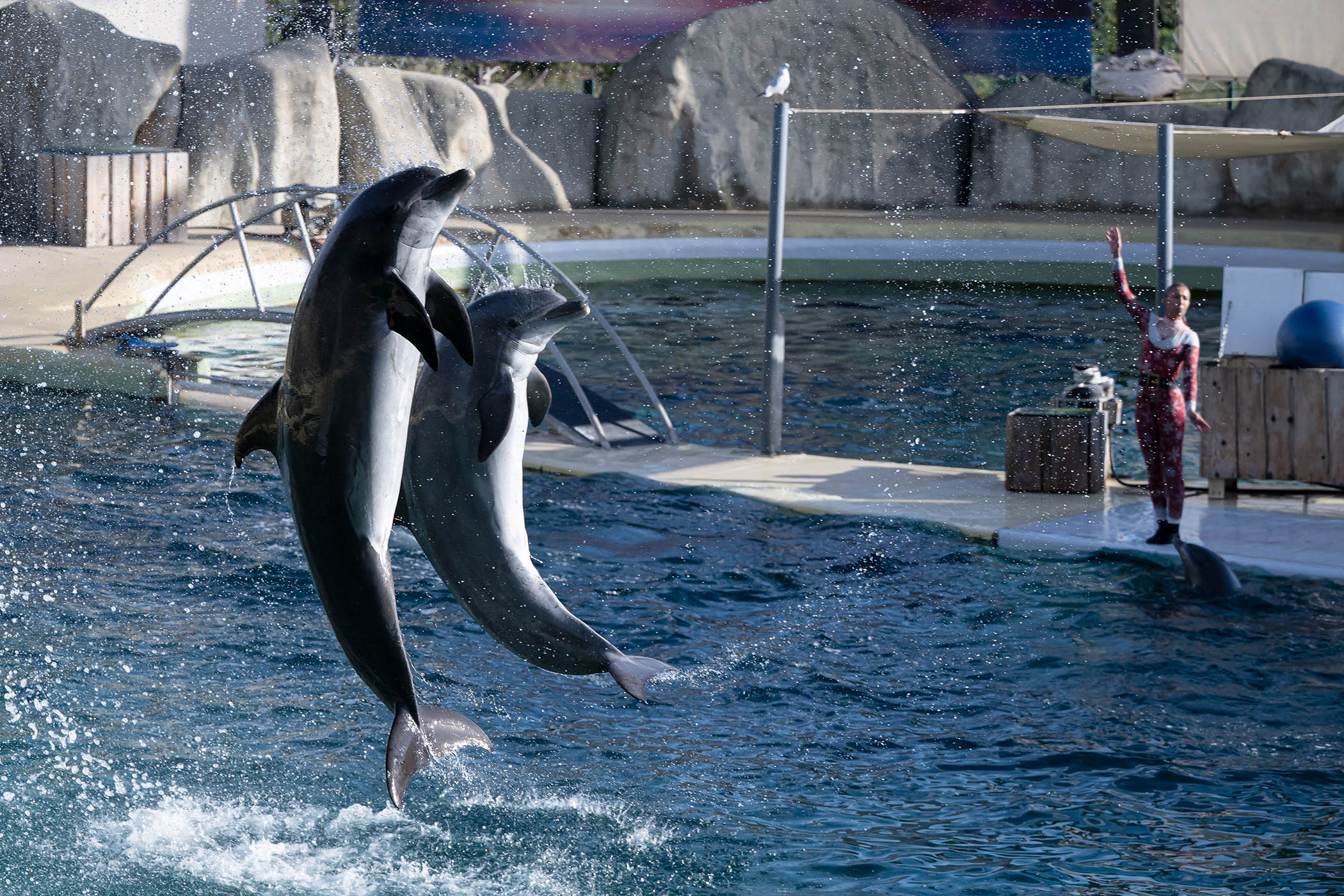
Bottlenose dolphins pictured at Marineland in January
A spokesperson for the French ecology minister, Mathieu Lefèvre, told The Observer the ministry was “in contact with the Canadian project leader and is looking into this possibility very closely”.
What is it about orcas? Even outside the parks where they have flipped and splashed for our viewing pleasure, they behave in ways that intrigue us, inscrutable but still almost human.
They communicate in a hypnotic language we can hear with underwater microphones but cannot comprehend and, just as we do, they have dialects specific to regional communities. Like us, they are a top predator. Like us, they experience menopause. To our anthropomorphic gaze, their faces seem to betray a slight smile.
In recent years, we have observed ever-more intriguing killer whale behaviour in the wild. In 2020, a group of Iberian orcas began ramming yachts, seemingly for fun, to the great delight of anti-capitalists. Orcas have been spotted sporting dead salmon on their heads as “hats” in what scientists have described as a “fad”, and were observed grooming each other with kelp this summer.
We watch as they carry the bodies of their dead calves around the ocean in 1,000-mile funerary processions and we feel we understand.
And while in the past we have hunted them for food, for pleasure and for science, we have also hunted alongside them. In Australia, the Thaua people of the southern coast of modern-day New South Wales collaborated with orcas on expeditions to ensnare much larger baleen whales. When the catch was made, the Thaua hunters ate the meat, while the orca pod got the tongue.
But it is only since we began capturing them and putting them on show that the whale we called “killer” has begun to fascinate us en masse.
Captivity gave “people the chance to see individual animals up close, as individuals with personalities, for the first time. This rapidly reframed perceptions of a species that had long been seen as a pest and competitor for useful resources at best, and a threat to people at worst,” said Jason Colby, historian and author of Orca: How We Came to Know and Love the Ocean's Greatest Predator.
In the wild, an orca can reach 90 years old, which means a whale alive today will have survived dramatic shifts in public attitudes about how and where it should live. It will have lived through the first captive whale going on show in 1961, the boom years of SeaWorld and Marineland, the Free Willy-buoyed optimism of the Save the Whale campaigns of the 1990s and the growing backlash against marine parks.
But it was the actions of Tilikum, a performing whale at SeaWorld Orlando that was responsible for the deaths of three people, that began to turn the tide on captive orcas. Blackfish, a 2013 documentary about Tilikum, prompted worldwide anger, though SeaWorld disputed its characterisation of events. SeaWorld ended orca shows in 2019.
Wikie and Keijo’s enclosure in Antibes is increasingly vulnerable to intrusion from urban explorers, who break into the park to snatch their viral moment with the creatures.
“There are videos on TikTok showing young people patting the orcas,” said Ducros, warning that interacting with the animals could lead to someone being killed.
As the situation deteriorates, it is believed the French government is coming close to a decision.
Arnal said the sanctuary in Canada could be ready by summer if given the go-ahead by the ecology ministry. But construction has not yet started and Charles Vinick, the boss of the Whale Sanctuary project who cared for Keiko during his rehabilitation, estimates they are still significantly short of the funding they need to get it up and running and transfer the whales before the wild Nova Scotian winter sets in.
Unsurprisingly, the logistics of sending a whale by freight are fraught
Unsurprisingly, the logistics of sending a whale by freight are fraught
Unsurprisingly, the logistics of sending a whale by freight are fraught. The animals are placed on a stretcher and placed into a tank, essentially “a large bathtub” filled with fresh water – not the salty water they are used to, because airline companies worry that it might corrode the electronics of the plane. To counteract the effects of the fresh water, the orcas are slathered in baby ointment and kept moist.
“You spray the whale with cool water the whole way because there’s only enough water in the box for him to be neutrally buoyant,” said Vinick. The trainers and carers travel with their charges, entering the tank with them if necessary.
After the flight, the whales in their tanks are loaded on a flatbed truck and driven to their destination, where they are lifted into their new home with specialised equipment.
So, if the sanctuary in Nova Scotia is their ultimate destination, will Wikie and Keijo enjoy living there? Ultimately, no one knows.
“It’s in a natural environment where they can explore the flora and fauna,” said Vinick. “They’ll see a crab. They’ll pick up a crab. They’ll see a lobster. They’ll explore, and their lives will be enhanced by it – we think. We don’t know. But it’s maybe the best we can do. And they deserve it.”
As the debate rolls on, the dolphins and orcas of Marineland await their fate away in the company of their carers and each other.
“The ones that are mostly affected by this – and this is what is really killing me – are the animals,” Van den Berg said. “Because in the end, they are the ones who are paying the price.”
Photograph by Miguel Medina /AFP via Getty; Valery Hache / AFP via Getty