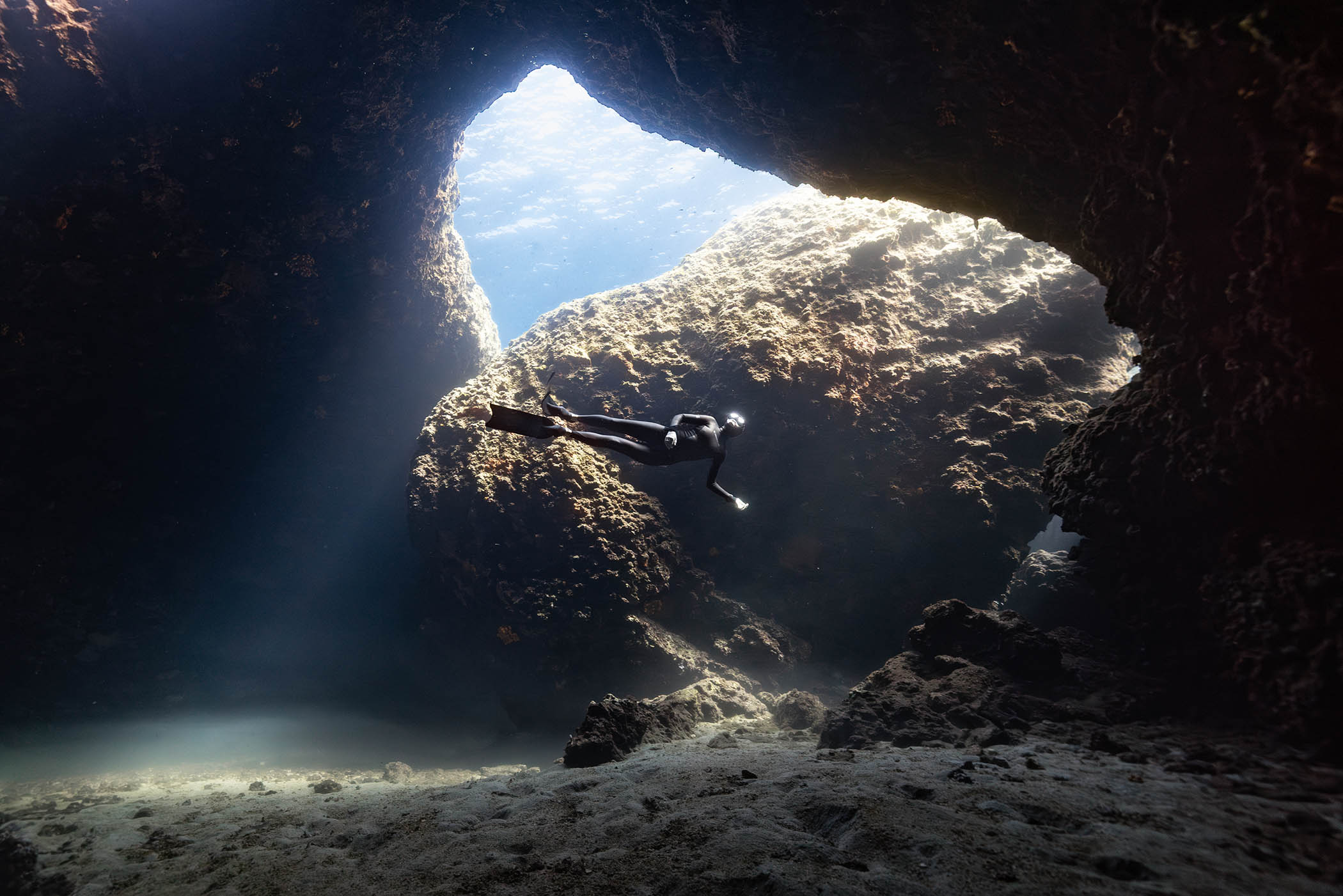

Deep Water is a new six-part investigative series from Tortoise Investigates and The Observer
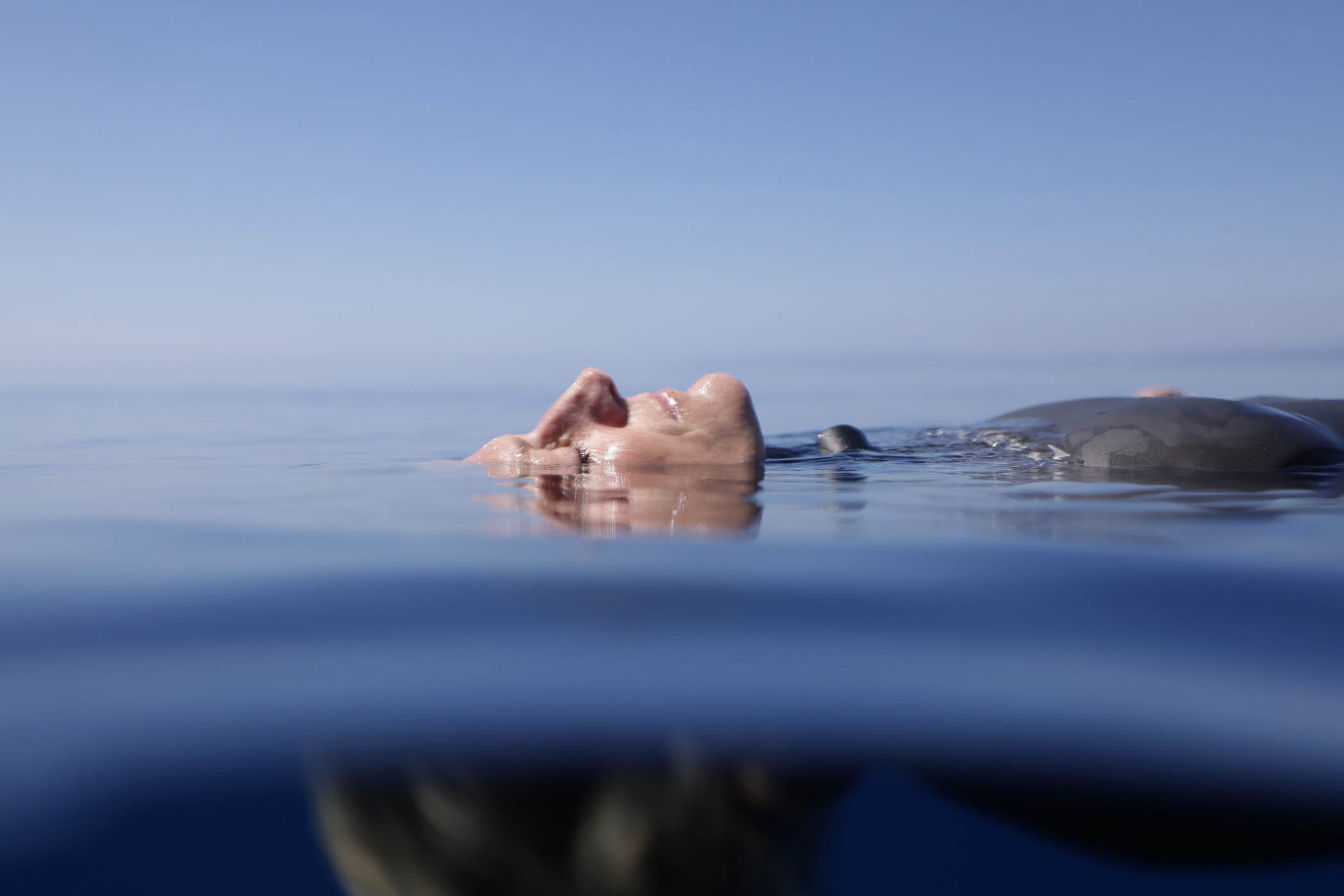
It begins with stillness. A freediver spends two or three minutes lying on the surface of the ocean, face to the sky, breathing slowly and deeply. Though they may be surrounded by boats, safety divers, cameras, action, they must leave it all behind and find focus. It’s not about flooding your body with as much oxygen as you can – it’s about release, letting go of anxious thoughts, noise, stress. Seventy, 80, 90 metres beneath the surface, all of that becomes a risk. Panic is the enemy of the freediver.
In 2022, I was working as a travel journalist, failing to balance work and a frenetic life as a mother of three boys, when I was invited to review a retreat in Spain. Towards the end of my stay, we ran to a local lake. The coach suggested we try a static dive: submerging our faces in this glorified puddle to see how long we could hold our breath. New to it all himself, the coach waxed lyrical about the physiological benefits – how holding your breath activates the parasympathetic nervous system and reduces stress. I was sceptical. But there, in that glorified puddle in Cadiz, I emerged euphoric.
The new athletes were playing up the stereotype of the gym bro. In their hands, freediving leaned into the extreme
I fell in love with a sport that is as simple as it is confounding: to dive as deep as you can on one single breath. I soon discovered that I’m not alone. Freediving attracts a broad spectrum of people who, at hotspots around the world – from Kas in Turkey and Kalamata in Greece to Dahab in Egypt and Dominica in the Caribbean – congregate all year round to train and compete together.
It is, I discovered, a primarily amateur sport, with more enthusiasts than athletes. But there exists a smaller, more competitive group. These are the people pushing the boundaries of what’s humanly possible deep in the ocean. They’re the subject of the popular Netflix documentary The Deepest Breath. A few years ago, 100 metres on a single breath was considered a spiritual depth for a freediver. But today a handful of athletes routinely reach depths of more than 120 metres, with a revered few passing 130 metres – names such as Alexey Molchanov from Russia, Petar Klovar from Croatia and Thibault Guignés from France. The world record is 136 metres on a single breath. That takes just over four and a half minutes, with only the air in your lungs, every cell under intense pressure.
For me freediving became a calling. After that retreat in Spain, I signed up to train with David Mellor, a seven-times world record holder. I took my first course at Vobster Quay in Somerset, and a few months later followed him to Kas. Across those first few qualifications, I learned about the physiology of the body in water.
For the first 10 metres below the surface, your body is buoyant and you have to make your way down by kicking with long fins, swimming unaided or using a rope to pull yourself. With your eyes gently closed, you assess your depth by the quality of the light.
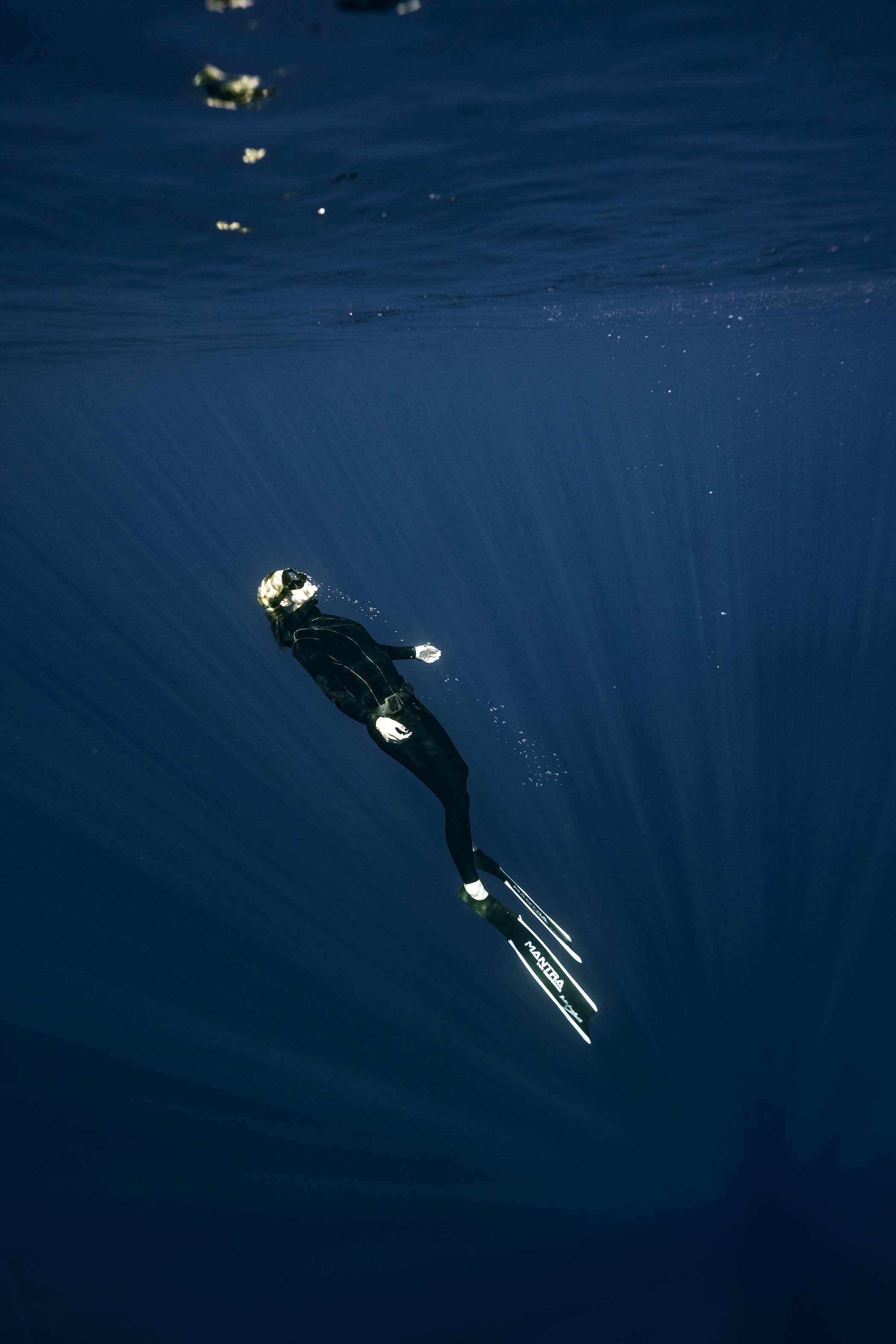
By 30 metres, your lungs have reduced to the size of a fist. You are more dense than the water. You start to sink at roughly one metre a second. This is the most meditative part of the dive. The freefall.
On a dive deeper than 130 metres, your body has to withstand a lot: the weight of the water column means there’s 14 bar of pressure on your body, 14 times what it was on the surface. And you are consuming oxygen from your blood without replacing it by breathing. Physiologically that means low oxygen, potential nitrogen narcosis, possible respiratory acidosis.
After two years of training, I was diving to 50 metres comfortably, but that wasn’t my end goal. I was being taught according to Mellor’s credo: you can’t force relaxation, you can’t cheat your nervous system. It’s not about the numbers. It’s about the quality of the experience. But as I spent more time with other divers, I began to see glimpses of another approach.
I heard rumours about a new and corrupting influence in the sport. In an already risky, extreme pursuit, my friends and colleagues were all hearing the same thing: freediving seemed to have a performance-enhancing drug problem. Perhaps it was inevitable – it had rapidly become more popular. It was being watched by the Olympic Committee for possible inclusion in the Games. In 2025 there were more than 7 million active freedivers – a significant growth in recent years.
I had intended to keep journalism and my beloved sport separate. But that soon became impossible.
The rumours started in 2019, when an audacious young diver in his late 20s appeared on the scene and was almost immediately in world record territory. Petar Klovar, along with his coach, Vitomir Maričić, was soon the subject of rumours that they might be using performance-enhancing drugs to get deep fast – a claim they have consistentlly denied. It’s not impossible to progress quickly in depth, especially with a background in swimming or another crossover sport. But 100 metres is elite territory. Most people spend years working their way there.
Klovar, from Croatia, was prone to deep blackouts – an underwater loss of consciousness – which can happen when a freediver has progressed too quickly. Some divers have the mental strength and confidence to push through signals that might make others stop and turn: involuntary contractions caused by the urge to breathe, or tunnel vision or euphoria, both of which are precursors to a blackout. Klovar also suffered from frequent, serious squeezes – pressure injuries that happen when the increasing atmospheric pressure damages the delicate tissues and blood vessels in the lungs. His reputation of risk-taking preceded him. Their rapid progression on the leaderboards ran counter to the old-guard philosophy of a slow adaptation to depth.
At the 2022 world championship in Kas, the elite diving community watched in astonishment as Klovar took the world record in the most punishing discipline: diving down a line without using fins or pulling on the rope with a 94-metre dive. He was closing in on one of the world records held by one of the greats of the sport, the veteran New Zealand diver William Trubridge.
But it wasn’t just their success that rang alarm bells. If Mellor’s process was at the mindful end of the spectrum, the Croatians brought a macho, train-hard-lift-heavy mindset to the other. With a background in swimming and sports climbing, they came to the water strong and conditioned, armed with a modern approach rooted in sports science. They soon became ambassadors for one of the biggest brands in the industry, Molchanovs, a freediving equipment company, and are sponsored by another, Double K.
And like many other athletes, they began to cultivate loyal followings on social media. Maričić grew his Instagram to 199,000, supplying his followers with a steady stream of muscular torso shots, underwater stunts and pure machismo. They were building a very particular brand: provocative reels of rescues from deep underwater blackouts and serious lung injuries, intentionally playing up the stereotype of the gym bro. In their hands, freediving leaned into the extreme.
William Trubridge, 45, built a reputation as one of the diving establishment. He grew up on a boat and started freediving in 2003, earning many world records and launching an online education platform, The Mental Immune System. He is the organiser of Vertical Blue, in the Bahamas, the most prestigious competition in the freediving calendar – the sport’s Wimbledon or Grand Prix.
As the concerns about drug use intensified around the new Croatian divers, Trubridge decided to use his position to mount an intervention. In 2023, Klovar publicly announced that he was planning to break Trubridge’s longest-standing world record: 102 metres no fins, at Vertical Blue. But when the athletes arrived at Deadman’s Cay airport on Long Island, they found Trubridge and a local police officer waiting to greet them.
They were escorted to a police station – a basic room with a sofa, table, and a few chairs. There Maričić, Klovar, a female Croatian diver, Sanda Delija, also coached by Maričić, and a Mexican diver, Pepe Salcedo, were searched. Their luggage was opened, and Maričić and Klovar were asked to submit to a drug test. All of this had been orchestrated privately by Trubridge, not through the standard channel: the officiating body, Aida. All four denied any wrongdoing. We know about this scene because a video of the search was soon posted to the Vertical Blue YouTube channel. It shows images of what appeared to be 33 different medications found in their luggage including two types of benzodiazepines in varying brands and strengths, and furosemide, a diuretic on the World Anti-Doping Agency (Wada)’s banned list known to be used by some athletes to clear their system of other banned substances in the event of being tested.
Images of the blister packs, audio recordings and clips of the encounter spread through the community, flooding every freediving chat group. The focus of outrage was what appeared to be the presence of benzodiazepines. Known as benzos, they are part of a family of prescription drugs usually prescribed for anxiety, similar to Valium or diazepam. Because of a lack of medical evidence, they are not banned by Wada and so are not considered doping. There’s also not enough medical research to prove that they are performance enhancing in diving – anxiety is the greatest barrier to depth for most divers. But as any lawyer or regulator will admit: there can be a gap between the rules and real life.
As I set out to investigate the scale of any drug problem in diving – a sport already flying so close to the winds of risk and injury – I spoke with several medical experts who confirmed that the use of benzos could be dangerous if used in freediving. One said the concept was frightening. “Benzos all cause respiratory depression… If you’ve got respiratory depression plus some sedation on top of that, so your body isn’t telling you to breathe and then your mind’s not telling you to breathe… you could potentially get past the point of no return.” The British freediver Gary McGrath puts it more bluntly: if people are experimenting with sedatives to gain depth, someone might end up dead.
Once the video of the bust was uploaded, freediving exploded into discord. On social media, hundreds signed and shared a petition, with an open letter calling for the Croatian athletes to be banned from competition. Vitriolic Instagram and Facebook posts circulated describing the team as cheats. One comment on the Vertical Blue post read: “For athletes that are claiming to be ‘built differently’ they sure need to have a lot of help from substances.”
Others, in their support of the Croatians, focused on how the bag search was orchestrated. Trubridge was called “judge, jury and executioner”. He was, after all, their competitor – he could, many argued, be motivated to remove them from the competition, a claim he denies. He banned them from competing at Vertical Blue for life. In response, the Croatians sought legal advice and Maričić posted a denial on social media: “The accusations of doping are false, unfair and unfounded. I’ve always adhered to principles of fair play and clean sport, valuing the integrity of competition above all.”
The official response to the scandal was uneven. Trubridge referred the evidence he had gathered to Aida’s disciplinary committee. They launched an investigation and upped their anti-performance-enhacing drugs efforts. The other governing body, CMAS, decided to ban benzodiazepines. Aida did not ban them. Which means that depending on the competition, the rules are now very different.
Two months after the scene in the Bahamian police station, Aida in fact allowed the Croatians to compete in the Depth World Championship in Limassol, Cyprus, in September 2023, and Klovar and Maričić took first and second place overall. They continue to dive today. They are currently first and third in the Aida world ranking. This year, Klovar finally took that 17-year-old record from Trubridge by diving 1 metre deeper.
While investigating the world of freediving, it became clear to me that the community was at war with itself on the question of drugs. Many people entrenched in this small community where athletes, competition judges, medics and organisers all know and rely on each other, both in and out of the water, were unwilling to go on record for fear of repercussions. But a few did want to speak.
Thibault Guignés, a French freediver based in Camotes, in the Philippines, was invited to compete in the Adriatic Sea by Maričić five years ago. There, he says he witnessed Klovar take Valium – a benzodiazepine – before a deep dive. We put these allegations to Klovar, who did not respond. At the time, Guignés says he took his concerns to Maričić, Klovar’s coach: “ He told me: ‘Yeah, Petar has some nerves sometimes. He usually takes it in the swimming pool before the dive.’ I shared with them, very vocally, my concern for the safety of doing it.”
This testimony, corroborated by another diver, suggests that Klovar had seemingly used benzos to dive years before being found carrying the drugs in his luggage at Vertical Blue in 2023. But Guignés also raised the gap between the rules and reality. “ The only real ‘doping’ product they had in their luggage was furosemide, a diuretic, which can be used to disappear traces of other ‘doping’ products. But it can also be used in cases of severe pulmonary barotrauma to limit the bleeding in the lungs.
The other products, from what I understood, were benzodiazepines, which at the time were not considered as doping products. They are still not [banned] by Wada; they are by CMAS. So now if it’s not a forbidden product, is it doping?”
Travis Tygart, CEO of the United States Anti-Doping Agency (and the man who caught Lance Armstrong), told me: “If it’s not in the rules, it’s not illegal, then I’m not willing to say that’s unethical or shouldn’t be done. That’s athletes doing what athletes do, which is to try to gain a performance any way they think they can.”
If a substance isn’t prohibited, Tygart’s position is that it’s not an anti-doping issue. Sport is a construction of rules, he said. It’s up to the rulesetters to protect the sport. But in a small sport like freediving, one that is largely reliant on volunteers, that is a problem. Is it realistic to expect the sport to create, enforce and safeguard its own rules?
Tygart said: “There’s a lot of power and money in sport. That’s why it’s so important to have independent organisations. I’ve termed it the fox guarding the henhouse. It would be impossible to have the fox guarding the henhouse effectively.”
Tom Peled, a prolific coach to Olympic athletes, told me regulation is important to stop the entire competition tilting in favour of those experimenting with drugs. “ There are already sports where if you’re not doping, you are nowhere near the top. If you want to be a part of that sport on a highly competitive level, you have to be taking some performance enhancement. We have to be very, very careful not to get there.”
Faced with near constant question marks over his dives and his record, Maričić has remained on the defensive. In a 2024 interview he claimed never to have tried benzos. On Instagram he said he has “always adhered to principles of fair play and clean sport, valuing the integrity of competition above all”.
I was in the process of setting up an interview with Maričić to ask him about the drug allegations when I received a voice note, forwarded to me on WhatsApp, from a source. In it, a voice which appears to be Maričić’s is telling a diver about trying benzos in a pool world championship. He is not encouraging the diver to take them, but he says: “It is not really doping” and “If you really want to try it, yeah you can – why not. It’s not against the law.” This seemed to directly contradict Maričić’s public denials. In the voice note he continued: “I took half [a benzo], I had a blackout and my dive was amazing. But all my dives in competition are usually amazing.” He said he was a “complete idiot” for trying it for the first time in a world championship, where “I was definitely preparing a world record and was going for a world record”.
When I spoke to Maričić, who was in Tulum, Mexico, on a video call in October, I asked him if he had ever tried benzos. He said no. Then, in the same conversation, he changed tack, saying: “In a competitive environment, no [I haven’t taken benzodiazepines]. But I have been testing [them]. I have tested once in a training environment after I was offered it. I have tested it in a pool.”
Like the position of the sport itself, Maričić’s position on benzos is inconsistent. He did not respond to an email requesting clarification on what he said in the voice note. But if benzos are not banned and are not medically proven to be performance enhancing, why was Maričić twisting and turning? He told me: “If someone finds [a substance] that is legal in all aspects, I would be careful in judging them. Because it’s not about them – it’s about how rules are set. Maybe someone finds something that is really, really good and they’re using it as a performance enhancer, and obviously they’re not telling anyone. If that’s legal, then it’s the flaw of the system, not of the person exploiting that.”
In a small sport that is largely self-regulated, it’s plausible that one persuasive voice can influence an entire culture. That is what many freedivers fear is happening with Maričić and Klovar. If I’m honest, I fear it, too. In September they posted a video that soon went viral: a compilation of clips of Klovar being rescued from a deep blackout. His eyes are rolling back in his head; he’s being held by Maričić, who’s trying to administer oxygen, but Klovar is vomiting bright-red foaming blood. His body is rigid, his eyes wide open, vacant. The blood keeps coming. The underscore music is dramatic, filmic. When he eventually comes round he’s moaning, coughing, crying out in pain. The caption reads: “When you push past your limits, the ocean pushes back harder. This is how close I came to breaking.” More than 35,000 people liked it.
Listen to Deep Water, a new six-part series, and watch Lydia's freediving in action on YouTube
Photographs by Martin Petrus and Daan Verhoeven