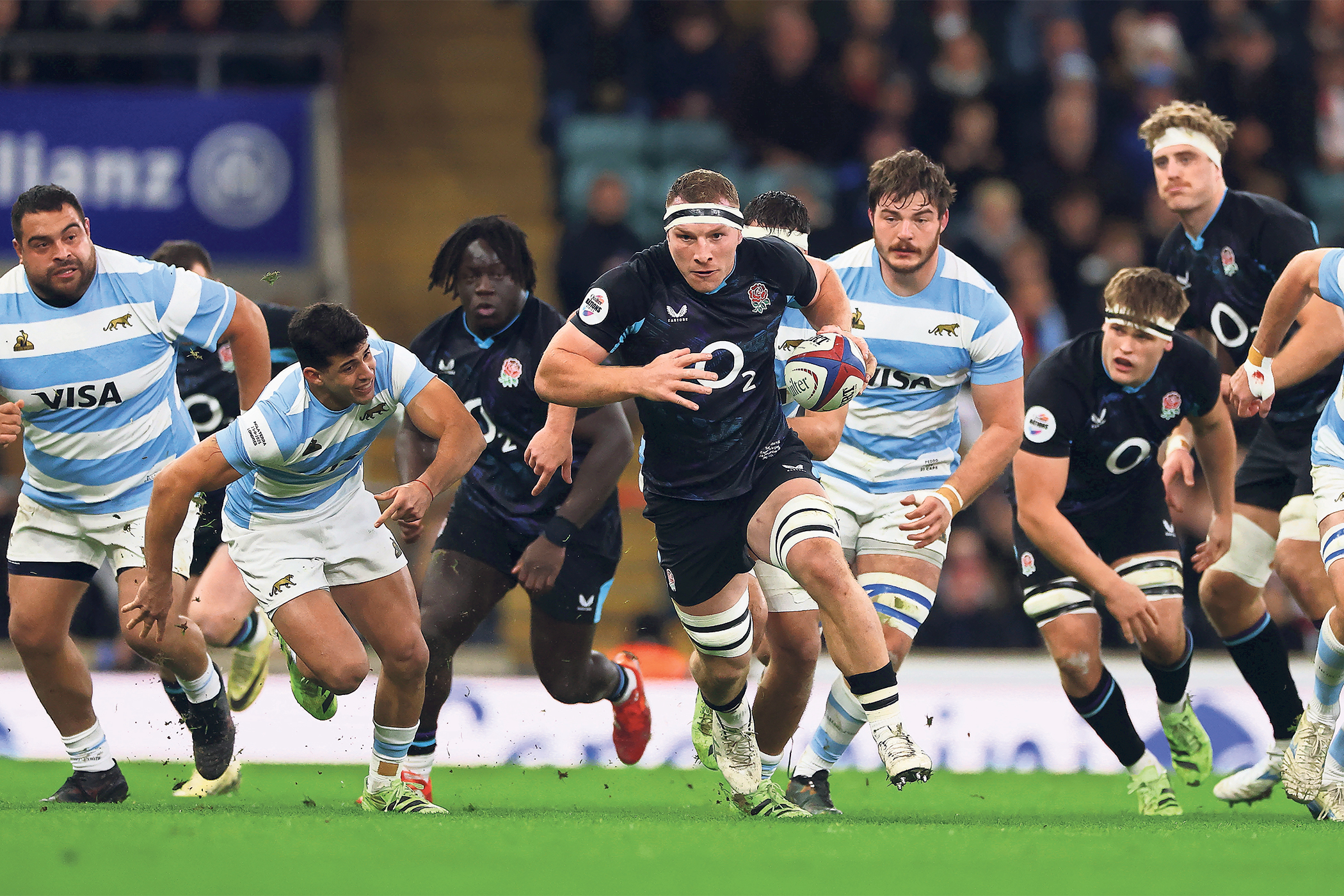



Steve Borthwick was not giving too much away after England’s win over Argentina last Sunday. He was pleased with the development of his side after four wins this autumn and the growth of the team in some areas (without specifying what those areas were). But there was also an admission that felt on the money: “I think this team can be a lot better than where we currently are.”
While England have been very good this autumn, there are still flaws to address. The nice thing about analysing a team coming off a run off 11 straight Test wins is that you can focus on the smaller details rather than having to tear the whole thing apart, as England have certainly had to do on occasion in the past. The shift in mood compared with this time a year ago, when England lost to New Zealand, Australia and South Africa, is significant.
Their issue at the back end of 2024 was that they could not finish games: blowing a golden chance to defeat the All Blacks at home, stunned by Max Jorgensen’s late match-winning score for Australia. Borthwick watched as South Africa brought on the “Bomb Squad” and eased clear of England in what was a tight battle up to that point. Finding success in “Q4”, the last 20 minutes, duly became a Borthwick buzzword in recent media sessions.
The way to fix those late slumps? Load up your bench with your best forwards and try to bring them all on together, as the Springboks have done with such success in recent years. The old ideology of starting your best players now seems a bit passé. Luke Cowan-Dickie, Ellis Genge, Will Stuart, Tom Curry and Henry Pollock were all replacements in tight games against Australia and New Zealand, arriving to give England a surge.
England’s scrum is noticeably better, a long-term project coming to fruition after Borthwick took over in December 2022 when England’s ranked statistically as the worst among the top 10 sides in the world. Time is the answer with that area. Borthwick noted how every Prem club scrums in a different way, so bedding in England’s approach under scrum coach Tom Harrison, building that cohesion, has taken time. Also, players just have more experience. The starting loosehead at times this autumn, Fin Baxter, made his debut last summer in New Zealand. He and tighthead Joe Heyes have arguably been England’s most-improved players in 2025.
They are also noticeably fitter, which ties into England no longer fading away in the final minutes. Slow ruck speed was another early stat cited by Borthwick where England have improved. Phil Morrow, head of team performance, and strength and conditioning coach Dan Tobin were given credit by Borthwick in the run-up to facing Argentina. Morrow, a key pillar in Saracens’ success, is someone Borthwick had wanted to bring in for some time.
The evidence that Borthwick provided to explain England’s improved conditioning was based on what he was seeing in training sessions at the start of each campaign. Previously, it would take a few days to get the squad back up to speed. “Over the last couple we have been able to pick up where we left off. It means you can keep taking steps forward, which is a credit to the work that players are doing outside of camp,” said Borthwick.
The Enhanced Elite Player Squad contracts – introduced in 2024 and enabling Borthwick to have a final say on any medical matters – also help. Crucially, there is still progress to be made with England’s conditioning. Borthwick has openly recognised this is not a huge England team in terms of size.
Related articles:
“We talk about sometimes we don’t quite have the same power as an England team used to have, but what we do have is this team can run,” he said. “Does it run the way I want it to now? Not at the standard I want yet, but it’s moved a long way.”
There is a lot to be said for how England have navigated bad patches in games before emerging with results. Failing to capitalise on their line breaks against Australia. The lineout wobbles against the All Blacks. Slow starts, in fact, in their first three matches of the autumn.
Newsletters
Choose the newsletters you want to receive
View more
For information about how The Observer protects your data, read our Privacy Policy
Sometimes you have to have some tight losses to understand how to make them wins
Sometimes you have to have some tight losses to understand how to make them wins
Steve Borthwick
The swing last Sunday between potentially going 24-3 up against Argentina on the verge of half-time, before Cowan-Dickie’s try was ruled out, to the scoreboard tightening up at 17-13, felt like another valuable lesson. Certainly a less painful one than previous tight defeats.
“Sometimes you’ve got to go through some difficult times, some tight losses to understand how to convert them into wins with a young side. That’s what the team’s doing,” said Borthwick.
Finally, this was England’s first full campaign with Lee Blackett installed permanently as attack coach. The players revere him. “He’s got phenomenal detail,” said full-back Freddie Steward, discussing how Blackett has tweaked Steward’s catch points and the subsequent benefits, helping to create overlaps. Centre Fraser Dingwall, when asked how Blackett had made a difference, said: “It’s as simple as giving clear direction to players around where they can be in each moment or where likely their next job is to allow the team to recognise where space is and then move the ball to that.”
Blackett’s celebration when Dingwall scored off a lineout against the All Blacks, caught on camera punching the air, suggested a planned tactic – swapping Dingwall and Ollie Lawrence’s roles – had come off. Keep adding that repertoire to the strength of their kicking game and England can hurt defences in multiple ways.
There is an air of confidence and competence now about this side, with minor dents to fix rather than entire panels. A first Six Nations title since 2020 needs to follow, but if England do that, then they will be genuine World Cup contenders.
Photograph by David Rogers/Getty Images