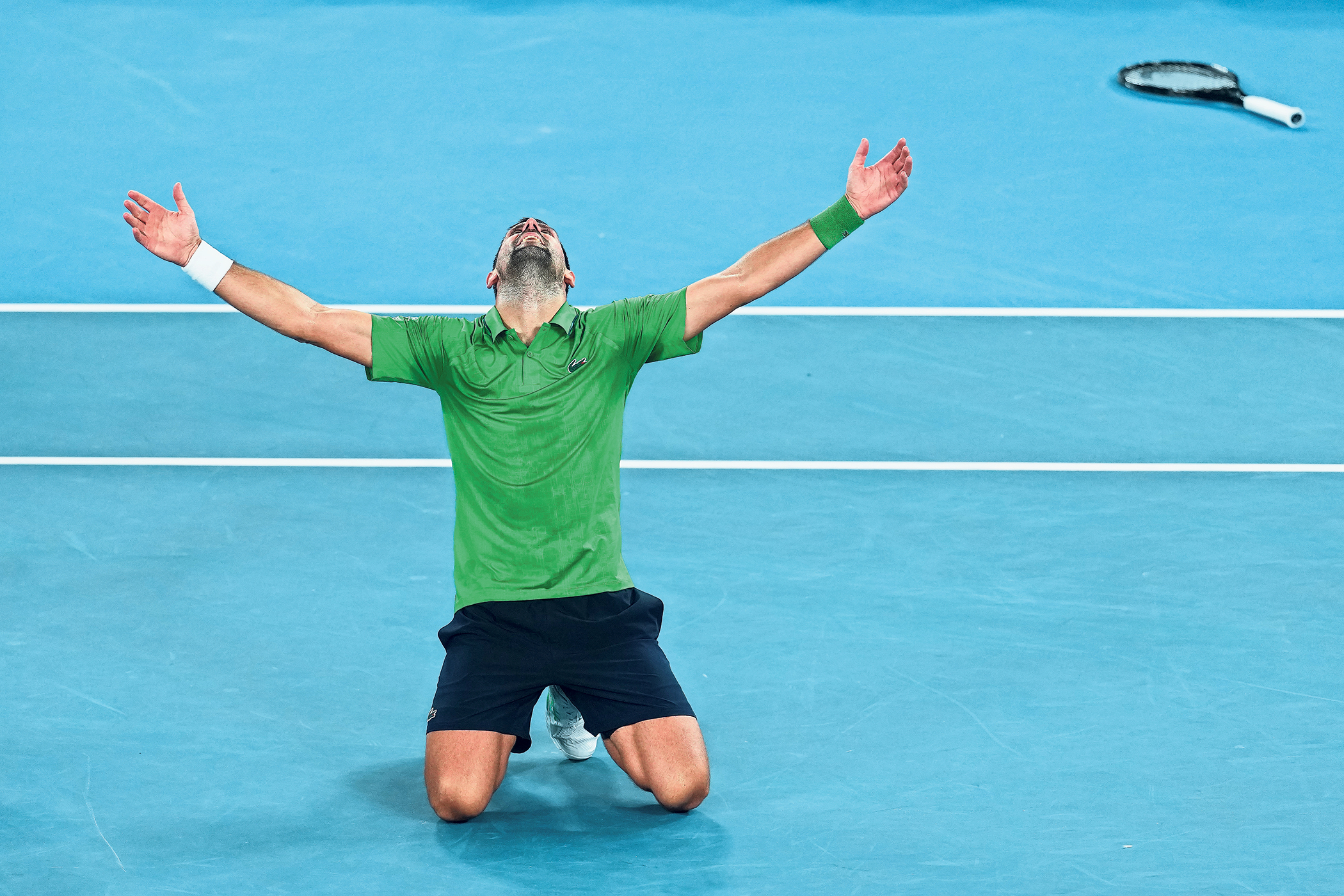
In the gold-flecked moments after his mountainous five-set Australian Open semi-final victory over Jannik Sinner, Novak Djokovic fell to his knees and prayed to the endless night sky above Rod Laver Arena. He bathed in wave after wave of the ungovernable adoration which had started four hours prior and showed no sign of slowing. For all the trophies and statistical accumulation, this felt like the sensation his 38 years have been spent searching for, a world united behind him, believing in his inevitable mastery and loving him for it without impediment. “Thank you,” he said to the crowd post-match. “Thank you from the bottom of my heart.” Unlike most players in that scenario, he meant it.
Since 2022, this tournament has defined and explained the vicissitudes of late-era Djokovic like nothing else. There was the agonising immigration fiasco for reasons entirely preventable and painfully selfish, followed by his father comparing his detention to the crucifixion. There was his return to lift the trophy once more a year later. There was the quarter-final victory over Carlos Alcaraz in 2025 and the subsequent semi-final retirement against Alexander Zverev, the supposed failed last push alongside Andy Murray.
At the very least, somewhere within this you can discern a three-dimensional person in a way few athletes allow us to. And yes, he’s petty and selfish and insecure, aggressively volatile and prone to quackery. Over the past decade he has said female players do not deserve equal pay, Kosovo should be a province of Serbia, and that a positive mental attitude can purify water. His relationship with hedge fund manager turned “seeker of truth and knowledge” Chervin Jafarieh, a man with “the soul [sic] intention to awaken a higher potential contained within each of us” is downright bizarre.
But in part we love sport because it feeds some deep, perverse self-loathing, reinforces our inadequacies and shows us what is possible. We are so quick to paint athletes as gods because it is easier to believe that they are superhuman rather than just better humans. And no-one is both more human and more superhuman than Djokovic, as flawed yet capable of perfection, still dragging everything imaginable from his body and mind, and then a great deal more.
He does everything we know we should, and is living proof that it works. Stretch religiously. Take recovery as seriously as warm-up. Warm up seriously in the first place. Eat less meat and gluten. Understand that spirulina is not a plague variant that did for half the population of 17th-century France.
He talks about visualisation, meditation and “conscious breathing”, about how we treat our bodies mattering. This feels particularly relevant on a day I ate half a bag of M&Ms for breakfast.
For all the flaws in the toxic modern fetishisation of self-actualisation, Djokovic is testament to the powers of obsession and devotion, to where humanity can push itself. Keeping himself functioning to the requisite level at 38 requires every available minute and a team of 10 people, not including the rotating casts of ambiguous gurus. There is a point where self-preservation becomes so extreme it strays into self-harm, and Djokovic plays jump-rope with that line. But he has never lost six hours watching Instagram reels about sharks, perhaps the real mark of a superhuman in 2026.
Djokovic is the high priest of high performance, a dedicated servant to his own potential and body, to the Novak Djokovic of tomorrow. An Orthodox Christian, more than anything he has always seemed to worship himself, with an ascetic’s dedication and a deity’s extravagant ambition, an evangelist for and disciple to his own brilliance. He’s always seemed somewhere between confused and cosmically perturbed that the masses have never quite taken to him, that everyone has not seen him as he sees himself.
Related articles:
‘A lot of experts have retired me. They gave me strength to prove them wrong’
‘A lot of experts have retired me. They gave me strength to prove them wrong’
Novak Djokovic
And at some point in his twilight years, Djokovic became everything to everyone; lunatic and wise man, grand master and pretender, visionary and traditionalist, belligerently individual and yet desperate to be loved. “I never stopped believing in myself,” Djokovic said not long before 3am on Saturday morning.
“I see there are a lot of experts all of a sudden who wanted to retire me or have retired me many times the past couple of years. I want to thank them all because they gave me strength, motivation to prove them wrong, which I have tonight. For me it is not a surprise. I know what I am capable of.”
Newsletters
Choose the newsletters you want to receive
View more
For information about how The Observer protects your data, read our Privacy Policy
That he still feels the need to justify this, justify himself, after everything he has achieved, is oddly admirable in one light and deeply sad in another. There has always been the sense that he is trying to fill an unfillable void, that winning a 25th grand slam would only trigger the quest for a 26th. The problem with Alexander weeping because there are no more worlds to conquer is that there are always more worlds to conquer.
Winning a 25th grand slam and eleventh Australian Open on Sunday morning would make Djokovic not only the greatest tennis player but probably the greatest athlete of the modern age, the ultimate combination of elite skill and extreme endurance, mental and physical mastery, spanning generations and worlds.
On Friday, Sinner won more points, served far better and hit more winners. But Djokovic saved 16 of 18 break points, a demonstration of the sheer force of his will, his unparalleled understanding of timing and moments, his sense of divine purpose. Just reaching the final is an achievement so unimpeachable and seemingly impossible that even the most fervent anti-Vakkers could not help but get caught up in its sheer majesty.
He has always existed to show us what is possible. Those horizons only keep expanding.
Photograph by Shi Tang/Getty Images