The spotlight was only there for the cameras, but it felt cruel, a cosmic gag. Aryna Sabalenka was attempting to process a third Grand Slam final defeat since the start of 2025, only redeemed by the US Open, when it seemed that all she wanted to do was scream and shout and break things. Instead she was frozen in place, a monument to self-loathing and self-pity, as the trophy podium was built around her. The Rod Laver Arena was enveloped in darkness bar two beams trained on her and Elena Rybakina; conqueror and conquered, chaos and quiet, opposing poles in so many ways.
Sabalenka is quite so much fun because her emotions escape from every vein and sinew, her eyes and mouth constantly betraying her. Her natural on-court state is rage at both her failings and her triumphs, because the latter only prove the former should not be happening, that she can actually do it. She says that she has no awareness of the grunts and roars, the “hoaaaa”s and “rahhhh”s accompanying every serve or swipe. On nights like these, it must be agonising to feel things as deeply as she does and have no outlet for catharsis.
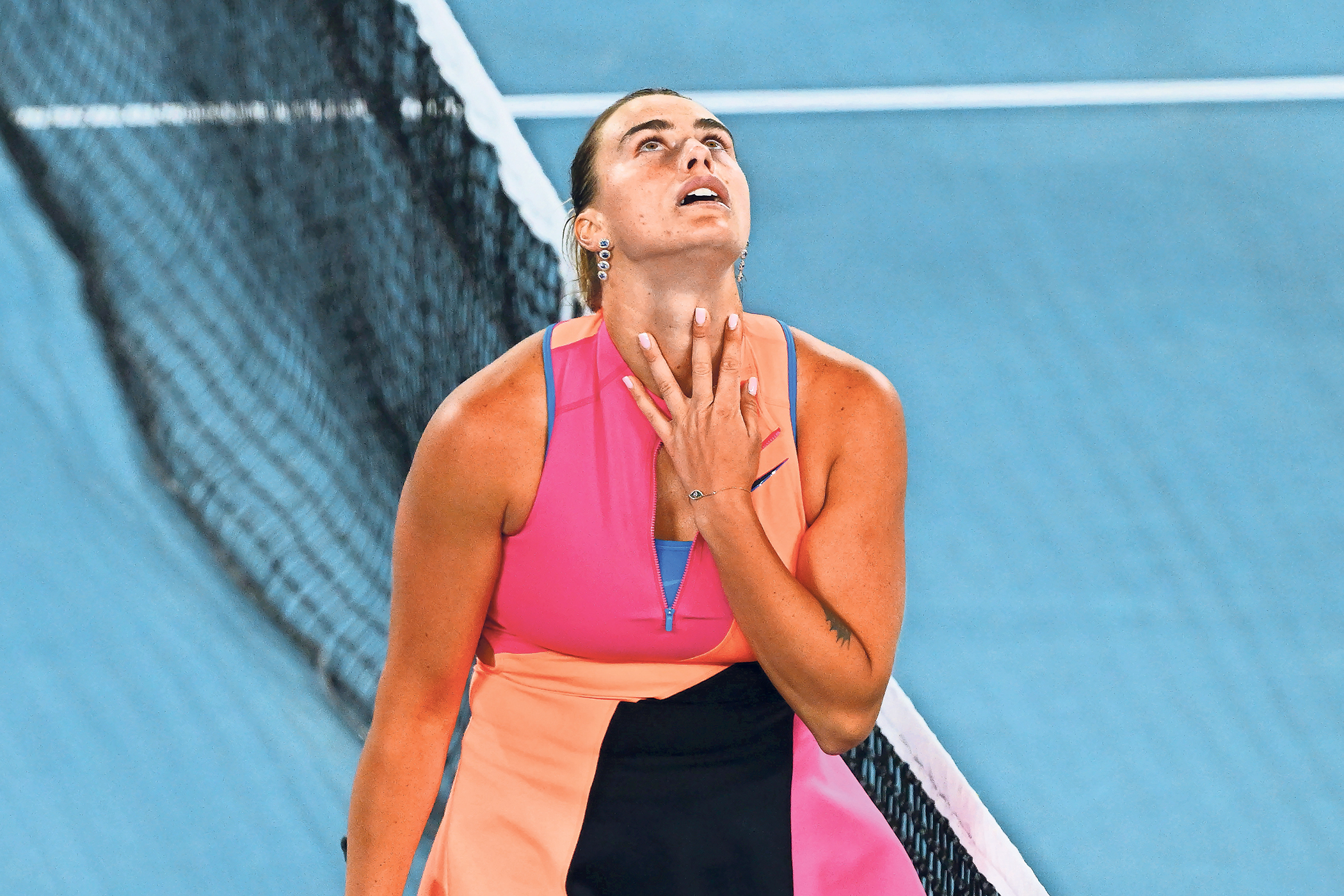
But we want athletes we can feel with, suffer and succeed with. After breaking Rybakina early in the third set, Sabalenka clumsily overhit a relatively simple return, then clawed down her throat and chest and double-tapped her temple as if willing her brain to think, when in fact thinking is what got her in that mess in the first place.
Thinking is Sabalenka’s sworn enemy in matches and moments like these; it disrupts her natural rhythm. She has won 20 consecutive Grand Slam tiebreaks, an all-time record – when she reaches flow state, when she plays on instinct, when the walls are closing in, there is nobody better in the women’s game. Long rallies of whipped forehands, diving net points in the dying embers – this is what she does, who she is.
But a looping ball that sits up nicely for her to thump back across the net? This is a problem, because then she does too much, keeps it too low or close to the baseline. There is a sense that she has finally made peace with the sound and the fury, with the rage and contempt, but has not yet worked out how to deal with the lacunae of quiet amid the chaos, where she has space to breathe. Perhaps she spent so long worrying about falling apart that she has forgotten how to take a beat, wound so tightly that she loses all perspective.
And going 3-0 up in the third set gave her time to think and relax. She screamed to the gods, but less than 15 minutes later she was 4-3 down, thumping her racquet on her coaching box after a brilliant Rybakina serve took her one game from victory. This is the Sabalenka experience.
Rybakina is everything Sabalenka wants to be; seemingly unflappable and unknowable, made for big moments and matches. She has the highest winning percentage against the incumbent WTA No 1 of any player ever, her 60% just topping Serena Williams’s 58.6, and has won 10 consecutive matches against top 10 players.
And yet still Sabalenka played well enough to win this final. Rybakina has the best serve on the WTA Tour, and Sabalenka matched her service numbers almost exactly. She hit seven more winners and only one more unforced error. It feels like she lacks the control to raise her level in the right moments, to know how to shepherd a lead through to the end. She took only two of her eight break-point opportunities, while Rybakina took half of her six, her serve excelled in the biggest moments, especially the final two points of the match.
Related articles:
Sabalenka does not seem to have that natural feeling for flow and timing, perhaps because she so rarely needs it, flicking most opponents from her path at will.
Before Saturday, Sabalenka had won 11 consecutive matches without dropping a set, hit the most winners in the 2026 Australian Open and won 26 of her last 27 at Melbourne Park. She has won at least one set in 110 straight Grand Slam matches and reached the semi-final in 12 of the past 13 slams, with the only exception the 2024 French Open, when she lost her quarter-final while suffering from food poisoning. She was the second woman to reach four straight Australian Open finals, only after Martina Hingis, and has made eight consecutive hard-court slam finals, winning half.
Newsletters
Choose the newsletters you want to receive
View more
For information about how The Observer protects your data, read our Privacy Policy
Sabalenka has been world No 1 for 75 consecutive weeks and is the most popular active female player among the general public by some distance, adding 300,000 to her 4m Instagram followers throughout this tournament alone, something of a miracle given the knottiness of her nationality. There’s a charming Jekyll and Hyde dichotomy between her destroyer-of-worlds on-court persona and the light, feminine 27-year-old that she is the vast majority of the time. She is painfully conscious of developing “Brand Sabalenka” – her ruggedly handsome boyfriend is an acai berry magnate who she met on a sponsorship shoot, which fits so perfectly you could not begin to satirise it.
“I always wanted to be something bigger than just a tennis player,” she said before this tournament began. She has deals with Gucci and Emirates, alongside boutique jewellery brand Material Good and supplement brand IM8, whose share price rose 10% when she was announced as brand ambassador, far more than it changed when it was announced that David Beckham was an investor. Her participation in the farcical Battle of the Sexes made her seem fundamentally less serious, even if it appeared the result of a misguided belief that it would raise the profile of women’s tennis, and a slightly more guided belief that it would make her a fortune and let her go on Jimmy Fallon.
Back in Melbourne, Sabalenka was asked to give an overview of her performance in her post-match press conference. She laughed perhaps the most bone-chilling laugh ever, a laugh usually reserved for serial killers asked where the bodies are being kept. She later called it “a hysterical moment”. She has spent as much time learning how to lose as how to win of late.
She has been here before. She will undoubtedly be here again. But for all the love and world and everyday dominance, life in the spotlight does not seem to be getting any easier.
Photograph by Quinn Rooney/Getty Images