


Every time you reach an end, the temptation is to worry whether you have reached the end – that is, the circumstances under which you may, or may not, restart. So it is with these Ashes, which reach Sydney already decided, and in some senses already defined.
Seeing his own end hove into view, Usman Khawaja has elected to make a farewell of this return to his former home. Test cricket will shamble on, but for the first time one can recall in an Ashes summer, one has begun to wonder: if this is the best that can be done, is it even worth fighting for?
What’s consented, however, is that an Ashes series which loomed so invitingly after the excitement of 2023 has, aside from the tumult of Travball plus the serial excellence of Mitchell Starc and Alex Carey, been a squib. Although both teams have in the last 15 months hosted India to exciting effect, they have largely squandered their own encounter as a means to advance the cause of red ball cricket.
The crowds who turned up in huge numbers have been treated to cricket bleakly entertaining in its chaos. The crowds who have really counted, however, have been those without the chance to see anything, who bought tickets for days that did not eventuate, who essentially lent their money interest free to Cricket Australia.
A total of 5,449 deliveries have been bowled: roughly equivalent to ten full 90-over days of cricket, out of a scheduled 20. Half an Ashes, in fact, feels about right. Two two-day Tests, a record for brevity. Nine wickets in barely a hundred overs of spin, a record for paltriness. Two hundreds to batters not called Travis Head, a new record just invented because there seems a need.
In the main, that’s down to England. They have actually been very lucky. A lot that could have gone wrong for them has not: touring teams can usually rely on one top six batter breaking a finger here, but England have been spared; Ben Stokes, irresistible force and immoveable object, was long odds to play every game, but has contributed in each.
At the same time, England have failed to seize colossal advantages gifted them by Australian injuries and indispositions. And while they have sent meek teams before, none have been so lackadaisical, so fundamentally unserious about their preparation.
Like Captain Renault they are shocked – shocked! – to find that white-ball frolics in New Zealand and centre wicket practice on a Perth village green do not constitute proper preparation for Australian conditions. They celebrated sliding 0-2 down by going on a jolly to Noosa.
Related articles:
They waited until the Ashes were decided before bringing so much as their B-game to Melbourne, where they were fortunate that to a fickle pitch Australia brought their C-game. Stalin, meanwhile, had nothing on the groundsman’s show trial afterwards.
Five-Test series are cricket’s most demanding genre, and its most generous. Yet of the visiting squad, only Josh Tongue can be counted as having enhanced his reputation across the journey thus far. Three of the pace attack in which Stokes invested so much hope – Jofra Archer, Mark Wood and Gus Atkinson – have failed to last the distance. His world-class wicketkeeper batsman, Jamie Smith, never got going; his first-choice slow bowler, Shoaib Bashir, did not even get on the field for which he was groomed.
Newsletters
Choose the newsletters you want to receive
View more
For information about how The Observer protects your data, read our Privacy Policy
Australia, meanwhile, have been as organised and composed as they usually are in their own climes, a mix of the pretty good and the merely good enough. You’d have got good money at the start of summer on Steve Smith arriving at the Sydney Test with a single 50 under his belt. Marnus Labuschagne, Jake Weatherald and Cameron Green have marked time if not gone backwards. A team falling back on Starc, Scott Boland and Michael Neser, respectively 36, 37 and 36 in the next six months, is hardly planning long-term. Yet that team is bound to be turned over further before the next Ashes, thanks to both natural attrition and to the growing inducements to take the T20 shilling.
The Sydney Test, then, might be considered the first Test of 2027 Ashes, with a chance to make a down payment on the team’s rankings relative to one another. For Australia, 4-1 would be a confidence boost at the end of a series full of intimations of mortality.
England, meanwhile, have the chance to tidy the scoreline to 3-2, which would burnish a career or two, and provide a modest half-tick for its coach Brendon McCullum. It might better reflect the teams’ respective talents. It would also, frankly, be perfectly undeserved given the damage that England have this summer done to Test cricket – the same Test cricket that for the last three years they have preened themselves on “saving.”
After the 2023 Ashes, Ben Stokes congratulated his men on being “a sports team that will live forever in the memory of people who were lucky enough to witness us play cricket”; if he cares as much as he says for the five-day game, he’d best hope that this team is forgotten.
For the public, so disused this summer, there will be a mix of feelings: hopes for a spectacle worthy of the name and permissible duration; a sense also that they’ll be glad when a series that has so disappointed expectations is all over.
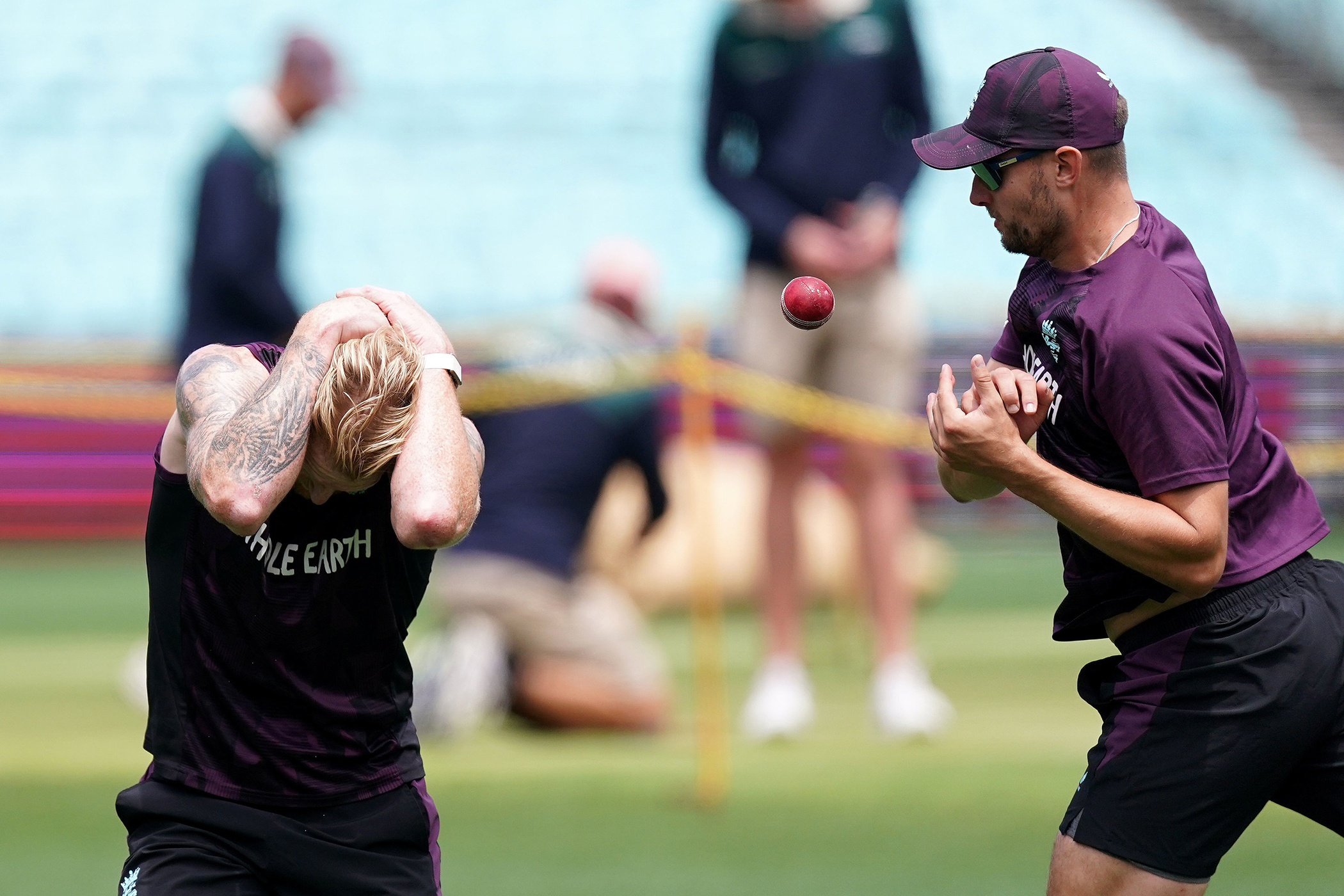
Photograph by Robbie Stephenson/PA Wire