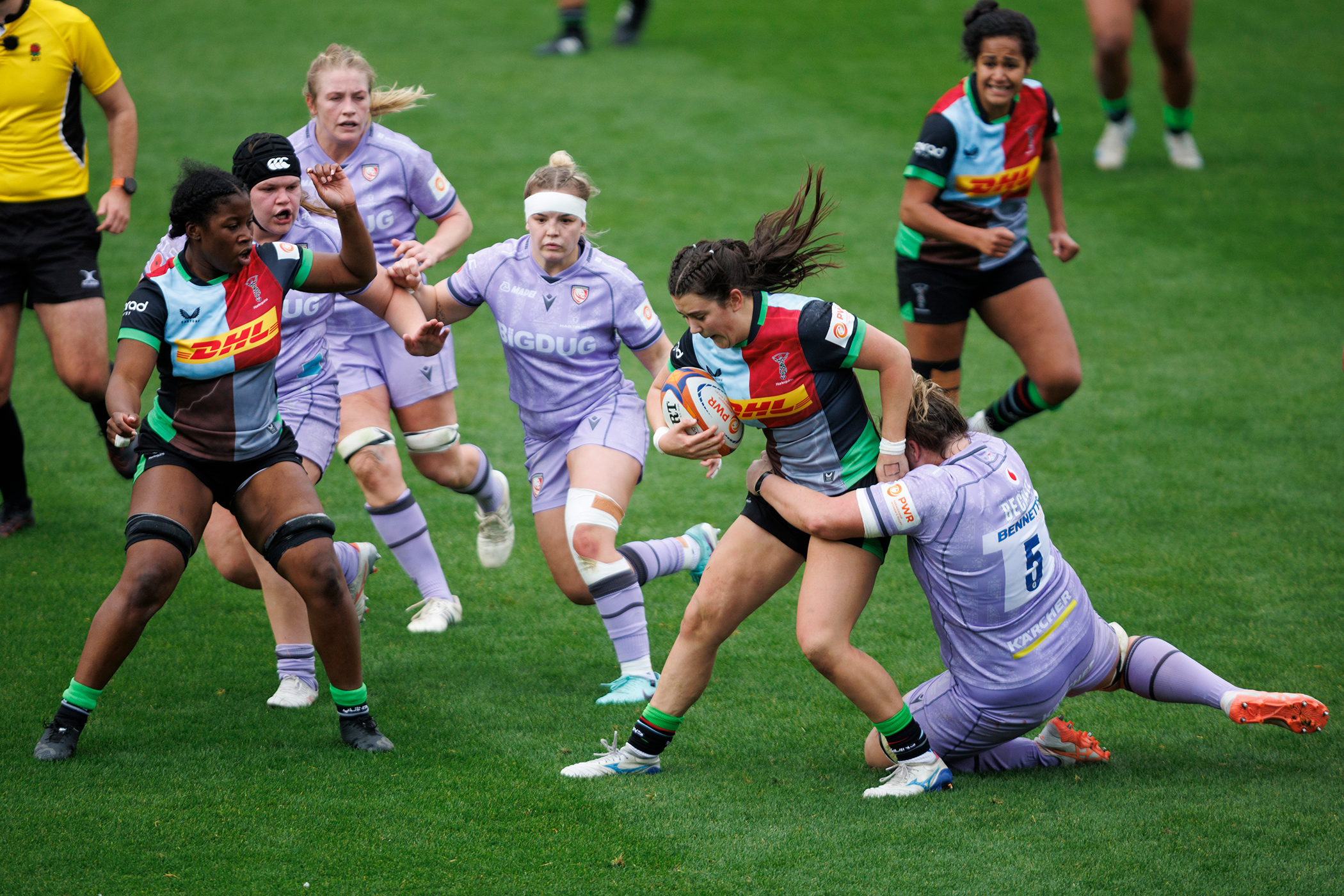



When the new season of Premiership Women’s Rugby (PWR) began at the end of October, about a month after England’s landmark Rugby World Cup triumph, attendances were unsurprisingly up on the previous year.
Supporters enamoured with an outstanding tournament, now wanted to see their heroes in action.
Factor in a frustratingly long gap for players, fans and executives between the World Cup final and England’s next home game, against Ireland at Allianz Stadium at the start of April kicking off the Women’s Six Nations, and the PWR feels even more important, tasked with continuing that surge of momentum behind women’s rugby in England and beyond.
The PWR announced that attendances for the opening weekend were up by “a remarkable 183%” on the previous season. Dig into that percentage and there were close to 3,000 supporters at the Stoop for Harlequins against Loughborough Lightning, crowd numbers were up by a third for Ealing Trailfinders against Exeter, and Sale’s game at home to Leicester Tigers was a 3,387 first time sell-out.
More bums on seats is always a positive, although there is admittedly a negative optical element about the current broadcast set-up with TNT Sports, given that having a camera facing an empty stand for PWR matches creates the impression that no one is watching, when in fact crowd numbers are on the rise.
Navigating the drop-off in supporters between international and club level is not a new issue for rugby union. There remains a chunky gap in the men’s game which many hard-working people have been attempting to bridge for years, with work still to be done.
While the spike created by Ilona Maher’s arrival at Bristol Bears back in January drew an impressive crowd of 9,240, the key to sustained success is, obviously, consistent growth. And there are good signs. The crowd for Harlequins’ recent fixture against defending champions Gloucester-Hartpury – 1,626 spectators – was three times the attendance from the same game the previous season. Figures provided to The Observer also show that TNT viewing figures for the PWR are up 96% on this point last season.
Listening to the RFU chief executive Bill Sweeney earlier this week, the mood around the women’s league and women’s rugby in general was naturally optimistic, referencing the RFU’s World Cup legacy programme.
Related articles:
“The PWR are talking about significantly increased audiences. They are very confident in terms of the numbers there and we want to keep that going,” Sweeney said. “The numbers in the women’s game generally are really strong. Since the Impact 25 programme came in, I think we are up 36% on girls’ registrations, which is great news.
“One of the major objectives of that Rugby World Cup was to grow participation and we worked with the clubs to make sure they were capable or knew how to accommodate that extra interest.”
Newsletters
Choose the newsletters you want to receive
View more
For information about how The Observer protects your data, read our Privacy Policy
Off-field buzz matters too. One PWR match per week is now shown on BBC iPlayer. Skincare giant Clinique is sponsoring the “GameFace Player of the Match” award, with eToro sponsoring “Try of the Week”. More commercial agreements are understood to be in the works at PWR and Red Roses levels.
At a briefing to mark the announcement of the RFU’s annual report this week, Sweeney also expressed concern that the fledgling PWR, beginning to take flight, was about to be snatched out of the sky by R360, the breakaway competition which in recent weeks has appeared to lose steam in its bid to set up a highly-paid rival featuring the world’s best players. On Friday, R360 announced a delayed launch until 2028.
Given that PWR clubs run on a budget of about £1m per season, players reportedly being offered contracts up to £270,000 by R360 would have put a spanner in the works.
The RFU currently spends £15m per season on the women’s game and generates £7m of income in return, with an objective to break even by 2030. Attempting to match those proposed R360 packages would derail that controlled spending plan, with those salary offers seeming even more outlandish when you consider that women’s rugby is only professional in a small number of countries. The news this week that any players who opted to join the breakaway competition would be ineligible for the inaugural women’s British and Irish Lions tour felt like another nail in the R360 coffin.
“We want to make England the best destination to play professional or high-level rugby for women and girls, we can only focus on that,” Sweeney said, a statement backed by Bristol signing Black Ferns star Ruahei Demant this week.
“There is a limit to how much we can pay, so we are not into matching some of those numbers that were thrown out by R360. But we’re just focused with PWR on making sure it’s the best female league in the world, and with the Red Roses that it’s the best program internationally you can play in. We want to protect what is going in a good direction in the women’s game.”
There is undeniable growth here, even if there has not quite been the tidal wave of fresh supporters many would have hoped for after a banner year for women’s rugby.
Photograph by Bob Bradford – CameraSport via Getty Images