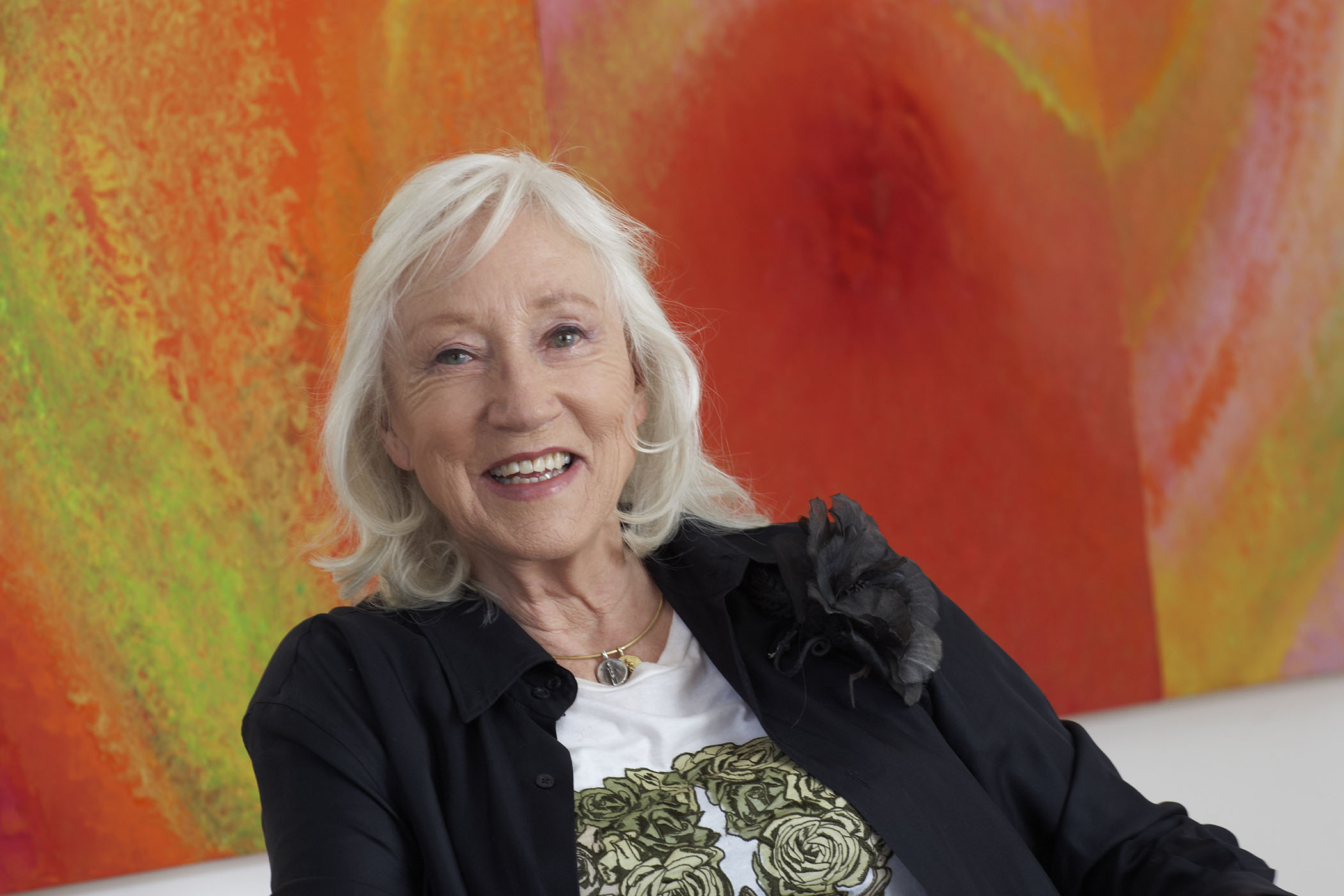
When Anne Madden was packing up the house in France where she had lived for almost 40 years with her husband, fellow Irish painter Louis le Brocquy, she was drawn to a book of poetry by William Blake. Two lines in particular resonated with her: “I went to the Garden of Love … And I saw it was filled with graves.”
Les Combes, their home in the Alpes-Maritimes village of Carros, had been very much a place of love. Madden often called it “paradise”. The couple worked at opposite ends of a large studio and entertained some of art’s most celebrated figures – Samuel Beckett, Francis Bacon, Marc Chagall, Joan Miró – with homemade wine and olive oil.
Yet Madden also knew great tragedy and spoke of creating “elegies of personal grief” through her art. Her beloved father died in a car accident when she was 14, then her sister, Vivian, was killed in a plane crash in 1967, prompting a series of studies of the megalithic tombs the siblings had known growing up in Ireland. When her brother Jeremy also died young, from injuries sustained in a fall, she was unable to paint until Beckett urged her to “tackle your dark … it’s nagging to be said”. The result was the Odyssey and Icarus series, in which a small boat or a pair of wings appears almost lost on a vast canvas of colour, a metaphor for the dangers and insignificance we face in life. She also produced works inspired by Pompeii, which she saw as a reminder that death can come unexpectedly.
Madden was conceived in Chile but born in London, at her mother’s insistence. After several years in South America, the family moved to her father’s native west of Ireland. She attended boarding schools in Harrogate and Oxford but was happiest during her holidays, riding on Exmoor or exploring the stark wilderness and ancient stone monuments of the Burren in Co Clare. “It was a most extraordinary country,” she said in 2017. “I fell in love immediately. I feel like I’m made of the same stuff.”
Madden had a fascination for rocks from the age of nine, when a great-uncle gave her two meteorites. As a child, she would smash open pebbles to see the crystalline whorls inside. She was a highly talented young artist but protested when her school sold her painting of The Flight into Egypt without permission, to benefit refugee children. “Could they not see that the painting was absolutely without merit?” she wrote in her journal. She was only 11.
Related articles:
Madden later went on to study at the Chelsea School of Arts and Crafts. In 1950, she suffered spinal injuries in a riding accident and needed three operations. Six years later came two life-changing moments: an exhibition of American abstract expressionists at the Tate that fired her imagination, and meeting Le Brocquy at a party. He visited her daily during her recovery from her final operation, then they moved to the South of France for her convalescence.
They married at Chartres Cathedral in 1958, lived for a year in a ruined water mill and in 1960, a year after her first solo exhibition, bought a 19th-century villa in Carros. It would remain their home and workplace for four decades. They had two sons, Pierre and Alexis, and were also co-guardians to her sister’s three orphaned children.
It is not everyone that can work in the same studio as their husband. Madden was very messy, painting on large canvases stretched across the floor, while Le Brocquy was as neat as a surgeon. She attributed the success of their partnership down to their 16-year age difference and contrasting tastes – Matisse for her, Picasso for him.
She said she felt overshadowed by his reputation in Ireland but could be her own name in France. Bacon described her as Le Brocquy’s “third eye”. The couple left France in 2000 and moved to Dublin. The previous year, Madden was commissioned to do a 54m² ceiling painting for the medieval castle in Carros, which had become an art centre. Le Brocquy died in 2012.
In her 70s, Madden painted a series inspired by the northern lights, including a 13-metre composition, A Space of Time, that took five years to complete. An exhibition followed in 2017 at the Hugh Lane Gallery, which featured new and vast works based on the myth of Ariadne and the Minotaur. She was 91 when the Irish Museum of Modern Art exhibited six paintings she did during the pandemic.
The journalist Catherine Heaney, who knew Madden as a friend of her father, the poet Seamus Heaney, described her as “at the centre of Ireland’s artistic life”, praising her as one of the country’s most important female artists. “She was immensely stylish, very elegant and great fun – an incredible force even in her 90s,” she said.
Pierre le Brocquy called his mother “the freest spirit” and said: “She was unbound by formula. The canvas led and she followed. Watching her paint was like witnessing an unrehearsed dance.” Of the tragedies in her life, he said: “She carried sorrow lightly and lived deeply.” Her final words were: “I feel I have lived and loved in a vast mystical space.”
Anne Madden, artist, was born on 11 June 1932 and died on 20 December 2025, aged 93
Photograph by Luke Taylor