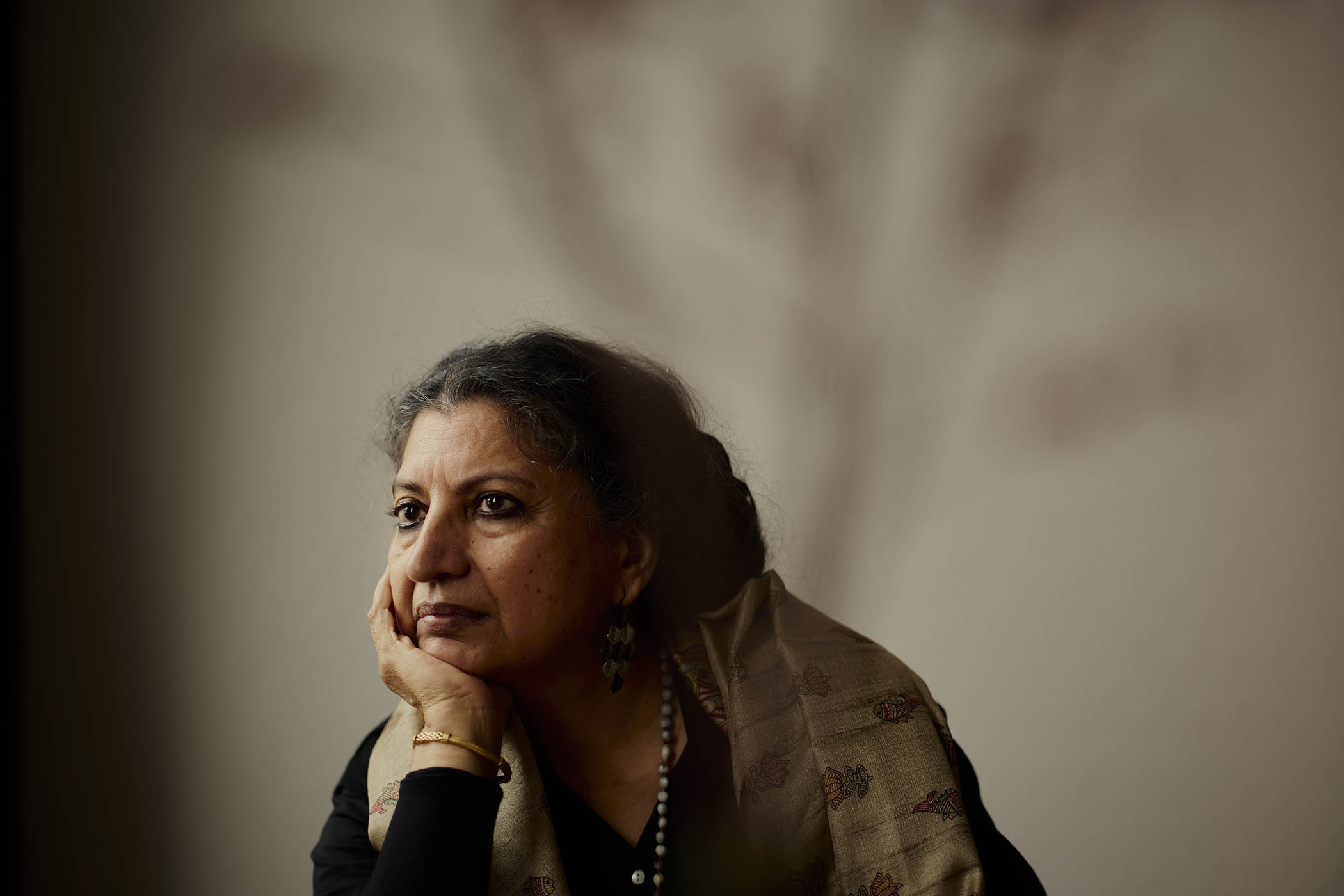

Geetanjali Shree was born in Uttar Pradesh, India, in 1957. She is the author of short-story collections and novels, including the 2022 International Booker prize-winning Tomb of Sand, which was translated from Hindi by Daisy Rockwell. Her third novel, The Roof Beneath Their Feet (2001), is now appearing outside India for the first time. The book, translated by Rahul Soni, tracks the friendship between two women as they spend time together on a rooftop. Usually based in New Delhi, Shree is currently in Berlin on a year-long writer’s residency.
Where in your life were you when you wrote The Roof Beneath Their Feet?
I don’t write quickly. I behave as if I have all the time on Earth. Every single work is spread out over at least three or four years, so I don’t remember what was happening in my life at that time. But before this, I had written a novel called Our City That Year, which is about the relations between the two major religious communities in India [Hindus and Muslims], and new obsessions about national identity. It kept me in a very serious state for several years. After that, I just felt: my God, I can’t write anything else so depressing, I must get back some joy and elation.
What drew you to the roof setting?
Those of us in India are very familiar with neighbourhoods where there are many houses close together with the roofs almost touching each other. You just have to jump from this parapet to the next and you are on the next row, and this can go on across a large neighbourhood. I remember some occasion when I went up on a roof with a friend and she was smoking a cigarette, which would not be allowed down below. Something about that idea inspired me, that here is a space of freedom, somebody from this end of the neighbourhood can climb up on to the roof, and somebody from another end can climb up from that side, and they can have all kinds of transgressions.
Did you intend for it to be another political novel?
One doesn’t have to try to be political or sociological in these times, when politics and society are so much upon us. Whatever you do, they creep in. It became about gender, about patriarchy, and about the people who cannot believe the closeness of the two women.
What appeals to you about domestic settings, which often appear in your works?
There’s a dichotomy that has been created between the home and the world. It’s too easily been thought that everything important – real life, philosophy, politics – is happening out there, and the home is the woman’s realm, where nothing is happening. I don’t think that one bit. The home is a microcosm of what’s happening outside, and they both have an interactive role to play. So this binary [thinking] itself gives rise to a falsehood. I think the changes that are taking place quietly and unobtrusively – and by people who don’t look like they are firebrands: the subservient domestic help or the housewife – are much more genuine than the ones happening with the sloganeering crowd outside. Outside, it’s very much an intellectual outburst. In here, it’s quietly lived.
What was your experience of winning the International Booker prize?
It hurtled me suddenly into the public space from a fairly private life. It’s been wonderful in all sorts of ways. It extended my literary experience – I’m in contact with many more writers, and I’ve been travelling the world. But it’s also brought me face to face with things like the market, and the role that stardom, visibility and iconisation play. They bring an immediate gratification, but I wonder: what does it add up to?
Has it left you with less time to write?
At first it did because I was travelling so much more. It’s wonderful, but then one has to start making the choice: you can keep whizzing around and enjoying that showbusiness, or you can decide to keep away from some of it. You have to find a balance. I think I have now.
Lots of Indian authors write in English. Why do you choose Hindi?
India was colonised by the British for so long, so English was my formal medium for education. But your mother tongue – in my case Hindi – never leaves you. Informally, that’s the language in which you are living. The writers who use English are mostly younger than me, and there is a difference between their generation and mine. In some ways, their English is an Indian language. They are using it in their own way, turning English on its head, which is fantastic. But a lot of them are more cut off from their mother tongue than children of my generation. We belong to the time that came immediately after independence, when there was a lot of idealism about India, and lots of us still belonged to the smaller, provincial towns. Today there is more cosmopolitan culture, more globalisation. In some ways I feel that being from my generation is what saved me. The smells, sounds and scenes of another India have nurtured me.
How is your writing received in India?
I have serious critics saying that my language is not Hindi because it is so eclectic and doesn’t always fulfil the expectations of correct grammar usage. I coin a lot of words, and I’ve often quite happily changed the gender of certain words – somewhere I turned “moon”, which is male, female, because I like the moon. I’m proud of that eclecticism. I think there’s something limited in [the critics’] way of seeing, their notion of purity. I’m absolutely against purity. My language is completely impure.
What have you read recently?
I’m a very haphazard reader, so I often feel I’m not a well-read person. But on my travels, I pick up things. Recently I was in Serbia and someone gifted me a copy of The Bridge on the Drina by Ivo Andrić, the Nobel laureate. And very recently I read Goat Days by a writer from Kerala called Benyamin. It’s quite well known in India, and I absolutely loved it.
The Roof Beneath Their Feet is published by And Other Stories (£14.99). Order a copy from The Observer Shop for £12.74. Delivery charges may apply
Portrait by Robert Rieger for The Observer
Newsletters
Choose the newsletters you want to receive
View more
For information about how The Observer protects your data, read our Privacy Policy
Related articles: